Summit endorses role of space
Although there is some controversy surrounding the outcome of last week’s summit on sustainable development there is one subject on which all delegates were unanimous: the important role that Earth observation satellites can play in assisting sustainable development.
The World Summit on Sustainable Development (WSSD) 54-page Plan of Implementation contains more than 10 specific references to Earth observation, clearly demonstrating that the Summit recognised the importance of space technology for sustainable development. This success goes back to ESA, which – in its role as CEOS Chair –delivered a number of official statements during the preparatory meetings and the Summit itself. Some of the statements delivered by ESA, on behalf of CEOS, were also followed by supporting interventions by national delegations to CEOS, such as Japan and the USA.
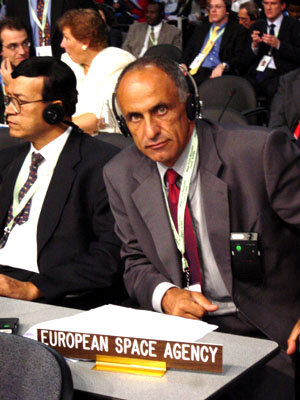
ESA staff had a busy but rewarding week, as this year ESA is chair of CEOS and co-chair of IGOS, the Integrated Global Observing Strategy partnership. José Achache, ESA Director of Earth Observation, addressed the plenary session of the Summit on behalf of these organisations. ESA staff also participated in a number of meetings and discussions on the use of satellite data at Ubuntu Village in Johannesburg, where ESA also had a stand.
Two important WSSD partnership initiatives concerning Earth observation data were launched during the week: the first by IGOS concerning the use of space and ground measurements for sustainable development; and the second by CEOS to encourage partnership on education and training in Earth observation. Both of these measures aim to widen the use of Earth observation data to protect the environment, particularly in developing countries, and to ensure that this data is available to all.
To follow up on the action taken at the Summit, a high-level meeting has been arranged for 19 November at ESRIN, ESA’s space research institute in Frascati, Italy. Here, government ministers, UN representatives and heads of space agencies will decide on how best to use satellite data to support sustainable development.
When asked about the Summit José Achache replied: “In Rio, heads of states achieved agreement on high level political declarations but with little underlying ground work. In contrast, Johannesburg did not lead to a strong political consensus but initiated many concrete actions and partnerships."
"Earth observation for space achieved a level of visibility and recognition at the Summit that has never before been achieved in such a forum."
"ESA is already contemplating the launch of a concrete initiative to support sustainable development and capacity building in developing countries, by the joint use of Earth observation and telecom satellites, particularly Envisat and Artemis."