Envisat's night eye supports icebound ship rescue in Antarctica
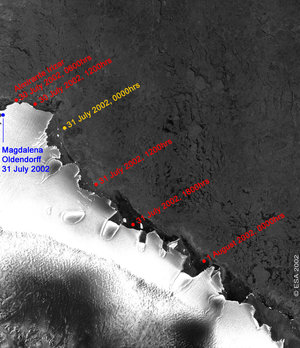
A German supply vessel and its crew are stuck in Antarctica until October after severe winds and ice fields 7 metres high forced an Argentinian rescue ship to retreat. A radar image from ESA's Envisat is helping the icebreaker plot its route to safety.
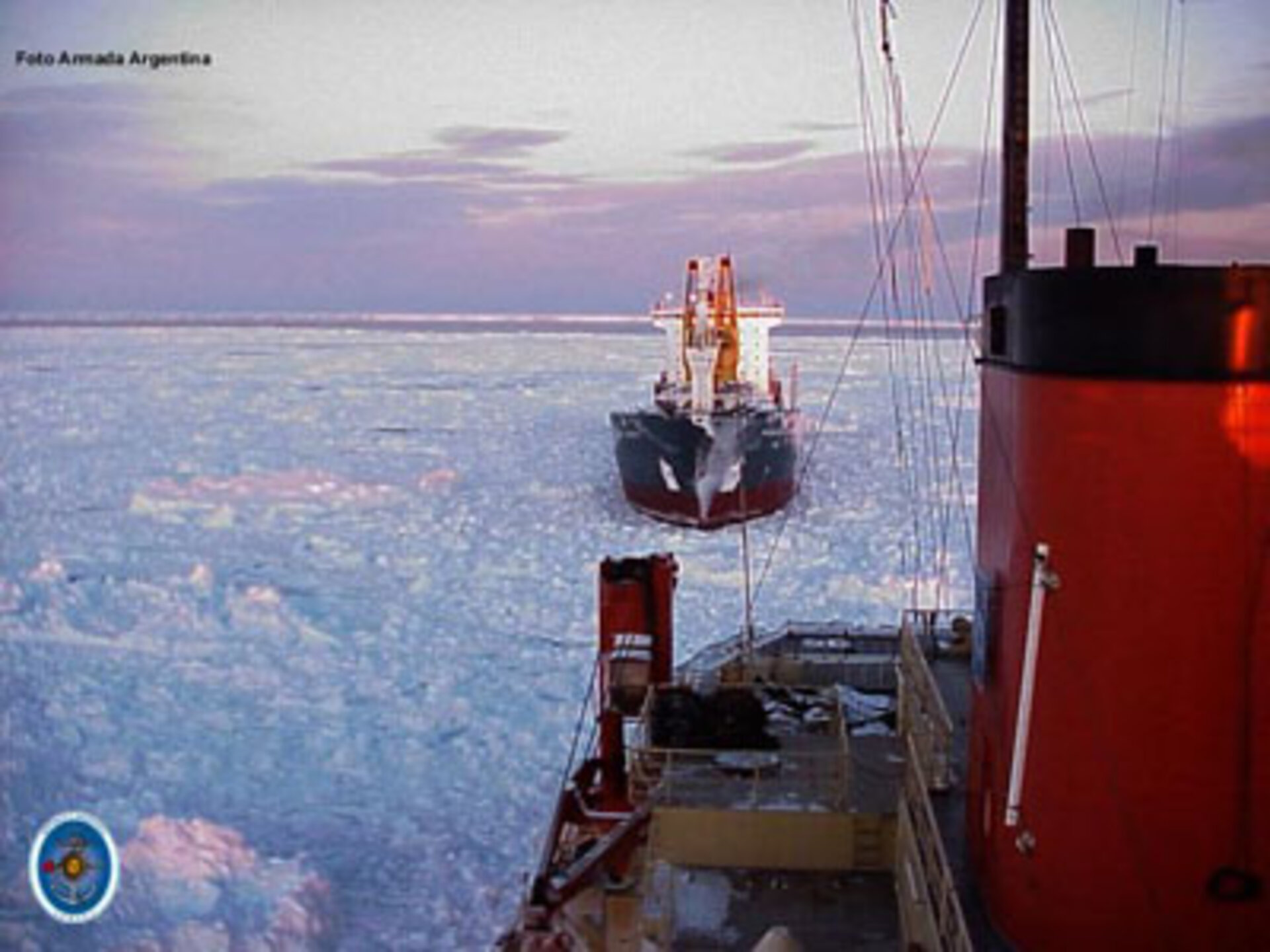
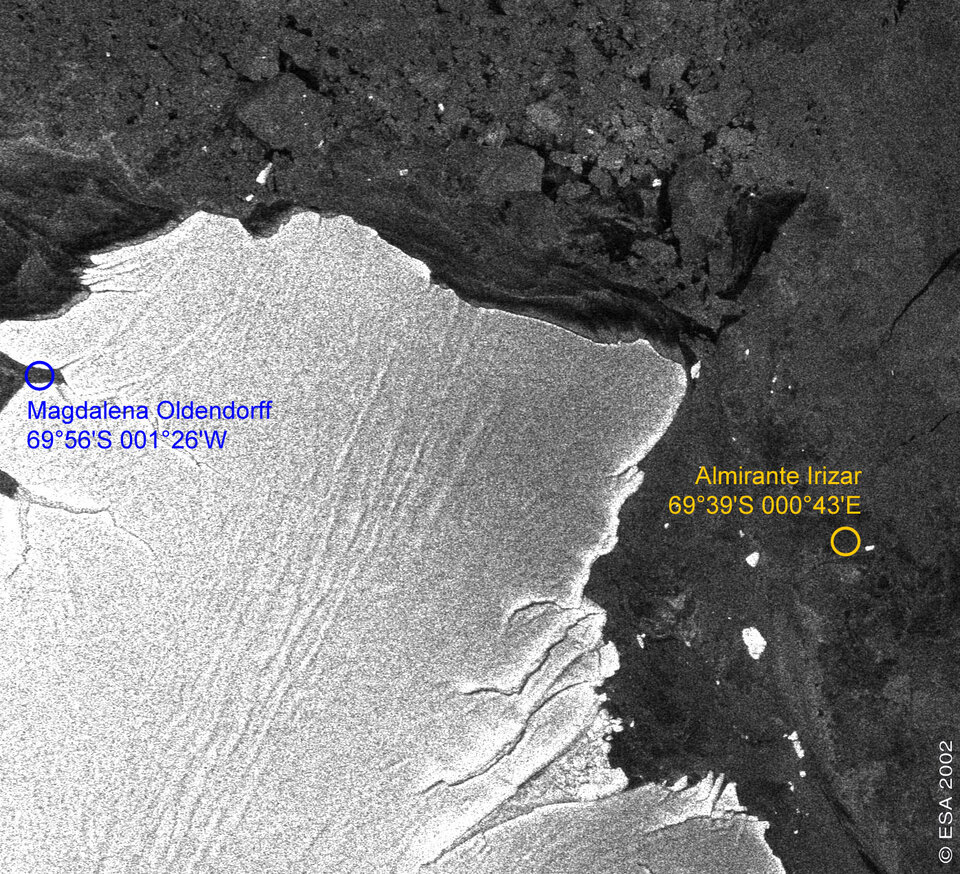
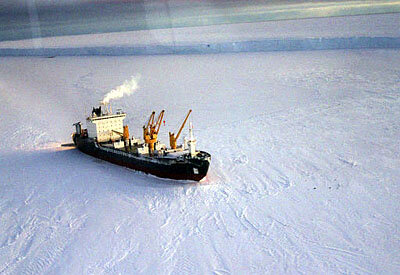
The German vessel 'Magdalena Oldendorff', with a skeleton crew of 17, has been trapped in ice since 11 June. The Argentine icebreaker, 'Almirante Irizar' was dispatched from Buenos Aires last month and has been trying to lead them to safety since 19 July. Finally on Tuesday 30 July, in temperatures of -32 degrees C and rapidly closing ice, they had to abandon the attempt. Before leaving, the icebreaker helped the Magdelena Oldendorff to a safe position in the Bay of Muskegbukta and transferred enough supplies for the crew to survive the winter.

The German Federal Maritime and Hydrographic Agency asked ESA to provide Envisat radar images to support the rescue efforts. During the winter months the hours of daylight are very limited. There are only two hours when visibility is sufficient for helicopter reconnaissance missions. But Envisat’s Advanced Synthetic Aperture Radar (ASAR) can view an area 400 km wide with unprecedented accuracy during the polar night.
The German agency passed the Envisat data on to the US National Ice Center, Washington, DC, and to the Argentine Navy, which sent it on directly to the Argentine icebreaker to assist in plotting the best possible route through the weakest points in the ice.
Captain Manuel Picasso of Argentina's Naval Glaciological Center, Hydrographic Service sent his personal thanks for the ASAR data to the ESA team.
Klaus Struebing of the German maritime agency explained the relevance of the data. "Satellite images are a most useful tool for ice services to provide ice information to their users. The data are mostly used by trained interpreters and the extracted info transferred to ice charts. For trained captains and ice pilots the image itself is the best information - if it can be read properly. The modern radar tools such as RadarSat, SAR on ERS and now ASAR on Envisat are extremely useful because the can provide data undependently from day-time and cloud cover." .
Obtaining this image proved quite a challenge, as Envisat Mission Manager Henri Laur explains. "There are two small areas in the world where we cannot recover ASAR data with the onboard recorders, and the ship was precisely within one of those areas", said Laur. "This required manual intervention by the ESA team, briefly interrupting acquisition of data from other Envisat instruments."
Most of the 79 Russian scientists and 28 crew aboard the Magdalena Oldendorff were rescued in late June by helicopters from a South African research vessel, but the 17-man skeleton crew remained so as not to abandon the Magdalena. The Magdalena's Master Ivan Dikiy says: "Regardless of our waiting position the mood is good onboard. To support this sweets, cigarettes and sometimes a beer will be provided to the crew."
In October, when the Magdalena Oldendorf is ready to make its escape, ESA will acquire another Envisat image of the area and provide it to the German Maritime Agency. The data will be used to analyse ice melt and the location of larger bergs in the area to assist in the departure of the ship.