![]() |
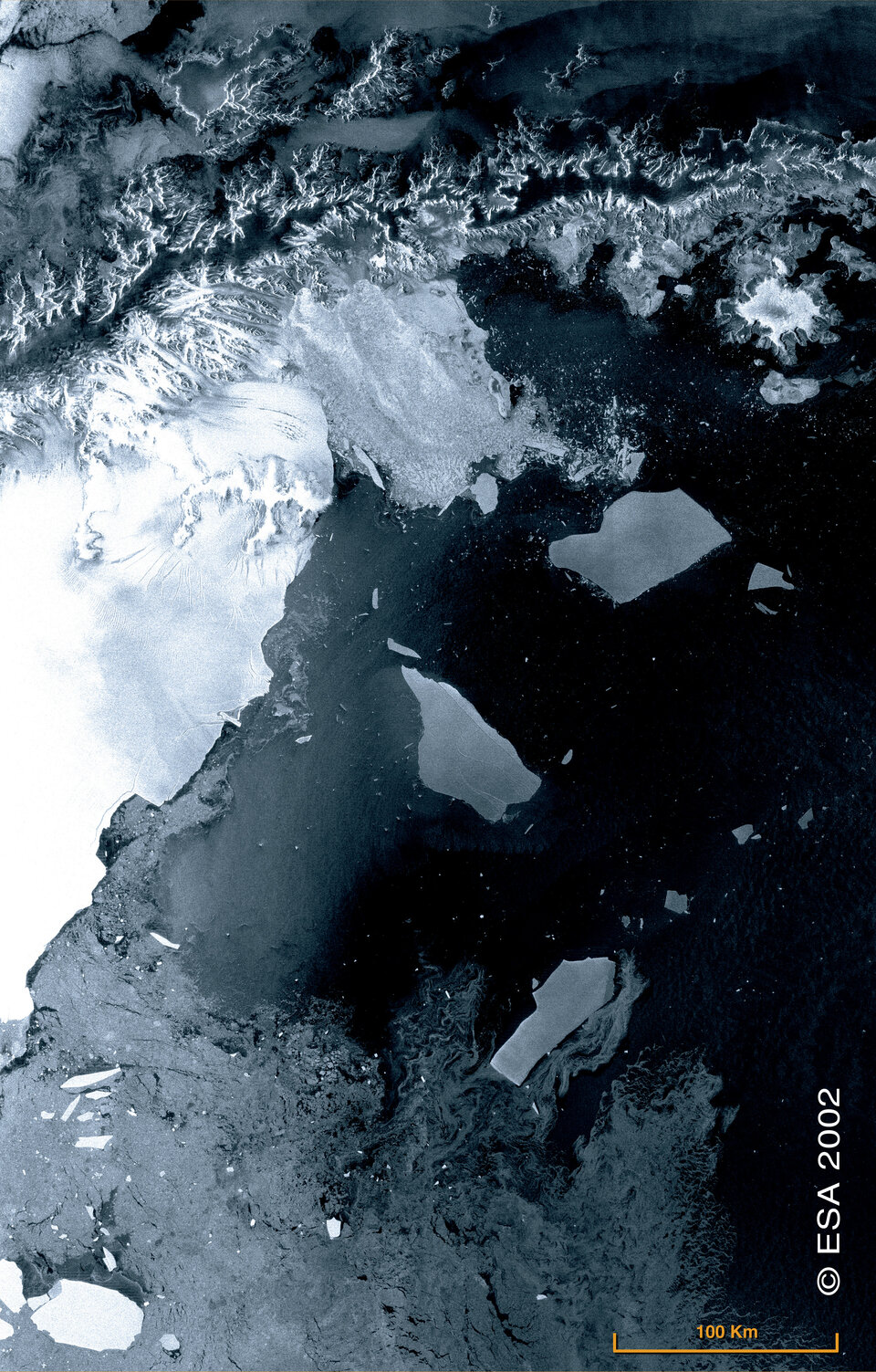
Envisat ASAR first check-up of the Earth - The story in pictures ![]() The Antarctic Peninsula resembles a 1,000-km-long arm reaching up towards the southern tip of South America. In the past its eastern coast has been entirely overhung by an ice shelf. Envisat’s first image of the collapsed Larsen B ice shelf highlights the dramatic effect of global warming that has taken place during the last half century in this region. ![]() Thousands of years of accumulated and compacted snow on the Antarctic central plateau have formed a mighty ice sheet which flows under gravity towards the coastal plane. Along the coast the ice gradually floats on the sea – to form massive ledges known as ice shelves. But as the temperature has increased, several ice shelves have broken up and disintegrated. ![]() In 1995 the northern part of the Larsen ice shelf (known as Larsen A) collapsed – a process observed by Envisat’s predecessor spacecraft ERS. On 18 March 2002 another part known as Larsen B followed it, as captured by ASAR. During this most recent collapse a 200-metre-thick shelf with an area of 3,300 km2, equivalent in size to more than a third of the island of Corsica or the whole of Luxembourg, was lost. ![]() The total ice lost in this event has been estimated at 720 billion tonnes. The collapse happened in a different way to the periodic process of iceberg ‘calving’. Instead, over the last two decades, there has been an increase in surface melting, causing the formation of melt ponds and channels, which weaken the structure and interior strength of the ice shelf with cracks and rifts. ![]() One of the first photos taken by Envisat, ESA's Earth observation satellite in March 2002. The collapse of the Larsen B ice shelf observed on 18 March 2002.
The Antarctic Penininsula has experienced exceptional atmospheric warming over the last decades, triggering the retreat and break-up of the ice shelves. The launch of Envisat occurred just in time to capture the disintegration of the Larsen B ice shelf. This 400 km wide ASAR image of 18 March 2002 (orbit 246) shows that the collapsed ice shelf has fractured into thousands of small icebergs, drifting eastwards into the Weddell Sea. This kind of breakup is quite different from the periodic calving processes taking place 1000 km further south which have led to the presence of the large drifting icebergs seen in the image. ![]() One of the first photos taken by Envisat, ESA's Earth observation satellite. ASAR image of 18 March 2002, MERIS image taken on 23 March 2002. Scientists estimate that the Larsen B ice shelf, which collapsed in spring 2002, had been stable since the last ice age 12 000 years ago – ice dynamic studies suggest it will take several hundred years of colder weather to completely rebuild it. What is more likely is that warming will continue, possibly reaching further south to affect the so-far stable Larsen C Ice Shelf. Envisat is particularly well suited to continue observing this remote, usually cloud-covered region. This combined ASAR and MERIS image shows cloud cover over the Peninsula, and how the ASAR pierces through it for weather-independent observation of the ice shelves. Existing ice shelves can also play an important role for the production of deep water known to take place in the Weddel Sea. “These regular observations with ASAR are therefore essential for the understanding of ice shelf dynamics, its retreat and subsequent influence on convective overturning and deep water formation, which are key processes for global ocean circulation” explains Prof. J.A.Johannessen of the Nansen Centre in Norway. Release date: 10 June 2002 |