Envisat's MERIS captures image of Hurricane Elida
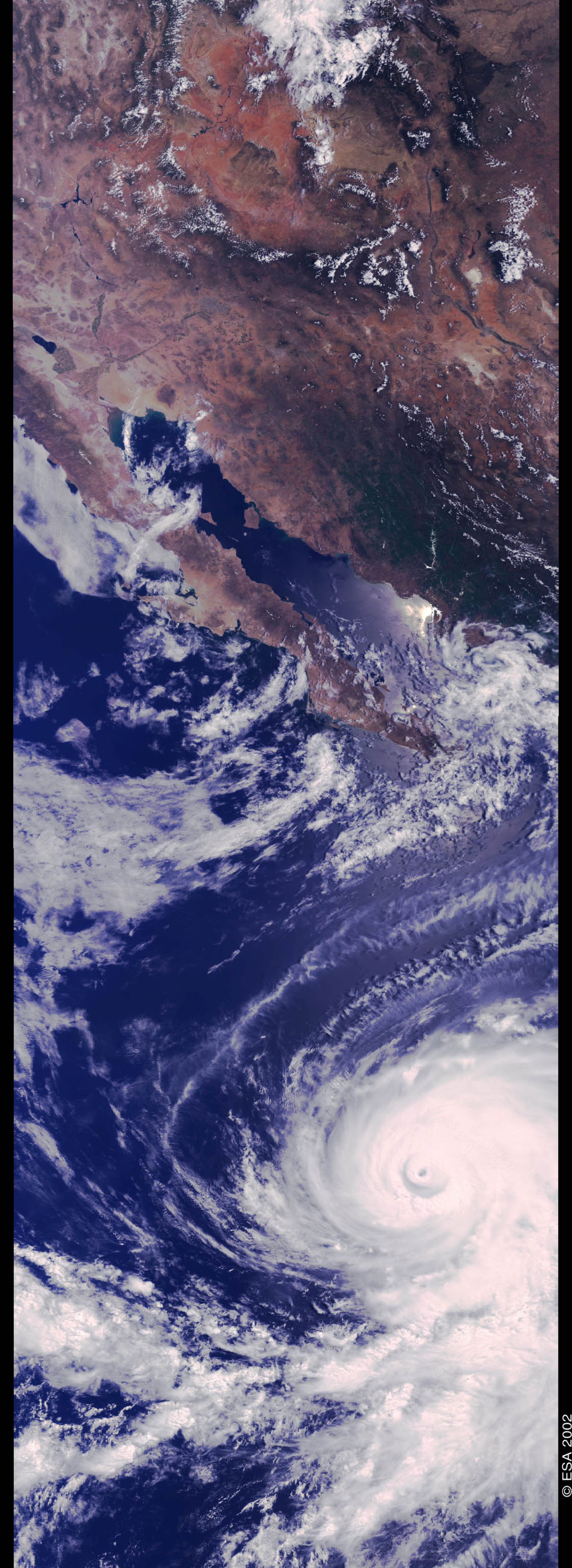
The Medium Resolution Imaging Spectrometer (MERIS) onboard ESA's Envisat environmental satellite captured this dramatic image of Hurricane Elida off the west coast of Mexico on 25 July 2002.
Elida started forming off the Mexican coast on 23 July. After few days, it was classified as a hurricane, with wind gusts reaching speeds over 200 km/hour. On 27 July, two days after the image was acquired, Elida was downgraded from a hurricane to a tropical storm, and downgraded again yesterday to a tropical depression by the US National Weather Service's National Hurricane Service in Miami, Florida.
The accompanying image of Elida was acquired by the MERIS sensor at the storm’s maximum strength, with the central eye of the storm perfectly visible in the image. To the north, the 1000 km-plus long Baja Peninsula puts the size of the storm into dramatic perspective.

Since its formation, Elida has moved northwest at approximately of 30 to 40 km per hour. It tracked along the coast of Mexico, and is heading off the coast of the Baja Peninsula. It is expected to last several days before it will slowly lose its power and finally disappear.
This is the first time that Envisat's MERIS sensor has observed such an event. The sensor measures radiation in 15 frequency bands to provide information about ocean biology, marine water quality, and land vegetation, along with data on land, cloud and water vapour.
From MERIS raw observations, an entire suite of atmospheric parameters will be proposed to Envisat users involved in atmospheric studies. These parameters include: cloud reflectances, cloud optical thickness, cloud albedo, cloud top pressure, cloud type and water vapour concentration. In total, about 20 geophysical products and corresponding data manipulation tools will be delivered to scientific users.
MERIS will provide data at two resolutions, 300 m and 1.2 km. Its 1150-km swath results into a three-day global coverage. The MERIS mission objectives are focused on marine biology but they have been extended to enable land and atmosphere monitoring as well.