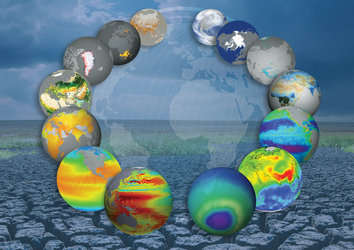
Water cycle conference makes a big splash
Earth has a limited amount of water that recycles itself in what is called the 'water cycle'. Climate change, weather and human life are highly affected by changes in this continuous, interconnected cycle.
Observing and monitoring the key variables governing the global water cycle is essential to our understanding of the Earth’s climate, forecasting our weather, predicting floods and droughts, and improving water management for human use. Recent advances in Earth observation (EO) satellite technologies have made it possible to survey several of these variables from space.
In the coming years an increasing number of EO missions will provide an unprecedented capacity to observe Earth’s surface, its interior and the atmosphere, opening a new era in EO and water cycle science.
To discuss the challenges and opportunities resulting from this coming increasing capacity, nearly 200 scientists from more than 30 countries gathered at ESA’s EO for Water Cycle Science Conference held at the agency’s Earth Observation Centre (ESRIN) in Frascati, Italy, 18-20 November, to assess the state-of-the-art instruments and scientific developments used in characterising global water cycle variability and to identify the main needs in modelling and data assimilation to improve our knowledge of water cycle science and our ability to quantify future changes in water cycle variables.

"The conference provided a good overview of current research capabilities and activities in the area of space borne observations of the water cycle," said Peter J. van Oevelen, Director of the Global Energy and Water Cycle Experiment (GEWEX) International Project Office. "The plenary discussions helped identify current and future critical gaps and omissions and, as such, provide valuable input in the strategy and future directions of global climate research coordinative programmes such as the Global Energy and Water Cycle Experiment of the World Climate Research Programme."
Presentations focused on novel space missions, precipitation, clouds and water vapour, water levels and surface waters, turbulent energy fluxes and evapotranspiration, floods and droughts, modelling the water cycle, and soil moisture, among others.
Round table discussions focused on the main gaps and scientific challenges ahead to better observe, monitor and characterise the different components of the water cycle in view of improving our ability to cope with water management and governance in a world where water is more and more at the centre of international policy and conflicts.
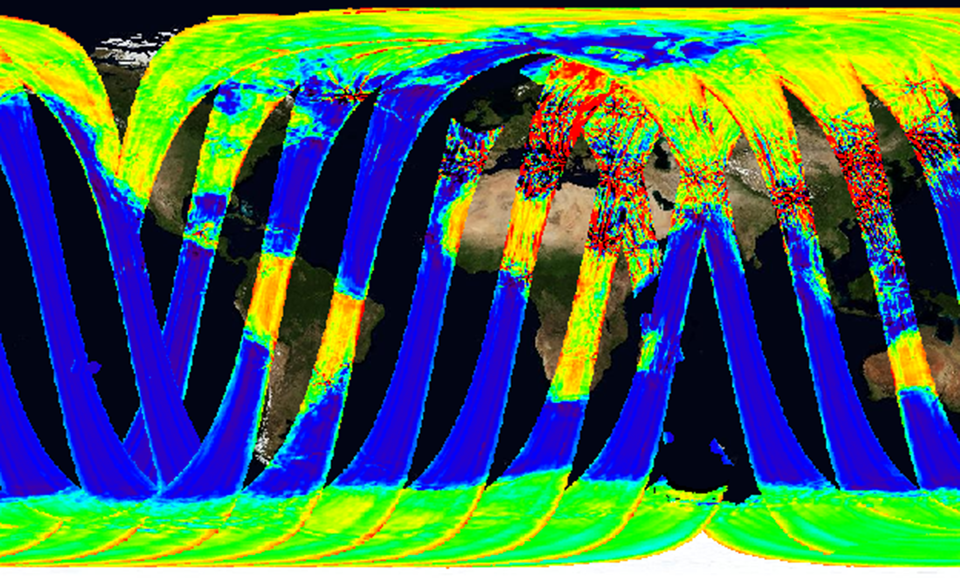
The conference also offered an excellent opportunity to the Soil Moisture and Ocean Salinity (SMOS) Lead Investigator, Yann Kerr, to unveil the first data sent to Earth by the satellite, launched on 2 November.
SMOS, an ESA Earth Explorer, is the first satellite designed to map sea surface salinity and to monitor soil moisture on a global scale. The first data received was acquired as part of the initial functional verification test following the instrument switch-on on 17 November. Although the image content could not be interpreted at the time, it proved the instrument was in good shape.
Data provided by SMOS will be important for weather and climate modelling, water resource management, agriculture planning, ocean currents and circulation studies and forecasting hazardous events such as floods.
The experts also discussed the challenges and opportunities in water cycle science in order to reduce uncertainties in water-related climate change impacts and adaptation strategies in water resources. The conference recommendations represent a solid scientific roadmap that outlines the main priorities for the development of novel and robust global geo-information data products, improved models and effective data assimilation systems.
The three-day workshop was organised by ESA, GEWEX, the European Geosciences Union and International Society for Photogrammetry and Remote Sensing.
Earlier this year, ESA launched, as part of its new Support To Science Element programme, the Water Cycle Multi-Mission Observation Strategy (WACMOS) project in collaboration with GEWEX to support the development of novel techniques to study the water cycle with satellites. At the conference, the WACMOS team showed the first preliminary results of the projects addressing key elements of the water cycle such as global evapotranspiration, soil moisture, clouds and water vapour.
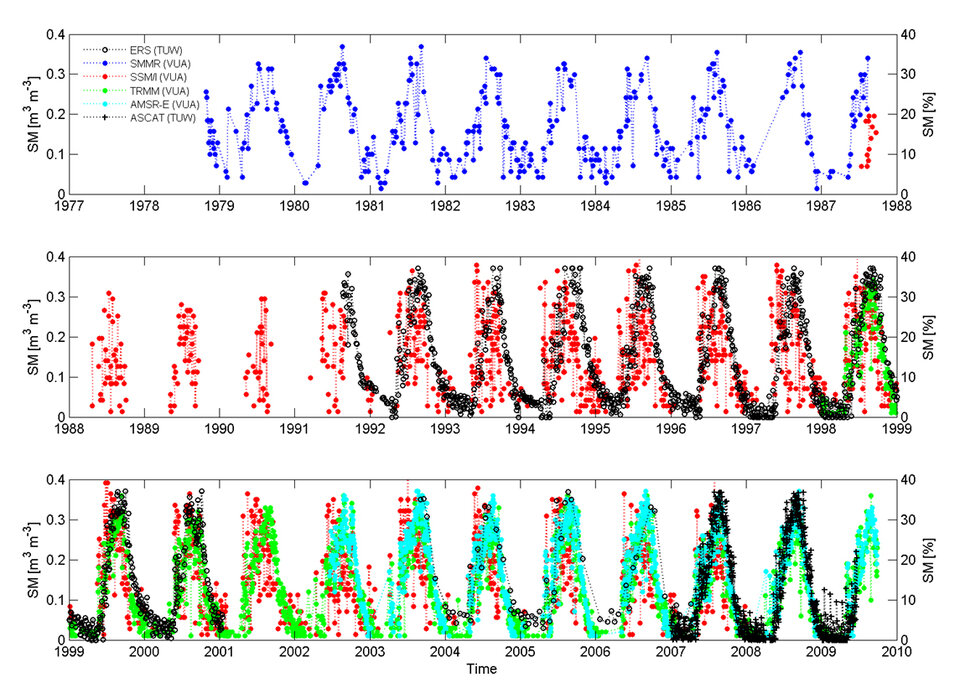
WACMOS, carried out by a international team of experts led by the International Institute for Geo-Information Science and Earth Observation, aims to develop the first global map of evapotranspiration exploiting the synergies using the Medium Resolution Imaging Spectrometer and the Advanced Along-Track Scanning Radiometer instruments on ESA’s Envisat satellite. Also, the Vienna University of Technology, in partnership with the Vrjge University of Amsterdam, aims to develop the first global multi-decade soil moisture data set merging passive and activate microwave sensors, such as the scatterometer on ESA’s ERS
This project, as well as the conference results, represents an ESA contribution to support the international coordination effort carried out by GEWEX to better understand, characterise and forecast the global water cycle.