Earth from Space: Larsen-B Ice Shelf on thin ice
The changing Larsen-B Ice Shelf, as witnessed over five years by ESA’s Envisat, to mark the week of the fifth anniversary of the environmental satellite and the start of the International Polar Year.
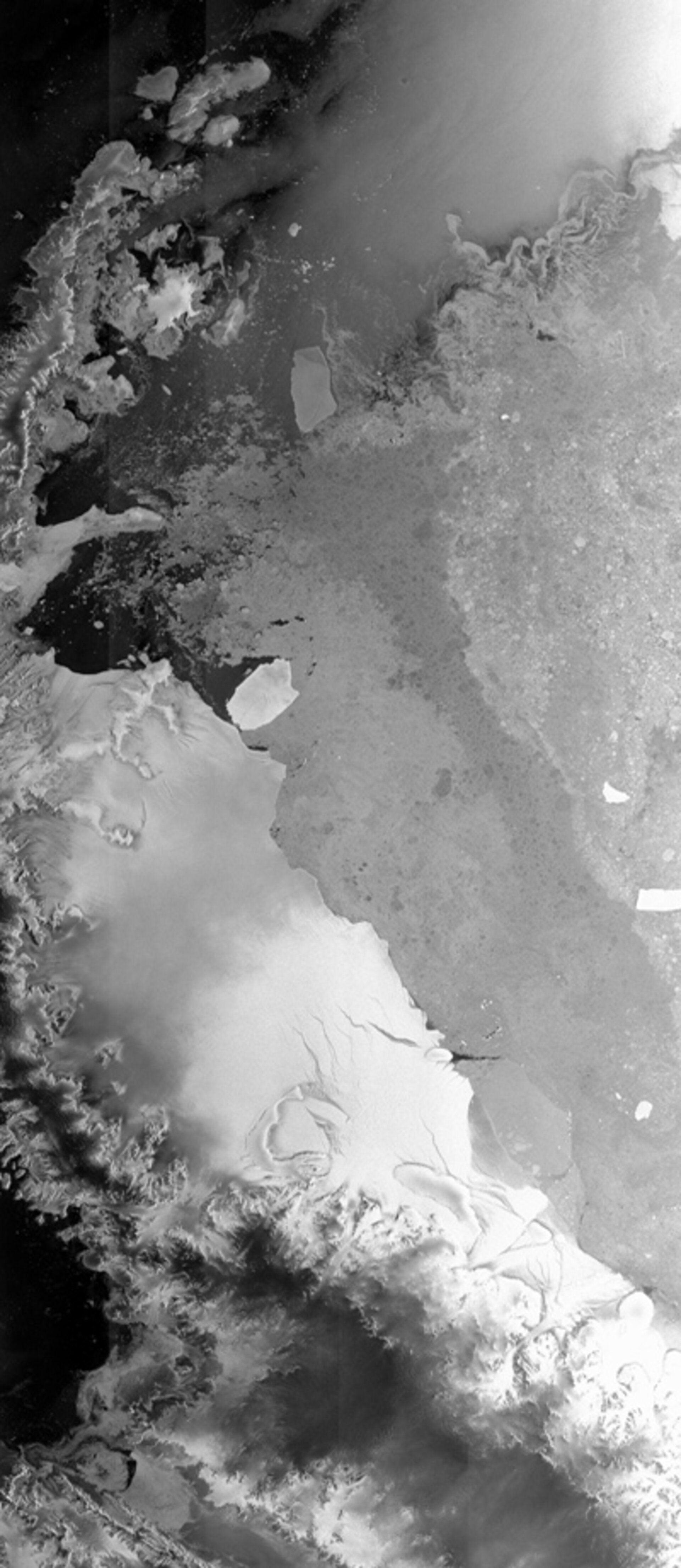
Captured by Envisat on 22 February 2007, this Advanced Synthetic Aperture Radar (ASAR) image highlights further changes in the ice shelf as compared to the first image (below) Envisat acquired over the area on 18 March 2002.
Just days after its launch on 28 February 2002, Envisat captured the disintegration of the 200-metre-thick Larsen-B Ice Shelf. The images surprised researchers, which estimate that Larsen-B had been stable since the last ice age
The 2002 image shows how the 3250-square-kilometre chunk of ice fractured into thousands of small icebergs and began drifting eastwards into the Weddell Sea.
"Since 2002, drastic ice retreat has continued due to ongoing climate warming in this region, and ASAR has been an important tool for documenting these processes," Innsbruck University's Professor Helmut Rott said.

The Larsen Ice Shelf is a series of three shelves – A (the smallest), B and C (the largest) – that extend from north to south along the eastern side of the Antarctic Peninsula. Changes in ice shelves are believed to be indicators of climate change, as evidence suggests high latitudes experience the greatest atmospheric warming.
Average temperatures in the Antarctic Peninsula have risen over the last 50 years by half a degree Celsius a decade. This warming is believed to have triggered the retreat and break-up of the Larsen-B Ice Shelf and the Larsen-A Ice Shelf, which disintegrated almost completely in January 1995.
Ice shelves, fed by glaciers, do not raise sea levels when they break apart because they were already floating. However, sea levels do rise if the glaciers that support the shelves begin to retreat, making the flow velocity of glaciers particularly interesting for researchers.
"The velocity of the glaciers increased up to eight-fold compared to the speed when the ice shelf buttressed the glaciers," Rott said. "The total estimated mass loss of glaciers above the disintegrated ice shelf sections since 2002 has been equivalent to about 2 percent of total sea level rise, which, although not a significant percentage, demonstrates the vulnerability of ice shelves to climatic warming and the importance of ice shelves for the stability of glaciers up-stream."
Altogether about 300 square km of grounded ice have now been lost at the outlet glaciers of the former Larsen-A and Larsen-B Ice Shelves. According to Rott, the significant decrease in area in the remnant southern section of Larsen-B and the stagnant ice shelf around the Seal Nunataks, a group of 16 volcano vents emerging from the Larsen Ice Shelf, coupled with the number of increasing rifts suggests the complete disintegration of Larsen-B in the near future.