Forests take centre stage at Copenhagen
As the UN Climate Conference in Copenhagen approaches its conclusion, negotiations are focusing on the role of forests in mitigating climate change. The new 'Reducing Emissions from Deforestation and Forest Degradation' policy has gained widespread support as a central element of any new agreement.
Since deforestation accounts for almost 20% of global greenhouse gas emissions, this new policy would enable developing countries to make a major contribution to emissions reduction. Linked to this, developed countries are signing up to a multi-billion euro financing framework that would make preserving the world’s tropical rainforests more economically attractive than uprooting them.
A key role for Africa
During COP15, representatives of local, regional and national governments, businesses, international development agencies and indigenous communities from rainforest nations came together in more than 25 different events to discuss how this new policy can be put into practice.
One of the highest profile events focused on the Congo Basin, where the 10 member countries of Commission des Forêts d’Afrique Centrale (COMIFAC) are working together for conservation and sustainable forest management of almost 30% of the world’s tropical forests.

The COMIFAC event was supported by ESA, the German Development Agency, the German Development Bank and other international partners. ESA, through its Global Monitoring for Environment and Security (GMES) Forest Monitoring project, is assisting three of the COMIFAC countries (Cameroon, Gabon and the Republic of Congo) to integrate Earth observation data into their national forest management and climate programmes. The project is being led by the German remote sensing company GAF and a consortium of international partners.
During the event, environment ministers from Gabon, the Democratic Republic of Congo and Congo Brazzaville joined with the German Federal Minister for Economic Cooperation and Development to highlight the importance of this new policy measure.
Addressing the packed meeting, international ambassador for the Congo forests and 2004 Nobel Peace prize-winner, Dr Wangari Matthai, said: "I ask you all to join forces in urging your heads of state to give COMIFAC an independent financing mechanism."
Satellites help put it into practice

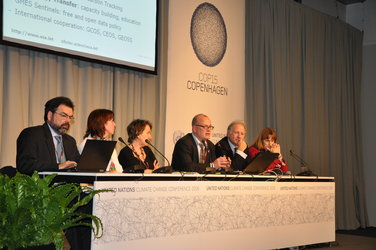
The important role that satellite observations of forests will play in enabling developing countries to implement this new policy was highlighted by Brazilian space agency (INPE) Director Gilberto Camara, who is the Chairman of the Committee for Earth Observation Satellites (CEOS). "We know that Earth observation data are essential for the planet but 'data democracy' needs to reach the masses," he said at the ESA side event on climate.
CEOS is supporting the Group on Earth Observation in the Forest Carbon Tracking activity by contributing satellite data to assist countries in developing their own forest- and carbon-monitoring systems.
The GMES programme of ESA and the EC is already establishing a comprehensive global Earth-observing space infrastructure that will underpin these new policies. ESA and EU Member States have so far invested €2 billion to develop the GMES 'Space Component', which includes five new types of satellites called Sentinels, and are preparing further investments to secure its continuous operation and data access over the next 20 years.
The free and open data policy recently approved by ESA Member States for the Sentinel missions will make a major contribution to the data democracy and transparency called for at COP15.