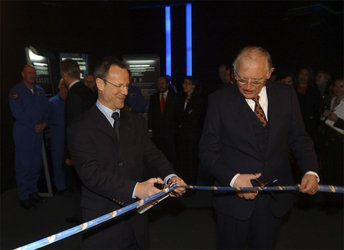
Our planet is star of the Earth and Space Expo
Visiting the Earth and Space Expo in Brussels is like nowhere else on Earth – you even take what seems like a walk through the sky to get inside! During the weekend upwards of 9000 visitors made the journey to experience a wide range of displays, interactive exhibits and breathtaking space-based views of our planet.
Those entering the Expo, at Autoworld in the Parc du Cinquantenaire, find that carefully placed mirrors on the floor, walls and ceiling give a sense of spacewalking beyond the atmosphere.
Some visitors have to slow down to make sense of it – but keep on going to find themselves in a 3000 square metre exhibition area – presented jointly by ESA and the European Commission, with the support of Eumetsat (Europe’s Meteorological Satellite Organisation) - chronicling Europe’s achievements in space during the last 30 years, as well as the shape of space projects to come.

A favourite with the many school parties is the rocket room, where children stand dwarfed by imposing scale models of ESA’s Ariane-5 and Vega launchers. Nearby are scale models of ESA’s Automated Transfer Vehicle (ATV) and the International Space Station (ISS) it has been designed to supply.
Further along is a model of ESA’s Mars Express scrutinising the Red Planet, together with a model of the ExoMars rover, a possible future European Martian mission. Also on view is the actual parachute-test model of the Huygens lander resting on the simulated surface of Titan, ESA’s latest interplanetary mission.

Schoolchildren get to have space-related lessons in an upstairs classroom, as well as trying on a suspended harness that lets them experience walking – and jumping – in simulated lunar gravity. Visitors of all ages are enjoying a range of lectures in the Space Theatre, and checking out the nearby Earth and Space Gallery.
While the gallery of the Expo highlighting exploration of space is the first part that visitors see, it is our Earth that is really the star of the show, with numerous large-scale Earth Observation images on display.
They include unique views of global land cover and oceanic chlorophyll concentrations, and an image of the Antarctic ozone hole beside Arctic ice extent. The most striking single satellite image is a three-storey high Envisat view above the Space Theatre showing all the continents – worth a visit to see by itself.
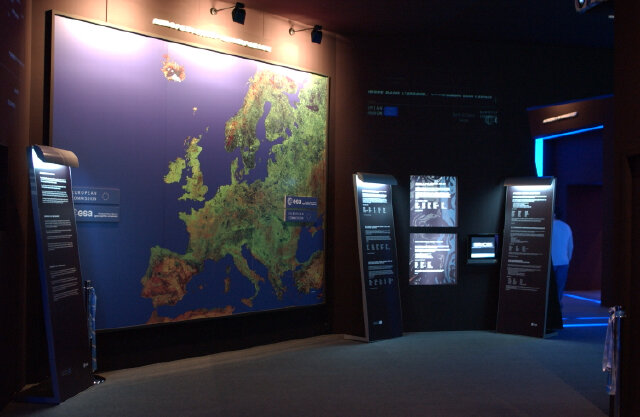
A further set of displays bring these satellite images down to Earth, and illustrate how Earth Observation is being combined with ground-based information for Europe’s Global Monitoring for Environment and Security (GMES) initiative, the building of a planetary monitoring system to protect the environment and the quality of life for European and world citizens.
Gas masks suspended from the ceiling show the seriousness of atmospheric pollution, with an interactive display nearby showing how satellite data is being applied to measure air quality, while streams of water that pour through broken cups highlight water scarcity, with the display recounting how Earth Observation enables wide-area monitoring of entire water catchments for any contamination danger.
Other displays discuss satellites for humanitarian aid and the preservation of bio-diversity – including the mapping of central African rainforest to help preserve the mountain gorilla, as well as the extent of Arctic ice floes to calculate what effect global warming may have on polar bears.
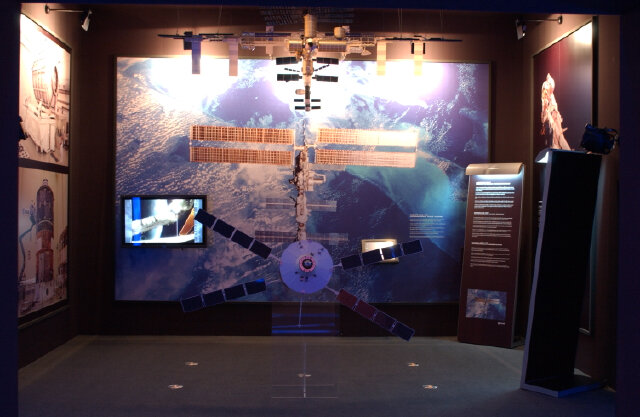
The satellites that return this imagery are hundreds or thousands of kilometres away in Earth orbit, but another attraction of the Expo is that for once they can be just above visitors’ heads – detailed models of Earth Observation spacecraft such as the ten-instrument Envisat, ESA’s new Cryosat mission designed to study the planet’s ice fields, Eumetsat’s MetOp and MSG spacecraft and even the Belgian-built and operated Proba microsatellite.
The evening of 14 February saw amateur astronomers, European astronauts and Earth and Space enthusiasts brave the Brussels evening for a Valentine’s Night ‘Star Party’ focused on the night sky.
Monday saw the start of a busy week, with a meeting of the Group on Earth Observation (GEO) due for Tuesday, and the Third International Earth Observation Summit taking place on Wednesday, expected to endorse a ten-year plan to implement a Global Earth Observation System of Systems (GEOSS), of which GMES is the European contribution.
Then on the remaining two days of the week occurs the International Conference on Cooperation in Space, discussing how best established and emerging space players can work together, and formally opened by the crew of ISS from orbit.
The Earth and Space Expo itself is free to the public and open 9.30 – 18.00 weekdays and 10.00 – 18.30 Saturday and Sunday, until the end of 20 February 2005.