

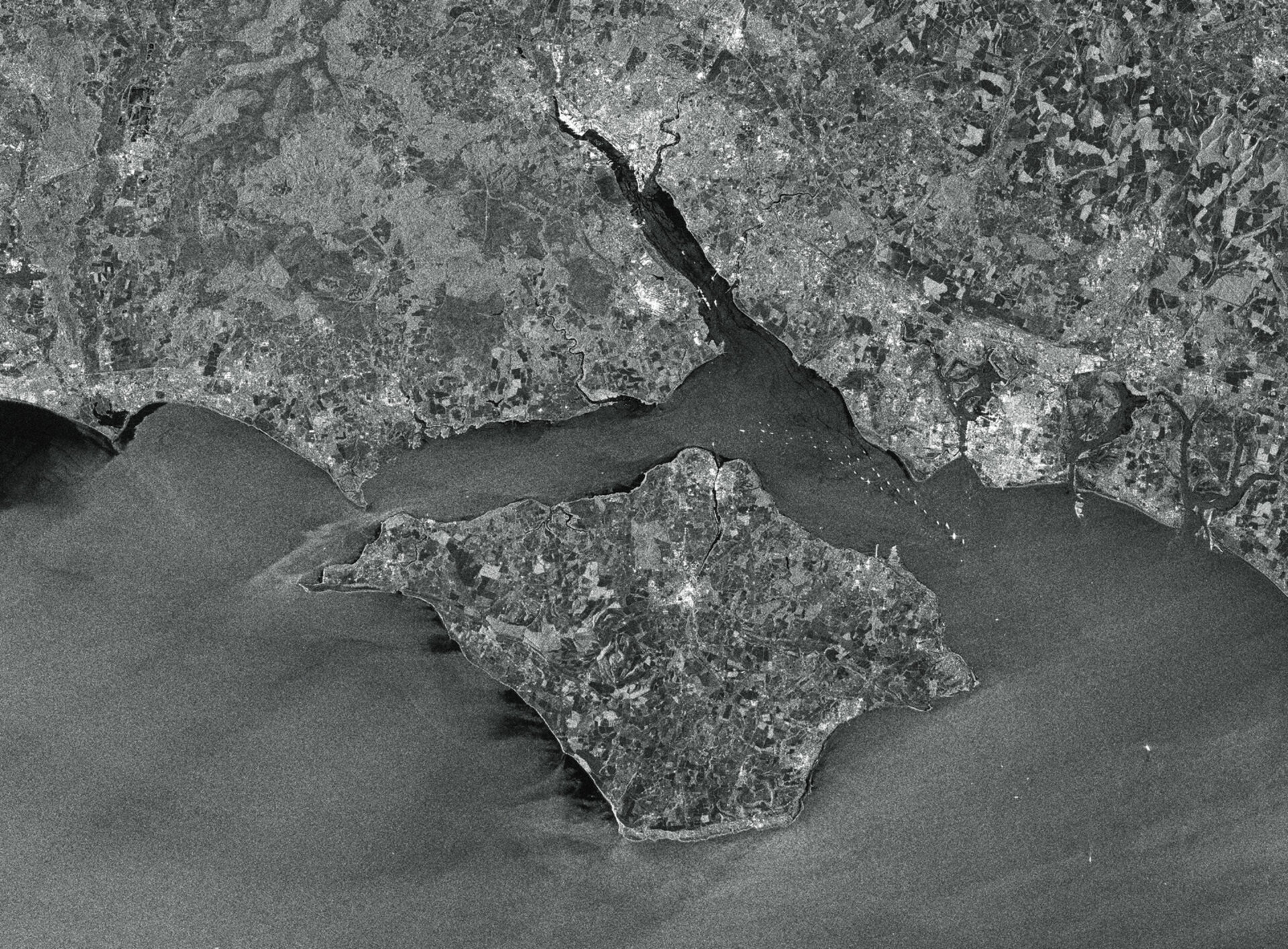
International Fleet Review viewed from space
In 1805 the British, French and Spanish navies fought at the Battle of Trafalgar, a British victory marred by the death of Lord Nelson. Two hundred years later, ships from all three countries joined together with those of another 33 countries for an International Fleet Review.
Much has changed in the past 200 years; Britain, France and Spain are now close allies, and all three countries are members of the European Union and Member States of the European Space Agency.
To mark this historic occasion, satellite images were taken by the Advanced Synthetic Aperture Radar (ASAR) on board ESA’s Earth Observation Envisat satellite. From space it is possible to see the ships of many nations gathering in the Solent off Portsmouth in preparation for the International Fleet Review.
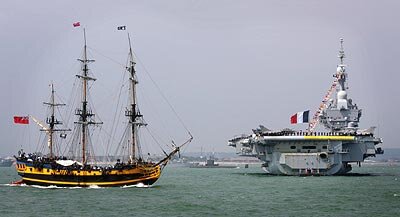
Tuesday’s review is the largest that has ever taken place. Altogether 167 vessels from 36 countries, and between 25 000 and 30 000 sailors, took part. Among them ships from India, Japan, South Korea, Pakistan, Nigeria and South Africa. The ships had been arriving in the Solent for days, together with thousands of spectator yachts.
The largest ship to grace the event was FS Charles de Gaulle, pride of the French fleet. When she arrived on Sunday her 21 "canon de salut" rang out across the water in greeting. Onboard the nuclear-powered aircraft carrier was Vice Admiral Jacques Mazars. Looking at the spectacle he said: "To be part of a parade of 160 ships is a once in a lifetime opportunity".

It took around two hours for Queen Elizabeth to sail up and down the lines of anchored vessels. The Queen reviewed the ships of many nations from a specially constructed viewing platform onboard the British polar survey ship, HMS Endurance. Following the review there was a sail past of tall ships, an air display and a sail past of hundreds of small yachts and craft that had come to Portsmouth to take part in the event.
The climax came in the evening when a mock battle took place between 17 historic ships from five countries, demonstrating how sea battles were fought in the time of Nelson and Napoleon. This ended with a huge firework display representing the massive storm that struck at the end of the 1805 battle.
This event follows a long English tradition of reviews of the fleet dating back to medieval times. The first was held by Henry V in 1415 and the last one took place in 1977 to mark the Queen’s Silver Jubilee.

