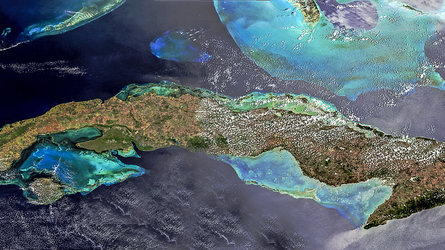
Earth from Space: Antarctic Peninsula
This Envisat image features the northern part of the Antarctic Peninsula, which stretches beyond the Antarctic Circle to within 1050 km to the southern tip of South America.
The 1000-km-long arm of the mountainous peninsula is situated between the Bellingshausen Sea on the west and the Weddell Sea on the east.
Along the peninsula, ice shelves are nourished by glaciers streaming down from the central ice sheet plateau, which extends as a narrow spine along the central part of the peninsula.
These ice shelves are important indicators for on-going climate change because they are sandwiched by rising surface air temperatures and a warming ocean.
Exceptional atmospheric warming of around 2.5°C over the past 60 years has triggered the retreat and break-up of several of the shelves. In the past 20 years seven ice shelves along the peninsula have retreated or disintegrated, including Larsen (on the east) and Wilkins (located farther south on the west).
Within days of its launch in March 2002, Envisat captured the spectacular disintegration of Larsen B. Scientists estimate it had been stable since the last ice age 12 000 years ago, and ice dynamic studies suggest it will take several hundred years of colder weather to completely rebuild it.
Long-term monitoring over Antarctica is important because it provides authoritative evidence of trends and allows scientists to make predictions. However, in addition to being very remote, the conditions often found there, such as restricted daylight and thick cloud cover, make it very difficult to carry out in situ research.
The advent of satellites has allowed scientists to continuously monitor the regions. Radar instruments, such as the Advanced Synthetic Aperture Radar (ASAR) on Envisat, are particularly suited for monitoring this area because they can operate at night and penetrate through clouds.
By acquiring daily images of Antarctica that are easily accessible to scientists, ASAR has provided an unprecedented time series of the most recent break-up events of the Wilkins Ice Shelf. Scientists monitor these developments continuously to better understand the break-up process of ice shelves.
This image was acquired by Envisat’s Medium Resolution Imaging Spectrometer on 5 February at a resolution of 300 m.