Earth from Space: A gush of volcanic gas
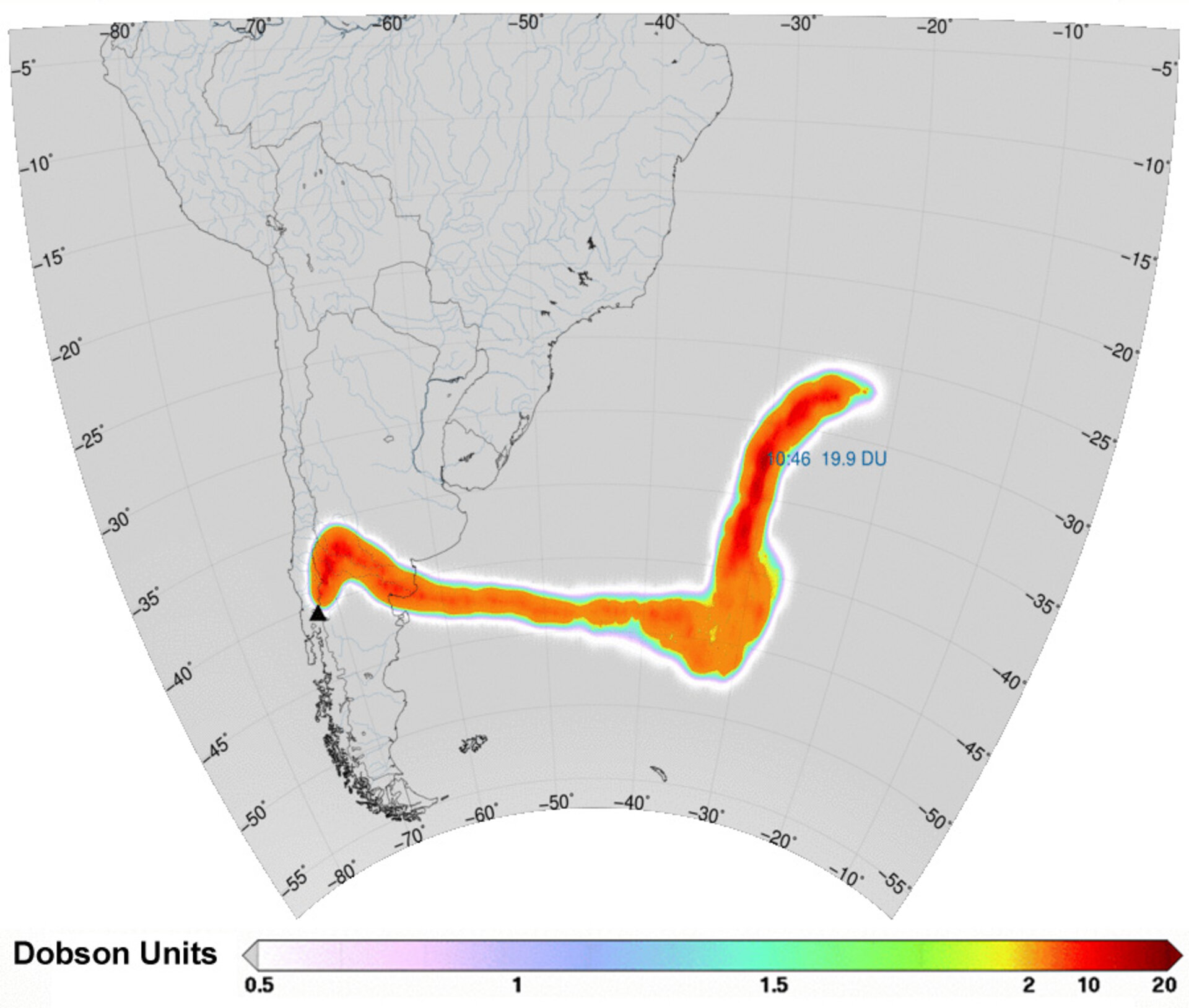
This image shows the huge plume of sulphur dioxide that spewed from Chile’s Puyehue-Cordón Caulle Volcanic Complex, which lies in the Andes about 600 km south of Santiago.
After lying dormant for more than 50 years, a series of rumbling earthquakes signalled the beginnings of this major volcanic eruption. On 4 June, a fissure opened, sending a towering plume of volcanic ash and gas over 10 km high.
Several thousand people were evacuated as a thick layer of ash and pumice fell and blanketed a wide area. Airports in Chile and Argentina were closed as a result.
The image was generated on 6 June using data from the Infrared Atmospheric Sounding Interferometer on Eumetsat’s MetOp-A satellite. As the eruption continued, the image shows how strong winds initially swept the broad plume of sulphur dioxide northwards and then eastwards across Argentina and out over the southern Atlantic Ocean.
Strong westerly winds are common in this region because it lies within the belt of the ‘Roaring Forties’. Since there is little land south of 40º, higher wind speeds can develop than at the same latitudes in the Northern Hemisphere.
Interestingly, over the South Atlantic, the plume take a sharp turn to the north as a pressure system causes the wind to change direction.
The Puyehue-Cordón Caulle complex is a chain of volcanoes that includes the Puyehue volcano, the Cordilera Nevada caldera and the Cordón Caulle rift zone. This event appears to have stemmed from the rift zone and is the most serious since the eruption of 1960, also from the same vent.
Chile has more than 3000 volcanoes, of which around 80 are currently active.
The image represents sulphur dioxide concentrations within the full vertical column of atmosphere. It was generated using data from the interferometer, which was developed by the French space agency CNES for MetOp-A.
The MetOp programme was jointly established by ESA and Eumetsat and forms the space segment of Eumetsat’s Polar System.