

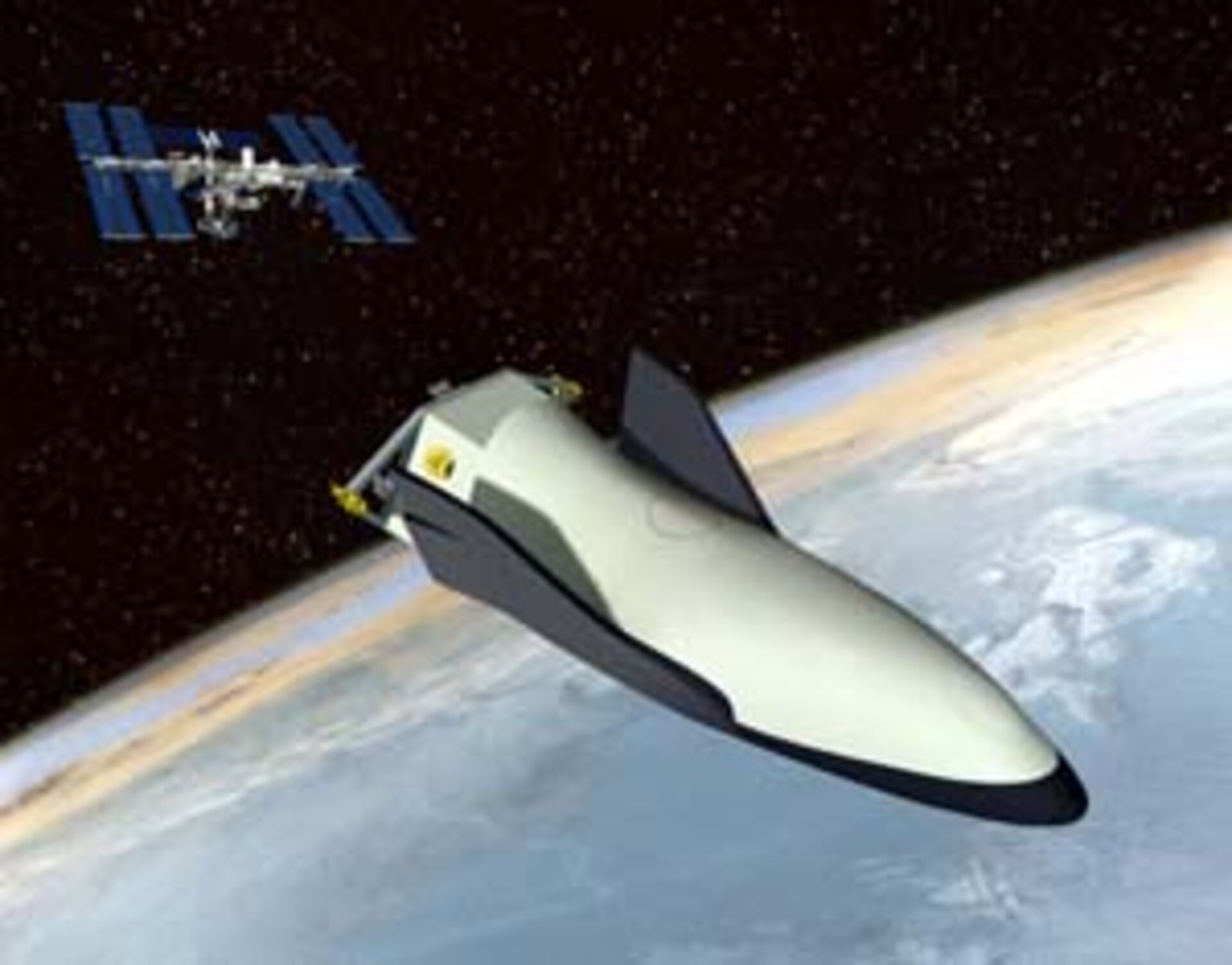
Crew Return Vehicle (CRV)
Manned Spacecraft to return the crew to Earth in case of emergency
The Crew Return Vehicle is a higly automated reusable spacecraft that serves as a space ambulance, life boat and alternate return vehicle for the crew on the International Space Station. The Crew Return Vehicle provides space for up to 7 astronauts.
NOTE: Since data for the real CRV is not yet available this fact sheet is largely based on the X-38, the CRV's prototype.
| Dimensions | |
|---|---|
| Crew Return Vehicle length | 9144 mm |
| Crew Return Vehicle width | 4420 mm |
| de-orbit-propulsion stage length | 1829 mm |
| Cabin internal volume | 11.8 m3 |
| Mass budget | |
| Crew Return Vehicle mass | 11 340 kg |
| De-orbit propulsion stage mass | 2722 kg |
| Propulsion | |
|---|---|
| De-orbit propellant | Mono-propellant Hydrazine |
| Attitude control system | Pressure regulated Nitrogen cold gas thrusters 922 x 111 N each) |
| Communications infrastructure | |
|---|---|
| S-band | |
| Ku band TDRS satellite |
| Environmental control | |
|---|---|
| Max. number of crew members | 7 |
| Cabin temperature |
18° - 27° C (Attached to ISS) up to 28° C after landing |
| Air pressure | 958 - 1013 hPa |
| CO2 and CO removal | Lithium Hydroxide cartridge |
| H2O vapor removal | Charcoal cartridge |
| Medical facilities | Ambulance style first aid can be administered |
| Electrical power | ||
|---|---|---|
| Launch phase | Power provided by Space Shuttle atttached to ISS: Dormant mode | (monthly low power maintenance checks from ISS) |
| De-orbit and descent | Power provided by 4 rechargeable Lithium batteries |
| Main construction material | |
|---|---|
| Pressure shell Internal structure | Various composite materials |
| Thermal protection | Ceramic Matrix Composite (CMC), Thermal tiles and Thermal blankets |
| Main European contractor | |
|---|---|
| MAN Technology (Bremen, Germany) and Alenia (Turin, Italy) | Leading 22 industrial companies in eight countries |
| Launch configuration | |
|---|---|
| Launch Vehicle | Space Shuttle |
| Launched inside the orbiter's cargo bay and berthed to ISS with the Space Station Remote Manipulator | |
| Launch site | Kennedy Spce Center (Florida, USA) |
| First flight | mid 2007 |
| Flight rate | 1 per 3 years |
| On orbit configuration | |
|---|---|
| Attached in stand-by mode to Node 3 | |
| Port-port for a period of 3 years | |
| Maximum mission duration for emergency departure | 9 hours |
| Maximum mission duration for medical return | 3 hours (because this allows time for optimum sequencing between ISS departure and re-entry burn) |
| Maximum tumbling rate of ISS still to allow separation | 2°/s |
| Landing configuration | ||
|---|---|---|
| Control during flight and landing | Autonomous with manual interference | |
| Attitude control | Cold gas and Air surfaces | (which take over in denser regions of the atmosphere) |
| Parafoil area | 685 m3 | Drogue chute deployment at 8 km. altitude |
| Main chute deployment at 7 km. altitude in 5 steps | ||
| Landing gear | 3 skis | |
| Landing accuracy | < 9 km radius | |
| Horizontal landing speed | < 4.6 m/s | |
|
Flight hardware (European built) |
Fin structure, Fin folding mechanism | |
| Aft structure design | ||
| Ceramic Matrix Composite (CMC) rudder, body flaps and nose cone | ||
| Trunnion retraction mechanism | ||
| Aerodynamic and Aerothermodynamic database | ||
| Landing gear system | ||
| Crew seats | ||
| International berthing/docking mechanism development model | ||
| Cockpit display technique development | ||
| Avionics | (architectural support) |