Inside the Columbus laboratory
Viewed from the outside, ESA's Columbus laboratory is just a big cylinder of aluminium alloy, 4.5 metres wide and 6.7 metres long. Inside though, the pressurized module is packed with high-technology scientific equipment, video and communications links, and the cables, ducts and piping needed for power, cooling and life support.
Beneath its unassuming exterior, Columbus is an entire multi-purpose research centre in miniature. In the weightlessness of orbit, Columbus offers scientists the chance to work in a microgravity environment utterly unavailable on Earth.
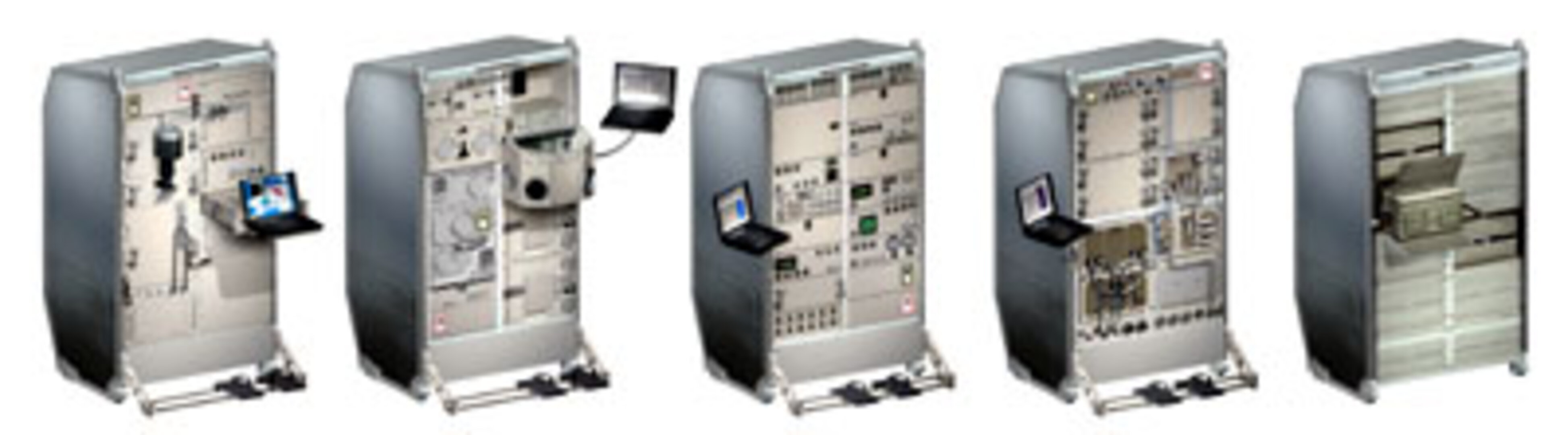
At the heart of Columbus - and the whole reason for the module's existence - are the experiment racks. There is room for 10 of these International Standard Payload Racks (ISPR), each of which can accommodate a plug-and-play science package that may weigh up to 700 kg. To be more accurate, the experiments 'mass' up to 700 kg, in orbit of course, they weigh nothing.
The research facilities that will make up the first four European payload racks have already been designed and built by ESA. All of this equipment had to meet tough specifications. Obviously, each facility had to be compact enough to fit into the restricted space of an ISPR and tough enough to withstand years of service. They had to accommodate multiple users too and since the station crew have only a limited amount of time to supervise ongoing experiments, the facilities must be largely automatic and fully controllable from ground stations.
These four payloads are the Biolab, the Fluid Science Laboratory, the European Physiology Modules Facility and the Materials Science Laboratory, each dedicated to a major science discipline. Over the lifetime of the ISS - at least 10 years - these labs will perform thousands of experiments. The data gleaned from them will be made available to scientists through ESA's giant microgravity database, which already contains records of European research in weightlessness that go back to the 1960s. They will yield knowledge of immense benefit to everyone on Earth.