

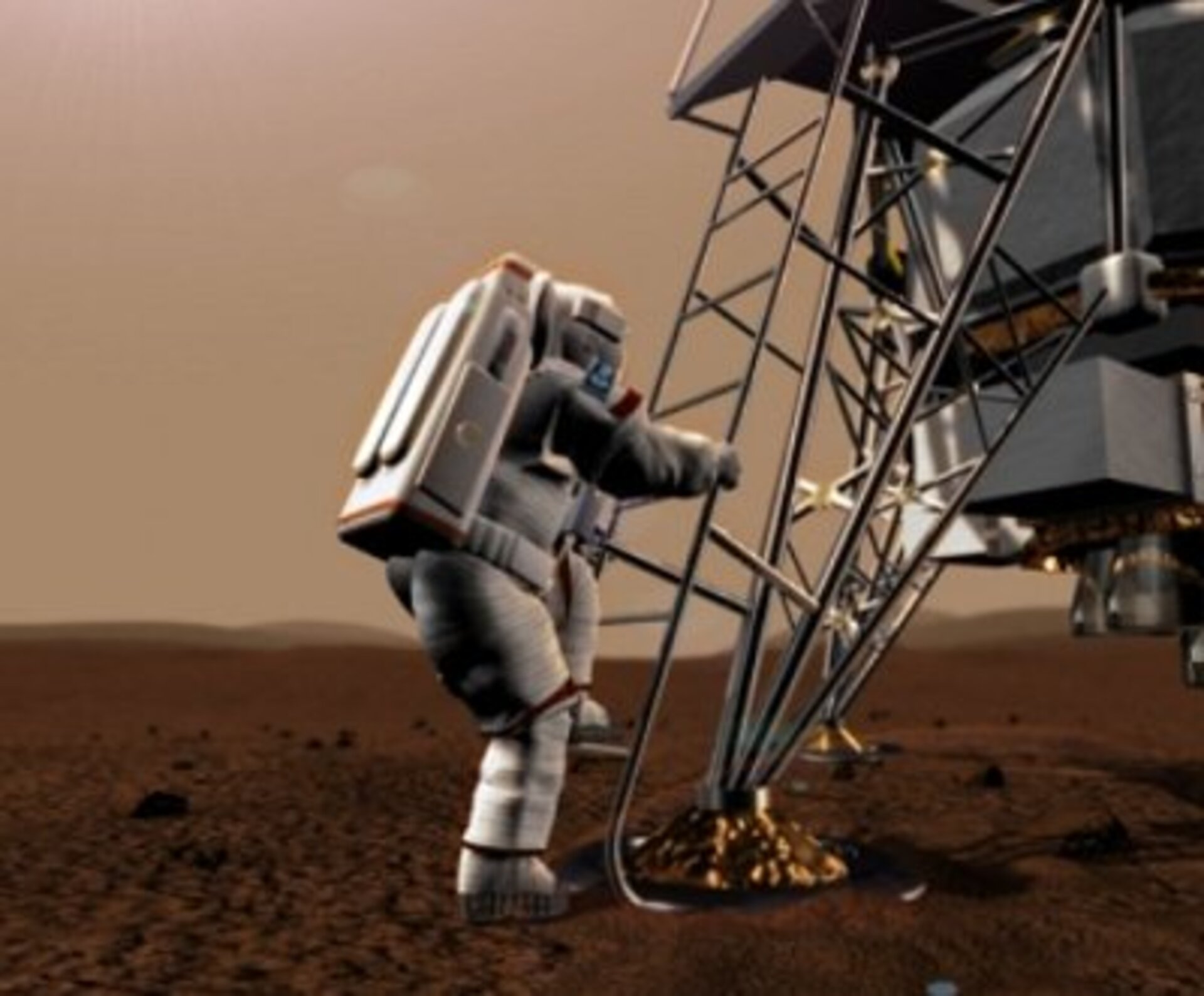
ESA seeks candidates for simulated 'Missions to Mars' in 2008/2009
ESA is preparing for future human exploration missions to Mars. We are currently looking for volunteers to take part in a 520-day simulated Mars mission.
To go to Mars is still a dream and one of the last gigantic challenges. But one day some of us will be on precisely that journey to the Red Planet. A journey with no way out once the spaceship is on a direct path to Mars.
Challenges
These men and women will have to take care of themselves for almost two years during the roundtrip. Their survival is in their own hands, relying on the work of thousands of engineers and scientists back on Earth, who made such a mission possible.
The crew will experience extreme isolation and confinement. They will lose sight of planet Earth. A radio contact will take 40 minutes to travel to us and then back to the space explorers.
A human mission to Mars is a bold vision for the time beyond the International Space Station. However, preparations have already started today. They are geared and committed to one goal: to send humans on an exploration mission to Mars, individuals who will live and work together in a spaceship for over 500 days.
Simulation
In order to investigate the human factors of such a mission, ESA has teamed up with the Russian Institute of Biomedical Problems (IBMP) and will send a joint crew of six on a 520-day simulated mission to Mars.
The simulation follows the mission profile of a real Mars mission, including an exploration phase on the surface of Mars. Nutrition will be identical to that provided on board the International Space Station.
The simulations will take place here on Earth inside a special facility in Moscow. A precursor 105-day study is scheduled to start by mid-2008, possibly followed by another 105-day study, before the full 520-day study begins in late 2008 or early 2009.
ESA is looking for 12 volunteers who are ready to participate in the simulations and thereby help to support the preparations of the real thing: a mission to Mars. Four volunteers will be needed for each of the three simulations. The selection procedure is similar to that of ESA astronauts, although there will be more emphasis on psychological factors and stress resistance than on physical fitness.
Interested?
For detailed information on this Call for Candidates and for the application form please refer to:
Concordia
Alongside such dedicated space mission simulations, a complementary approach to understand the complexities of human health and behaviour is to look at analogue environments. These are operational environments, which, through their natural situation produce some similar constraints as for example a mission to Mars.
ESA has already been active for some years in the Antarctic Concordia research station. In support of the scientific and technical projects there, ESA is looking for one person (each year) with a medical background. The details of that Call for Candidates can also be found at the web address indicated above.


