Personal digital assistants in space
Can tiny and ubiquitous devices like Personal Digital Assistants (PDAs) be of use for space applications? The answer is a definite yes. Recent tests have demonstrated current and future uses for PDAs on board the International Space Station.
Current applications
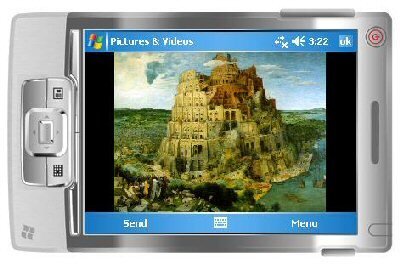
Up until late 2006, PDAs had been used on board the International Space Station (ISS) mainly as personal computing or entertainment platforms.
In the near future, PDAs will start being used as integrated components of real applications.
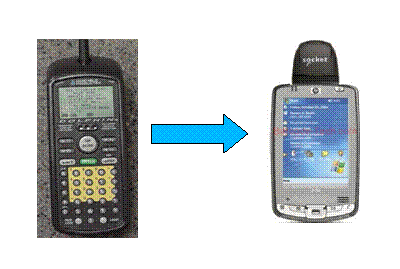
For example, on the space station there is an application called the Inventory Management System (IMS) that is responsible for keeping track of the location of all items stored on board. This application is based on the use of barcode labels. Starting in March 2007, the old barcode reader terminals will be replaced by PDAs. These PDAs will be equipped with a barcode reader and will be connected to the IMS via a wireless network.
A special application, known as the PDA Depressurisation Program (PDP) and conceived by the astronaut Thomas Reiter, has been developed by ESA to compute the ‘egress time’, – the time that is left before having to abandon the ISS in the event of depressurisation.
This application, tested for usability by Reiter during his long duration mission – from July to December 2006 – is currently undergoing qualification by NASA and will become part of the standard set of software packages loaded on each astronaut PDA.
Prototype applications and research areas
PDAs have been investigated as alternative or complementary platforms for some of the applications currently running on the ISS laptops. The idea is to use a PDA in those situations where a laptop might be inconvenient because it is too big or cumbersome.
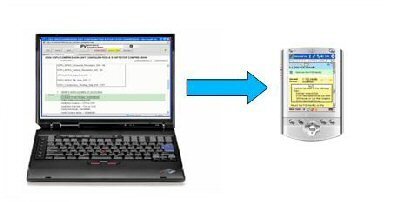
An example of laptop to PDA conversion, developed by industry using ESA research and development funding, is the porting of the ESA/NASA International Procedure Viewer (IPV) application. In this type of conversion, the critical factor is adapting the laptop based user interface to a new platform where the available screen area is significantly smaller.

Another area of research is the use of the PDA as a voice or speech processing platform. Combined with wireless communication, PDAs could become suitable devices for crew-to-crew communication (VOIP applications) and crew-to-system communication (speech synthesis and speech recognition – an example is shown in the illustration – click the figure to enlarge).
One limitation for applications employing voice sounds for either input or output is the noise that is always present on board the ISS, most of which is generated by the ventilation system. The PDA Depressurisation Program uses speech synthesis to notify the crew members about the time remaining before egress. However, ambient sound is not an issue for this application because, if depressurisation occurs, the ventilation system is automatically switched off as safety measure.
For more information
Maurizio Martignano, Senior Engineer, Software Systems Division.
Maurizio.Martignano @ esa.int