Landmark flight for ESA’s microgravity research
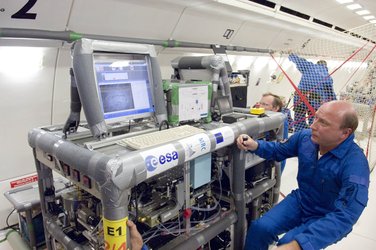
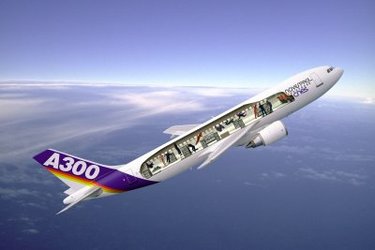
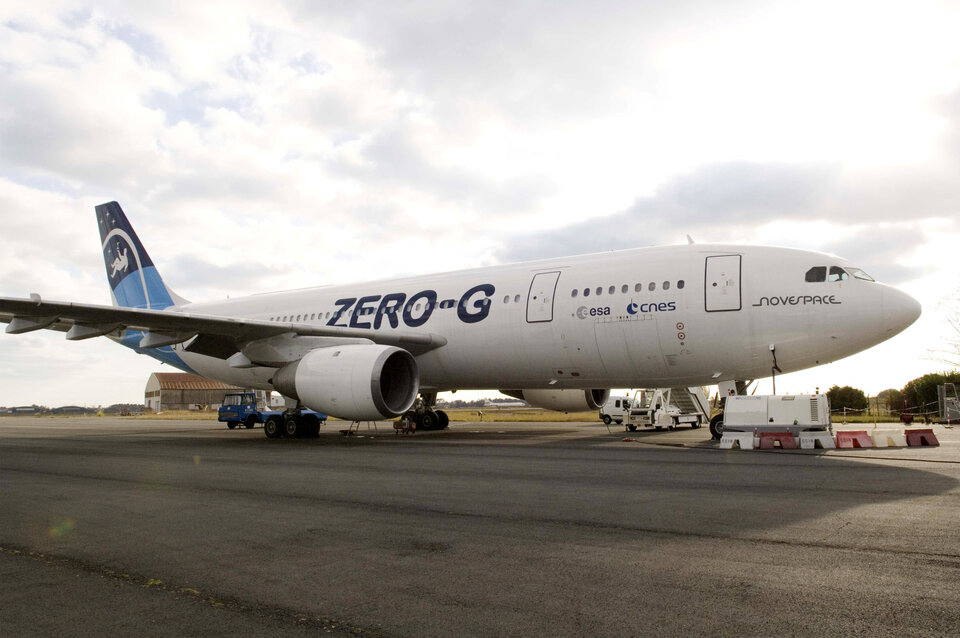
The first of two ESA parabolic flight campaigns organised for this year takes place this week in Bordeaux, France. On board the modified Airbus A-300 aircraft will be a suite of 10 microgravity experiments provided by European scientists in cooperation with scientists from Canada and the United States.
The emphasis of ESA's 48th Parabolic Flight Campaign is on the study of heat transfer. This is a key scientific problem which is the subject of extensive research. ESA sponsors several projects in this field that are run by consortia of European institutes and laboratories where these parabolic flight experiments are developed.
The ultimate aim of this research is to improve the efficiency of many systems relying on heat transfer, spanning from the generation of energy, through to high power electronics. In the general context of rising energy costs and global warming, this research is clearly of high importance.
“The aim is to gain a basic understanding of the different processes involved, and their interrelation. This will help to improve existing systems and develop new ideas or designs for future systems,” said Vladimir Pletser, Project Manager of the ESA Parabolic Flight Campaigns. “Such research is important because, for example, we need to understand and improve heat removal from integrated circuit boards or other spacecraft systems.”
“Unfortunately, we could not accommodate all of the experiment teams that applied to fly on this campaign because most of them require a lot of power. Some had to be deferred until the next parabolic flights that will take place in October or November,” added Pletser.
All of the instruments flown on this campaign are extensions and adaptations of those used previously as scientists learn from their results. Furthermore, these experiments often prepare for longer duration investigations on the International Space Station (ISS).
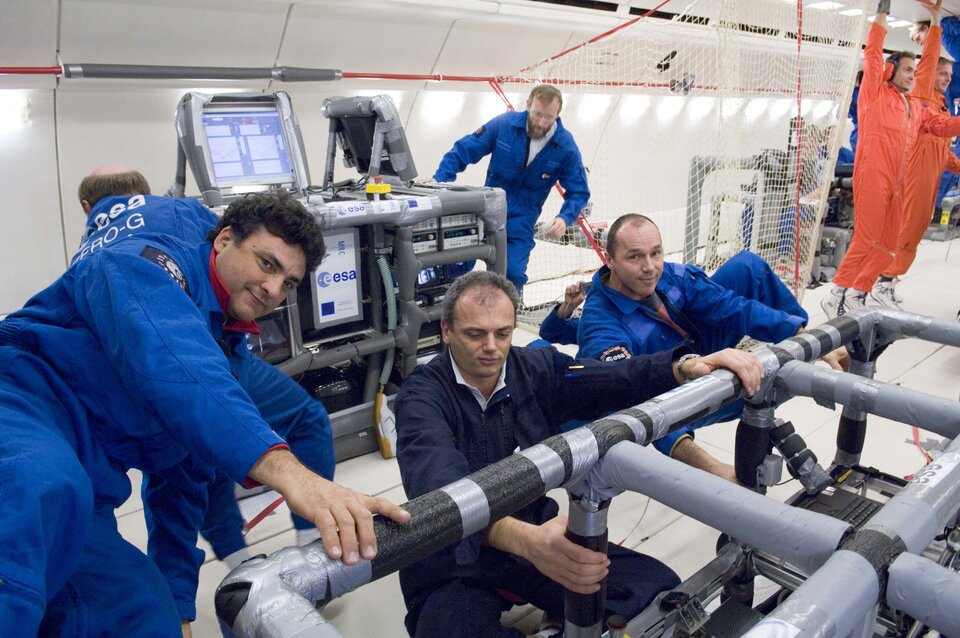
The majority of these experiments exploit the fact that a liquid absorbs a much larger amount of heat when it boils. The situation becomes more complicated compared to a simple liquid and still requires much research to be accurately described, and then predicted.
An experiment prepared at TU Darmstadt by the group of Professor Peter Stephan will measure the temperatures around a single boiling bubble stabilised at a hot spot. At the Polytechnic of Marseille, the group of Professor Lounès Tadrist developed a system enabling to quantitatively investigate the growth of vapour bubbles when boiling occurs in a confined space, which is almost in two dimensions.
An experiment developed at ENEA, Rome, under the leadership of Professor Gian Piero Celata, looks at the efficient quenching of hot tubes. This issue is particularly relevant to the thermalisation of cryogenic rocket motors. It involves using a boiling liquid to lower the temperature of pipes under microgravity conditions and comparing the results with similar experiments on the ground.
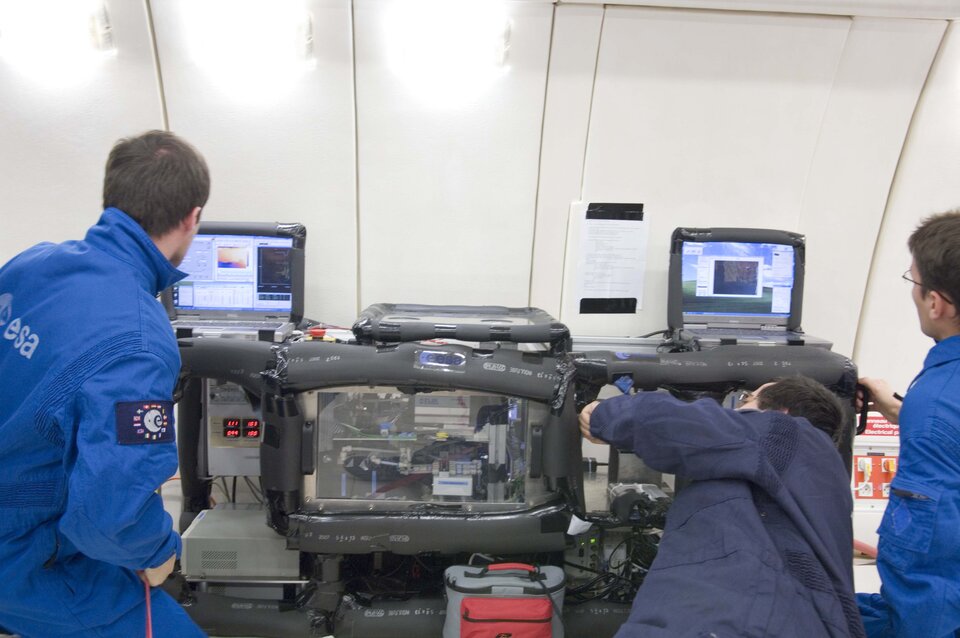
Preparations for the 48th Parabolic Flight Campaign began on 11 March, with the arrival of the experimental teams in Bordeaux. After completion of the final ground preparations, the experiments will be installed in the aircraft, with final safety checks on 17 March.
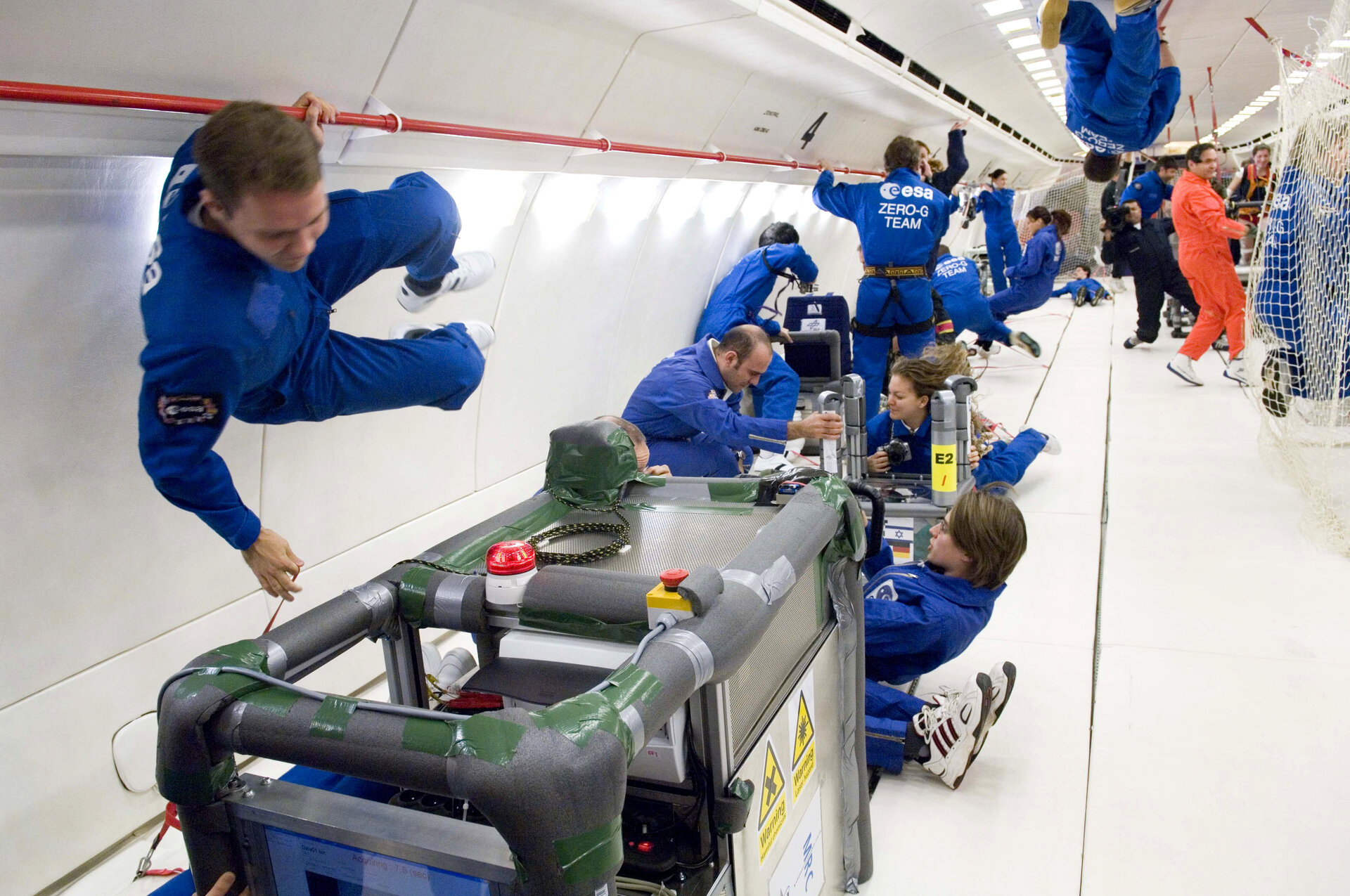
Over the following three days, the Airbus is scheduled to take off from Bordeaux-Mérignac airport and head out over the Bay of Biscay – weather permitting. Once the first 'warm up' ascent and descent is completed, the experimental programme will begin. Over the next three hours, the aircraft and its occupants will experience 30 parabolas, each providing about 20 seconds of microgravity.
French company Novespace owns and operates the A300 Zero-G aircraft, and is in charge of the preparation of the flight campaigns. ESA sponsors the flight opportunity.
ESA has a permanent announcement of opportunity open for researchers wanting to take advantage of the agency’s parabolic flight campaigns. Applications may be put forward at any time. The proposals undergo a peer review by experts from outside ESA and are selected on scientific merit.
The next ESA Parabolic Flight Campaign is scheduled to take place in October - November 2008.