

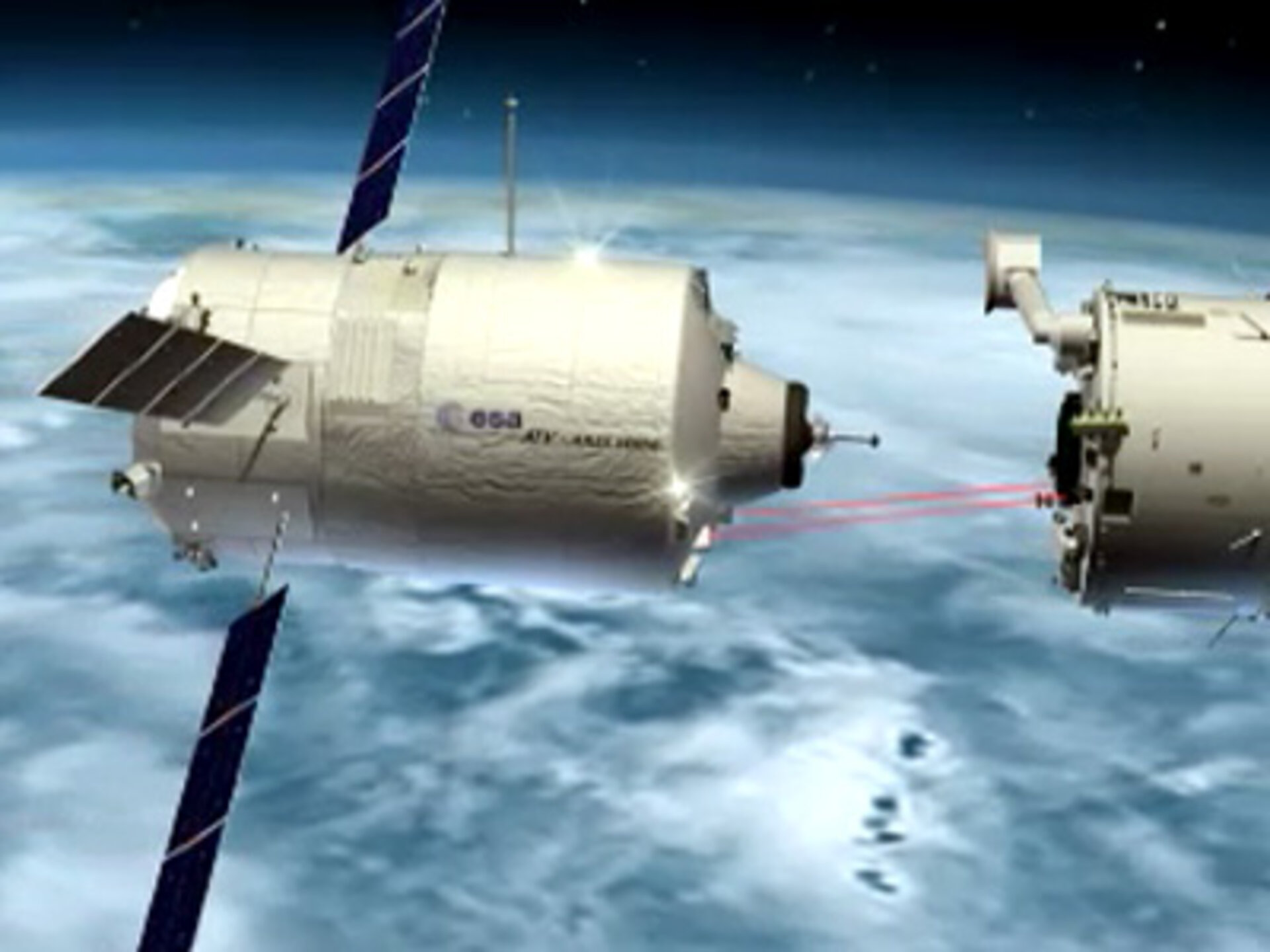
ATV mission scenario - animation
The International Space Station depends on regular deliveries of experimental equipment and spare parts as well as food, air and water for its permanent crew. From 2008, Europe's Automated Transfer Vehicle (ATV) has been one of its indispensable supply spaceships.
After launch, ATV is well protected at the top of Ariane 5 during a three-minute, high-pressure aerodynamic ascent. 100 minutes after liftoff, ATV becomes a fully automatic spacecraft navigating toward the International Space Station.
ATV uses its laser-guided rendezvous sensors to dock precisely and safely, becoming a habitable extension of the Station.
The 45 m³ pressurised module can deliver up to 6.6 tonnes of equipment, fuel, food, water and air for the crew, and is used to raise the Station's altitude, which naturally decreases over time due to atmospheric drag.
Six months later, loaded with 6.4 tonnes of waste, ATV separates from the Station and burns up during a controlled reentry high over the Pacific Ocean.