ESAColumbusHuman Spaceflight and ExplorationISSAstronauts
   
About Columbus
Columbus laboratoryColumbus facts & figures
Columbus facilities
BiolabEuropean Drawer Rack (EDR)European Physiology Modules (EPM)
European Transport Carrier (ETC)
Fluid Science Laboratory (FSL)Microgravity Science Glovebox (MSG)
External payloads
EUTEFSOLAR
Columbus operations
Columbus Control CentreUser Support and Operations Centres
Columbus Mission
Downloads
Information Kit (pdfs)Mission newspapersBrochure (pdf)
Multimedia
Image galleryVideo galleryMagic bookExhibition material
Services


Bookmark and Share


printer friendly page
European Transport Carrier (ETC)
 
European Transport Carrier (ETC)
 
Multi-user logistics carrier in Columbus and MPLM

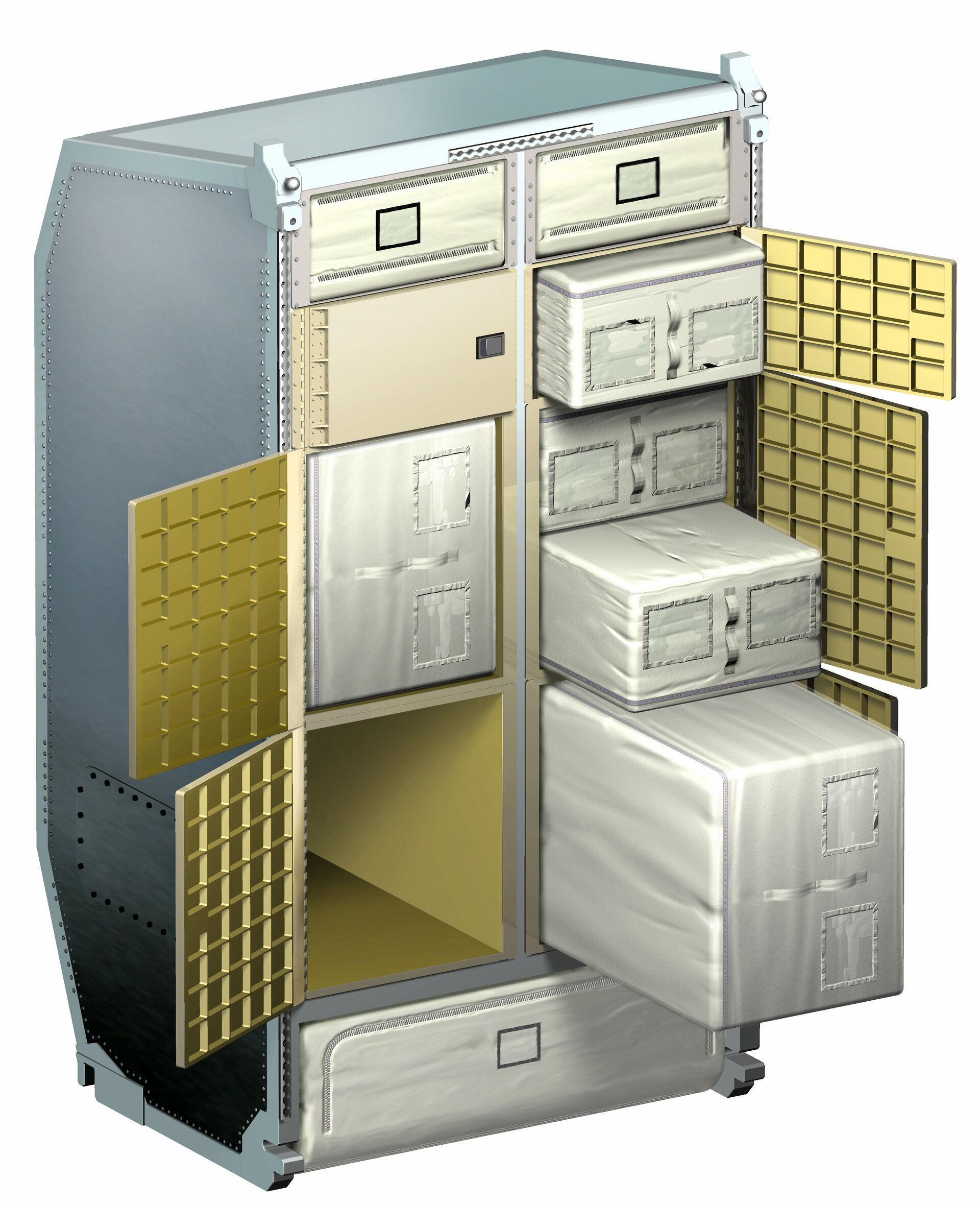
The European Transport Carrier carries payload items that cannot be launched within the ESA facilities because of stowage or transport limitations. In orbit it serves as a workbench and stowage facility to support experiments with Biolab, the Fluid Science Lab, the European Physiology Modules and the European Drawer Rack.
 
 
Operations and utilisation:
 
Accommodation and transport

The European Transport Carrier launches inside the European Columbus laboratory. After launch ETC remains in Columbus for the duration of first use, serving as a flexible stowage facility for the ESA payload facilities Biolab, FSL, EPM, and EDR.

The secondary objective for the ETC is its use within the Multi-Purpose Logistics Module - MPLM. After replacing ETC within the Columbus laboratory by an active experiment rack, ETC supports the expected continuous logistic supply needs between the ground and the ISS for the European payload racks inside Columbus. ETC can be reconfigured on ground to accommodate the specific transport and stowage needs of each flight. ETC is designed to serve for up to 15 flight missions.
 
 
Operational concept

Before beginning with nominal stowage activities in orbit, ETC is checked and some initial installation tasks completed. At the end of the planned mission time ETC is prepared for download and has to be moved from Columbus to the MPLM. After landing, ETC will be reconfigured and outfitted for the next planned mission. From then on upload and download, as well as all stowage activities, are performed within the MPLM.
 
 
Utilisation scenario

On board the International Space Station the doors of ETC are unlocked for access to the facility. The Zero-g Stowage Pockets (ZSP) in the upper and lower part of ETC, which can only be used in weightlessness, are set up. The stowage containers can be used for various kinds of payload stowage activities.

When ETC is prepared for download, all the Zero-g Stowage Pockets (ZSP) are first emptied, then the pockets folded, and stowed away. The doors are then locked again and the whole ETC rack is transferred to the MPLM for landing inside that module.
 
 
Schedule

The European Transport Carrier launched on board the STS-122 Space Shuttle mission accommodated within the Columbus laboratory.
 
 
Last update: 23 July 2008


Columbus facilities
BiolabEuropean Drawer Rack (EDR)European Physiology Modules (EPM)Fluid Science Laboratory (FSL)Microgravity Science Glovebox (MSG)
External payloads
European Technology Exposure Facility (EuTEF)SOLAR


   Copyright 2000 - 2011 © European Space Agency. All rights reserved.