

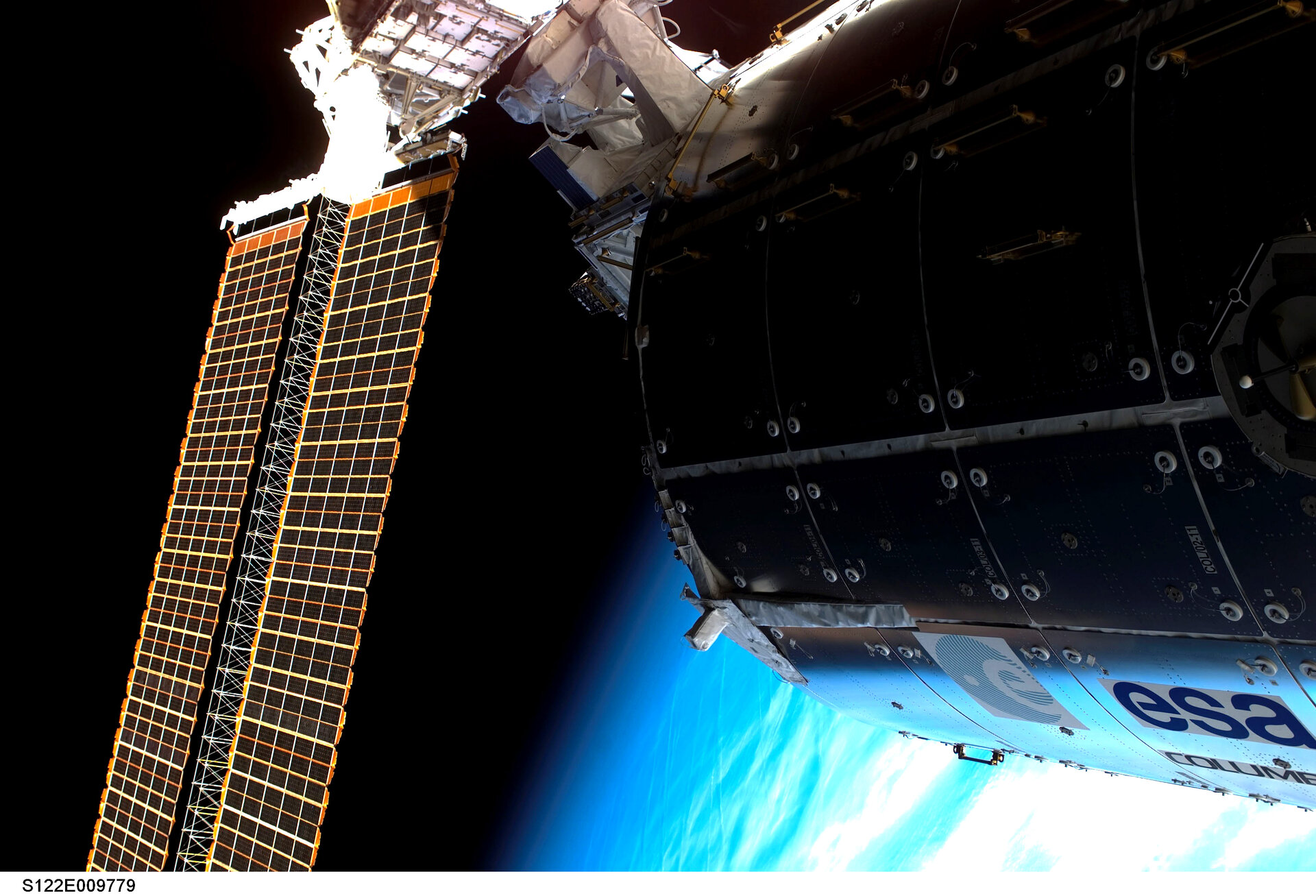
Columbus Mission
On 7 February 2008, the European Columbus laboratory was launched with STS-122 mission on Space Shuttle Atlantis.
After it was attached to the Harmony module on 11 February, Columbus became an integral part of the International Space Station bringing years of organisation and hard work to fruition.
With a projected 10 years in orbit, Columbus is part of space history as the first European laboratory dedicated to long-term experimentation in weightlessness.
ESA astronauts Léopold Eyharts from France and Hans Schlegel from Germany were crewmembers on the Columbus assembly and commissioning mission. They joined five NASA colleagues on the STS-122 Shuttle flight.
The Columbus Mission had two phases:
The 13-day STS-122 mission, also known as the 1E assembly mission, was to attach the European laboratory to the International Space Station, activate and begin commissioning of the laboratory. This included the attachment of European external experiment facilities and additional assembly/maintenance tasks.
After the undocking of STS-122, Léopold Eyharts remained on the Station for nearly 7 weeks as a member of Expedition 16.
Eyharts continued Columbus commissioning activities, activating the internal experiment facilities as well as undertaking European scientific, public relations and educational activities and additional activities in his role as ISS Flight Engineer 2.Eyharts returned to Earth with Space Shuttle Endeavour, STS-123 mission, on 27 March 2008 after nearly 49 days in space.
