Magnetic sails
Or Tacking in the solar wind
 1
1
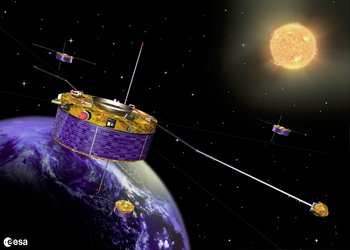
As well as light, the Sun produces a constant stream of charged particles, mostly protons and electrons, flooding out at speeds of around 400 to 600 km s-1. This gives the inventive space scientist something else to push against. The easiest way to deflect a moving charged particle is to use a magnetic field and the easiest way to produce a magnetic field is to pass a current through a loop of wire. A magnetic sail would therefore be a loop of conducting material producing a magnetic field perpendicular to the solar wind. As the magnetic field deflected the particles, they would push against the magnetic sail and so drive the spacecraft in the desired direction.
Another advantage of a magnetic sail is that it would be able to react directly with a planet’s magnetic field as well as the solar wind. This means that a magnetic sail spacecraft could gain a magnetic assist as well as a gravitational assist (the 'slingshot effect') by passing close to a planet. When it reached it’s destination it could use the target planet’s magnetic field to decelerate and so enter orbit.
The direction of thrust would depend on the angle that the sail made to the solar wind (or the planet's magnetic field) and the size of the thrust would depend on the area of the loop and the size of the current generated. However, because there is far less momentum associated with the solar wind than with sunlight the current loop would have to be huge, maybe 50 km radius or more and it would also have to be a superconductor, so that the current would continue to flow without the need for a driving potential. Fortunately unfurling a magnetic sail should not be as complex a process as it is for a solar sail; the magnetic field itself will cause the loop to open up and form a circle without the supports and guy lines needed by a solar sail.
We should not get ahead of ourselves though as the technology needed to produce hundred kilometre long lengths of superconducting material does not yet exist, let alone the techniques needed to keep them at the required operating temperature. For the time being, magnetic sails must remain in the minds of researchers and on the pages of science fiction. Maybe though, not for very long.