The rocket principal
or Getting a reaction
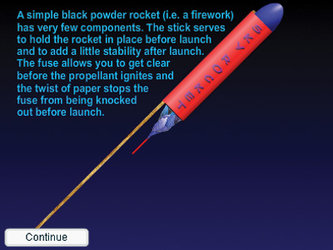
What is it that makes a rocket? In the simplest terms a rocket is a jet propulsion system that relies entirely on momentum exchange from a propellant that is carried by the vehicle. Newton’s Third Law of Motion states that "for every action there is an equal, but opposite, reaction". In other words a rocket engine relies on ‘throwing mass out the back’ in order to push the vehicle forwards. We can see this in many examples from the science lab.
Video of air track and other demonstrations by Lutterworth College students showing that ejecting mass backwards generates a forward thrust and that the thrust can be increased by ejecting more mass or providing more energy:
The air track video shows the two things that any rocket system needs, propellant mass (the 10 gram masses in the air track demonstration) and an energy source (the stretched rubber bands on the air track). In many rocket engines the two come from the same place, the fuel – oxidant mixture that is carried by the rocket. The video shows though that that isn't always the case.
Another example of separation of propellant and energy is also shown in the video. In the water rocket the propellant mass is provided by the water but the energy store is provided by the compressed air.
One toy rocket that everybody is familiar with is the balloon. Normally the balloon will fly off in almost any direction but introducing a nozzle allows us to fly it in one direction. The propellant mass for the balloon is the air stored inside it, but what is the source of energy? Think back to the video before you answer, there are two energy sources!