

First satellites: Galileo In Orbit Validation Element / GIOVE
Two experimental Galileo satellites -
GIOVE-B was launched on 27 April 2008 from Baikonour. The launch of the test satellites for Galileo represented some major programmatic achievements:
- the first time Europe has flown a navigation satellite
- the first time Galileo signals have been transmitted from Space
- the first time Europe has flown a satellite in Medium Earth Orbit (MEO)
- Europe is meeting the requirements for the Galileo frequency filing
- the hydrogen maser clock will be the most accurate clock ever flown in space
GIOVE-A
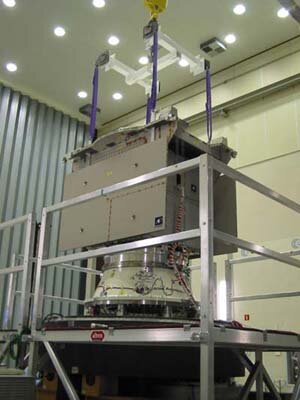
GIOVE-A was developed by Surrey Satellite Technology Ltd (UK). This first mission for a Galileo satellite is a complete success, with the achievement of all its objectives:
- securing the frequency filings with ITU: frequencies were brought into use on 3 March 2006
- validation of key technologies - all performing largely in line with expectations for the different elements such as the new rubidium clocks
- facilitating the experimental reception of navigation signals from Medium Earth Orbit (MEO) - using two transmission channels in parallel
- characterisation of the MEO environment using two different radiation monitoring instruments
This 3-axis stabilized satellite has a cubical body of 1.3 m x 1.8 m x 1.65 m with a lift-off mass of 600 kg and a power demand of 700 W provided by two wings of sun-tracking solar arrays each 1.74 m long. The satellite uses a butane propulsion system with two tanks containing 25 kg each.
The satellite carries a payload that transmits a Galileo experimental signal in two separate frequency channels. The main elements of the payload are:
- the antenna: a phased array of individual
L-band elements, illuminating all the visible Earth below the satellite - the signal generation units: two sets, one able to generate a simple Galileo signal, and another one, able to generate more representative Galileo signals
- the clocks: two redundant, small-size Rubidium atomic clocks with a stability of 10 nanoseconds per day
Beyond its expected lifetime of 2 years, GIOVE-A is operating nominally.
GIOVE-B

The GIOVE-B satellite was developed by European Satellite Navigation Industries (formerly Galileo Industries), a European consortium including Alcatel Space Industries (F), Alenia Spazio (I), Astrium GmbH (D), Astrium Ltd (UK) and Galileo Sistemas y Servicios (E).
GIOVE-B is intended to fulfil similar objectives to GIOVE-A: securing frequency filings, expanding the technologies experimentation to include the passive hydrogen maser clock, characterisation of the MEO orbit using one radiation monitoring instrument, improved signal transmission capabilities using 3 channels in parallel, and enabling expanded signal experimentation.
This is a 3-axis stabilized satellite, with stowed dimensions (with the solar arrays folded) of 0.95 m x 0.95 m x 2.4 m. It will have a lift-off mass of 523 kg and will be equipped with two solar array wings each 1.49 m long supplying up to 700 W of power.
The satellite is using a hydrazine propulsion system with one tank containing 28 kg.
The satellite carries a payload that transmits a Galileo experimental signal on three separate frequency channels. The main elements of the payload are:
- the antenna: a phased array of individual L-band elements, illuminating all the visible Earth below the satellite
- a navigation signal generation unit with significant flexibility to generate different types of signals
- the clocks: one small size rubidium atomic clock with a stability of 10 nanoseconds per day, and a larger passive hydrogen maser clock, another type of atomic clock with better stability (1 nanosecond per day) and which will be the most stable clock ever flown in space
GIOVE-B has reached its expected lifetime of 2 years and is operating nominally. Its operations have been extended.

