First Galileo satellite producing full spectrum of signals
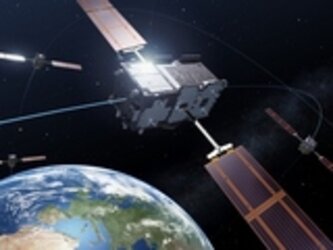
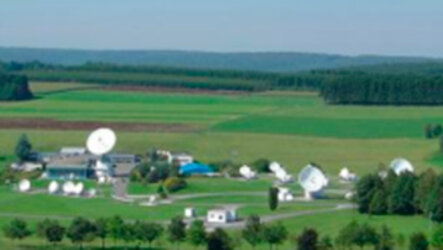
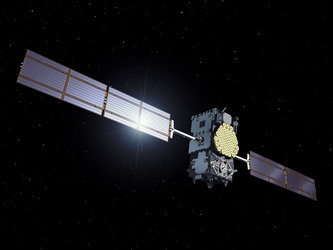
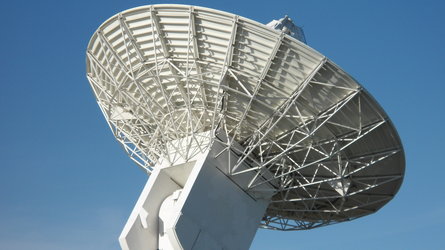
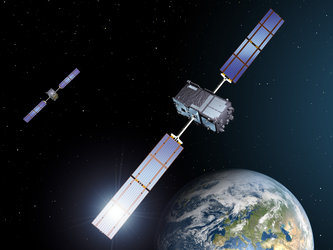
Europe’s first Galileo satellite appears in blooming health, transmitting test signals received by ESA’s ground station in Redu, Belgium across the whole of its assigned radio spectrum.
The first two Galileo satellites were launched by Soyuz from Europe’s Spaceport in French Guiana on 21 October. They are currently in the midst of a rigorous campaign to check that their highly sophisticated navigation payloads are operating as planned, unaffected by the strains of launch.
Testing is centred on the first Galileo satellite for now, expected to progress to the second satellite early in the new year.
Galileo is a state-of-the-art global satellite navigation system offering various groups of users a total of ten different modulated signals across three spectral bands, known as E1, E5 and E6.

Last weekend all Galileo signals were activated simultaneously across these bands for the first time, following the switch-on and ‘outgassing’ – warming up to vent potentially harmful vapours – of power amplifiers in the remaining E6 band.
The signals were received by Galileo Test User Receivers deployed at the Redu ground station, within Belgium’s Ardennes forest, as well as by identical receivers at ESA’s Navigation Laboratory, in ESA’s ESTEC technical centre in Noordwijk, the Netherlands.
These test receivers work in the same way as operational receivers will once Galileo begins its initial services in 2014. They are capable of processing the Open Service, Commercial Service and Safety-of-Life Service signals from the Galileo constellation.

Galileo combines multi-frequency signals with the most accurate atomic clock ever flown in space for navigation, accurate to one second in three million years. Its signals should open up a large number of commercial applications by combining this accuracy with the increased reliability of dual- or triple-frequency measurements.
Receiver developers can choose among the variety of Galileo signals on offer to meet the needs of their customers in the most efficient way. They can even combine the processing of Galileo signals with US GPS or Russian Glonass signals to offer more robust positioning information in challenging environments such as city centre ‘urban canyons’.