ESA   Home
Factsheet
Venus Express
 Back to Press Kit
28 November 2007
 
Venus Express is Europe’s first mission to Earth’s twin world. Venus is a place of many mysteries waiting to be solved. The big question is: why did a planet so similar to Earth in size, mass and composition evolve so differently over the course of the last 4000 million years?
 
Objectives
 
The mission’s major objective is the first global examination of the atmosphere of Venus. The very hot and dense atmosphere appears to be completely different from the one around Earth. Existing meteorological models fail to predict the behaviour of Venus’ thicker blanket of gases. Venus Express’ objectives include the study of:

  • the huge greenhouse effect on Venus (the strongest found in the Solar System)
  • the hurricane force winds that permanently encircle the planet
  • the mysterious ultraviolet absorption features at an altitude of about 80 km
  • the way solar wind particles interact with the upper atmosphere
  • the surface and geological activity
  • the similarities/differences with our own planet

Major achievements so far

Venus Express has provided:

  • the first global views of the double-eyed vortex at Venus’ South Pole
  • the first detailed views of atmospheric structures such as clouds, waves and convection cells, in different regions
  • detailed maps of wind fields and their velocities
  • the first sets of 3D data about the structure and the dynamics of the atmosphere
  • the most complete temperature maps of the atmosphere at different altitudes
  • the most detailed view of the ‘oxygen airglow’ and ‘carbon-dioxide fluorescence’ of Venus, which make the planet glow like a space lantern
  • the first large-area temperature maps of the searing surface of the southern hemisphere
  • the most complete data set to date of the chemical species in the atmosphere
  • the water escape rate from the atmosphere in relationship to the bombardment by the solar wind
  • the first unambiguous detection of lightning in the atmosphere

 
Cost
 
ESA’s investment is about 220 million Euros, covering the development of the spacecraft, the launch and the operations. This amount includes 15 million Euros as support to several research institutes for building the instruments. Rosetta, Mars Express and Venus Express are a family of missions in which costs are shared.
 
Launch
 
Venus Express was launched from the Baikonur Cosmodrome in Kazakhstan on 9 November 2005 aboard a Soyuz rocket, using a Fregat upper stage to place it in a transfer orbit to Venus.
 
Orbit
 
Its journey to the planet lasted 155 days. Venus Express was captured into an orbit around its target on 11 April 2006, via a delicate manoeuvre that required the spacecraft’s main engine to fire for 50 minutes. About five days later, a two-week series of manoeuvres began to put the spacecraft into its final operational orbit, reached on 7 May 2006. This orbit circles above the poles every 24 hours. At its closest, the orbit reaches down to 250 kilometres altitude (at 80ºN, almost over the North Pole). At its furthest, it is more than 60 000 kilometres from the planet, almost over the South Pole. After a period of commissioning for the spacecraft and instruments, Venus Express started science operations on 4 July 2006.
 
Planned mission lifetime
 
The science mission at Venus is planned to last until end 2014.
 
Spacecraft
 
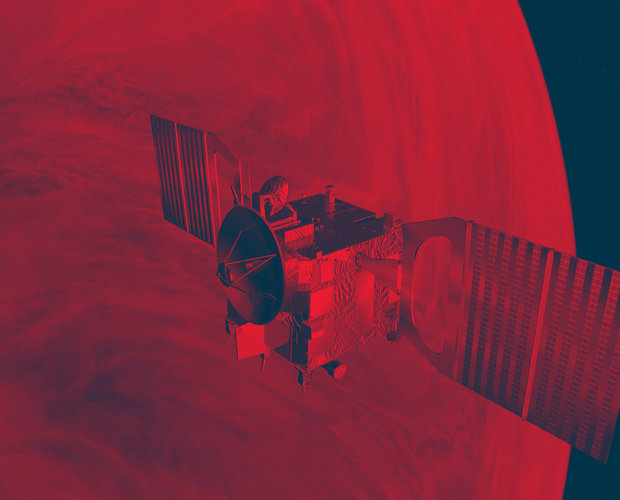
Design: Venus Express is a virtual twin of Mars Express. However, the engineers modified the spacecraft to withstand the harsh environment around Venus (the spacecraft receives four times the amount of solar radiation as Mars Express). The body is a honeycombed aluminium box that houses all the systems and payload. Wherever possible, off-the-shelf units were used; the instruments are largely flight spares from Mars Express and Rosetta. Spacecraft technology developed from Rosetta was also reused wherever possible. Both approaches helped to keep down costs.

Dimensions: 1.5 x 1.8 x 1.4 m (excluding solar wings). With the solar wings extended, Venus Express measures about 8 m across.

Mass: 1240 kg in total, including 93 kg of payload and about 570 kg of propellants.

Industrial involvement: The prime contractor was Astrium, Toulouse (France), leading an industrial consortium involving 25 companies from 14 European countries.
 
What’s on board?
 
Venus Express makes use of two instruments originally built as flight spares for Mars Express and Rosetta, as well as two new instruments. It carries seven scientific instruments:

UV and IR Spectrometer for solar/stellar occultation and Nadir Observations (SPICAV/SOIR)
SPICAV/SOIR is searching for the small quantities of water in the atmosphere. It is also looking for sulphur compounds and molecular oxygen, and it is determining the density and temperature of the atmosphere at 80–180 km altitude.

Principal Investigator: Jean-Loup Bertaux, Service d’Aéronomie du CNRS, France, leading a team of 22 co-investigators from five countries.

UV-visible-near-IR imaging spectrometer (VIRTIS)
VIRTIS is studying the composition of the lower atmosphere, below the cloud decks at 35–40 km altitude, and it is tracking the clouds at ultraviolet and infrared wavelengths. This is allowing scientists to study the atmospheric dynamics at different altitudes, and to build the first 3D view of the atmospheric structure.

Principal Investigators: Pierre Drossart, Observatoire de Paris, France, and Giuseppe Piccioni, IASF-INAF, Rome, Italy, lead a team of co-investigators from ten other institutes.

Analyser of Space Plasma and Energetic Atoms (ASPERA)
ASPERA is investigating the interaction between the solar wind and the atmosphere by measuring outflowing particles from the planet’s atmosphere and the particles of the solar wind. It is studying how molecules and ions escape from the planet.

Principal Investigator: Stas Barabash, Institute of Space Physics, Kiruna, Sweden, leading a team of 32 co-investigators from 12 other institutes.

Venus Radio Science (VeRa)
VeRa uses the powerful radio link between the spacecraft and Earth to investigate the conditions in the ionosphere. Scientists are also using it to study the mass, density, temperature and pressure of the atmosphere from 35–40 km up to 100 km altitude, and to determine the roughness and electrical properties of the surface. VeRa is also allowing the conditions of the solar wind in the inner Solar System to be deduced.

Principal Investigator: Bernd Häusler, Universität der Bundeswehr, München, Germany, leading a team of seven other co-investigators from five other institutes.

Venus Monitoring Camera (VMC)
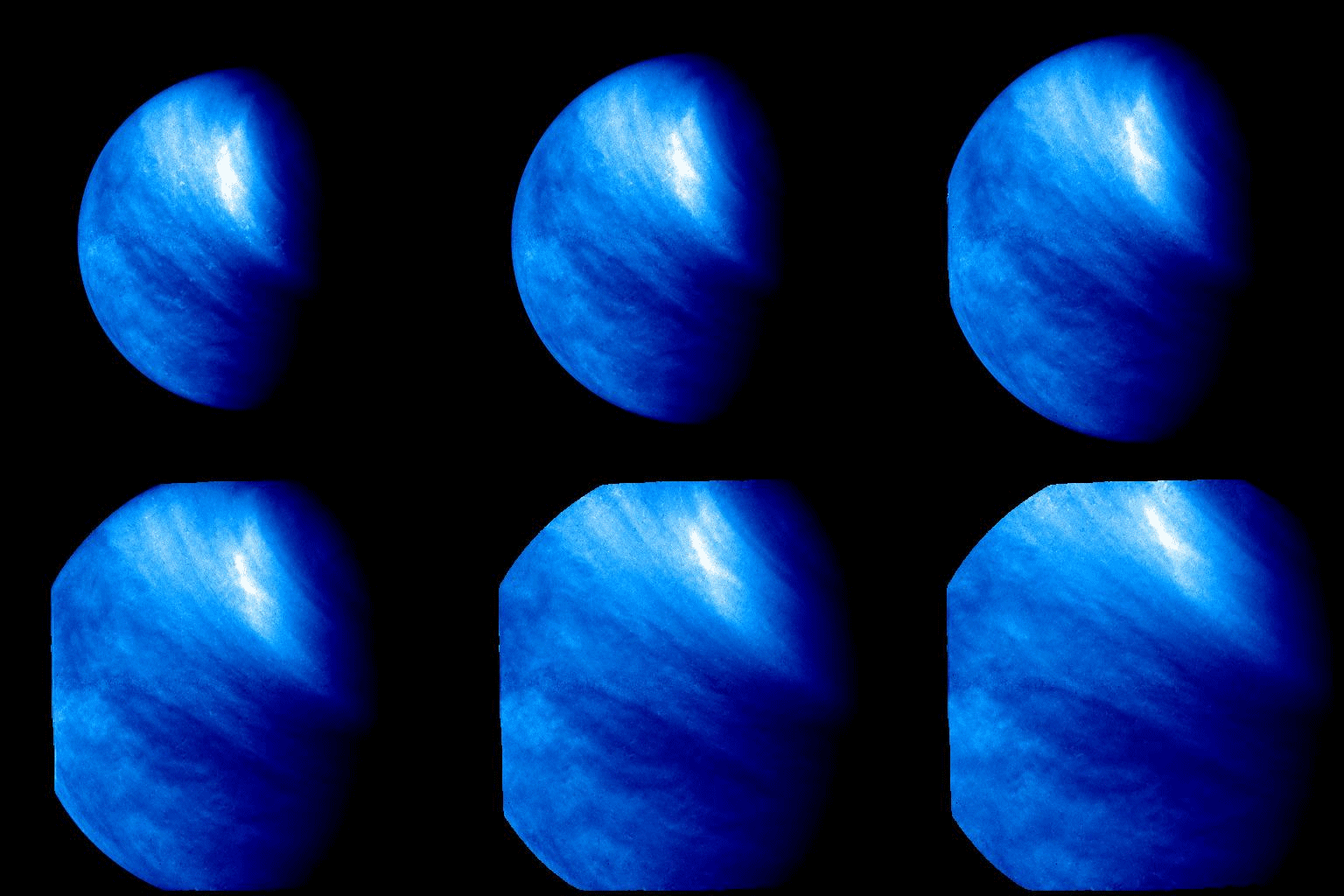
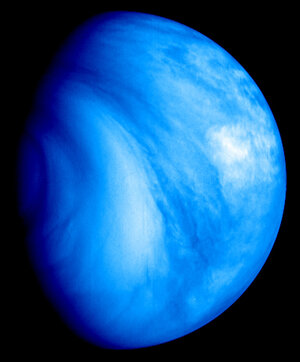
VMC is a wide-angle multi-channel camera able to image the planet at near-infrared, ultraviolet and visible wavelengths. It is providing global images of the planet, studying the cloud dynamics and imaging the surface. In addition, it is assisting in the identification of phenomena seen by other instruments. It is a new instrument.

Principal Investigator: Wojtek Markiewicz, MPI-Ae, Katlenburg-Lindau, Germany, leading a team of 13 co-investigators from ten other institutes.

Magnetometer (MAG)
Venus has no detectable internal magnetic field and the field around the planet is entirely due to the interaction between the solar wind and the atmosphere. MAG is studying this process and helping in understanding the effect this has on the atmosphere. It is a new instrument that reuses the sensor design from the Rosetta Lander.

Principal Investigator: Tielong Zhang, IWF, Graz, Austria, leading a team of 18 co-investigators from seven other institutes.

Venus Express’ High Resolution Infrared Fourier Spectrometer (PFS) has unfortunately never been operational, owing to a malfunction that could not be fixed by a series of attempts performed in space. The pointing mirror is stuck in its closed position, preventing the spectrometer (otherwise working perfectly) from seeing its targets. PFS was meant to measure the temperature of the atmosphere at altitudes of 55–100 km at a very high resolution, and to make composition measurements of the atmosphere. It was also meant to measure the surface temperature and thereby search for volcanic activity. Thanks to careful scientific planning and optimised use of the other instruments, several of the PFS’s scientific objectives are being achieved.

Principal Investigator: Vittorio Formisano, IFSI-CNR, Rome, Italy, leading a team of 41 co-investigators from 11 other institutes.
 
Operations
 
Ground control: : The Mission Operations Centre is located at the European Space Operations Centre (ESOC) in Darmstadt, Germany. Communications with the spacecraft take place via ESA ground stations around the world. Immediately after launch, the stations at Villafranca (Spain), New Norcia (Australia) and Kourou (French Guiana) were used. Ever since the spacecraft has been orbiting Venus, ESA’s ground station at Cebreros near Madrid, Spain, has been used as the main station, with occasional support from New Norcia for the VeRa experiment.

The Venus Express Science Operation Centre (VSOC) is in ESA’s ESAC centre in Villafranca, near Madrid, Spain. It is defining and coordinating the scientific observations and assisting the teams in operating their instruments.

ESA Mission Manager: Fred Jansen
ESA Project Scientist: Håkan Svedhem
ESA deputy Project Scientist: Olivier Witasse
ESA Spacecraft Operations Manager: Octavio Camino


Published by ESA Media Relations, Paris
tel: +33 1 5369 7299, fax: +33 1 5369 7690
email: media @ esa.int (Media inquiries only)

   Copyright 2000 - 2012 © European Space Agency. All rights reserved.