Cassini-Huygens view of Saturn
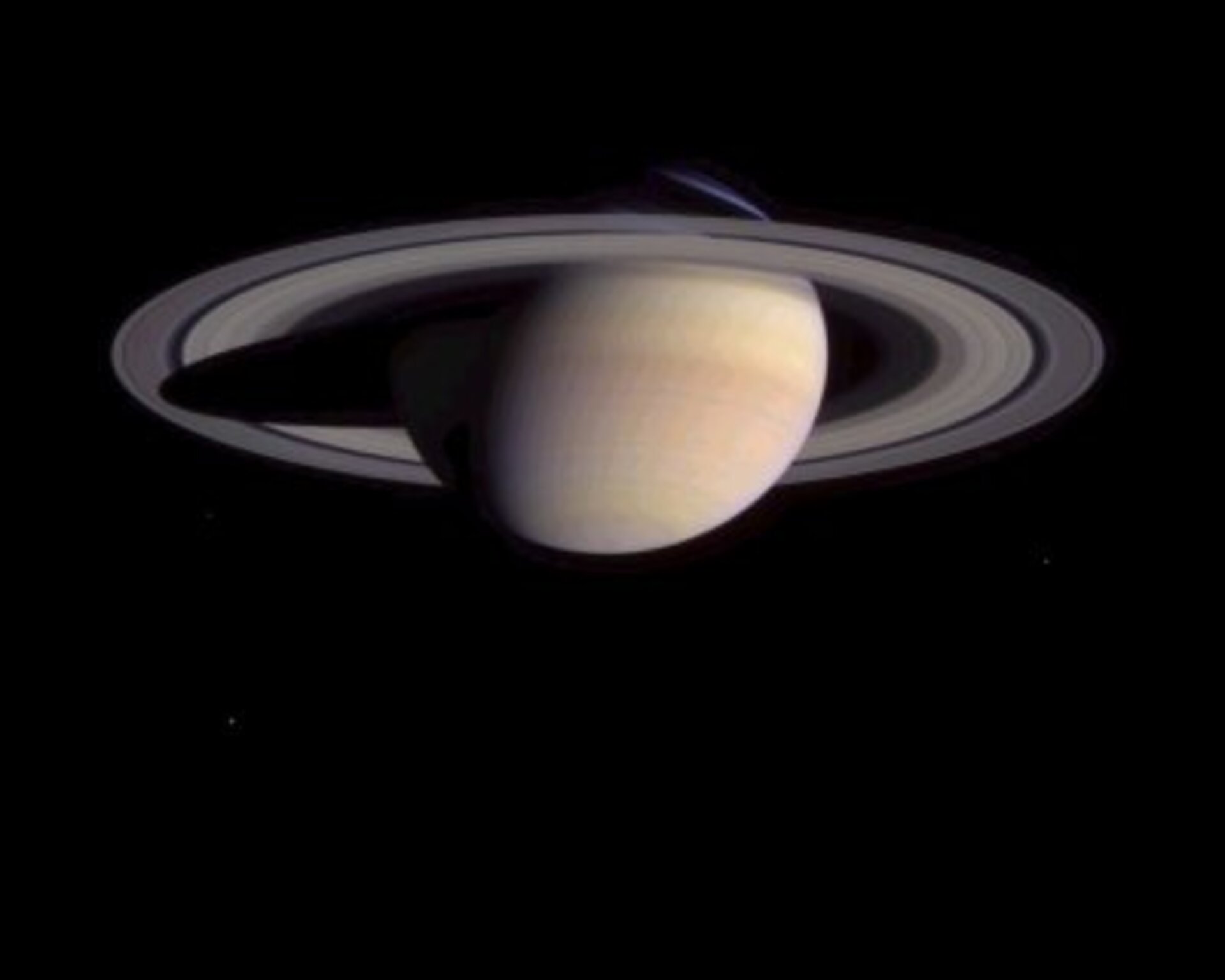
As the NASA/ESA Cassini-Huygens spacecraft closes in on Saturn, its view is growing sharper and now reveals new atmospheric features in the planet's southern hemisphere.
Two small, faint dark spots, visible in the southern hemisphere, will become clearer in the coming months. The spots are located at 38 degrees south latitude.
The spacecraft's narrow angle camera took several exposures on 8 March 2004, which have been combined to create this natural colour image. The image contrast and colours have been slightly enhanced to aid visibility.
There are three moons visible in the lower half of this image are: Mimas (398 kilometres across) on the left, just below the rings; Dione (1118 kilometres across) also on the left, below Mimas; and Enceladus (499 kilometres across) on the right. The moons appear extremely small on this image - they had their brightness enhanced to aid visibility.
The spacecraft was then 56.4 million kilometres from Saturn, or slightly more than one-third of the distance from Earth to the Sun. The image scale is approximately 338 kilometres per pixel.
The Cassini-Huygens mission is a co-operative project of NASA, ESA and the Italian Space Agency.