Cat's Eye Nebula (NGC 6543)
Cats may have nine lives, but this star only has one and here it is caught in its death throes, causing this ejection of glowing gases into outer space over a thousand years ago. NGC 6543 is 3000 light-years away in the northern constellation Draco.
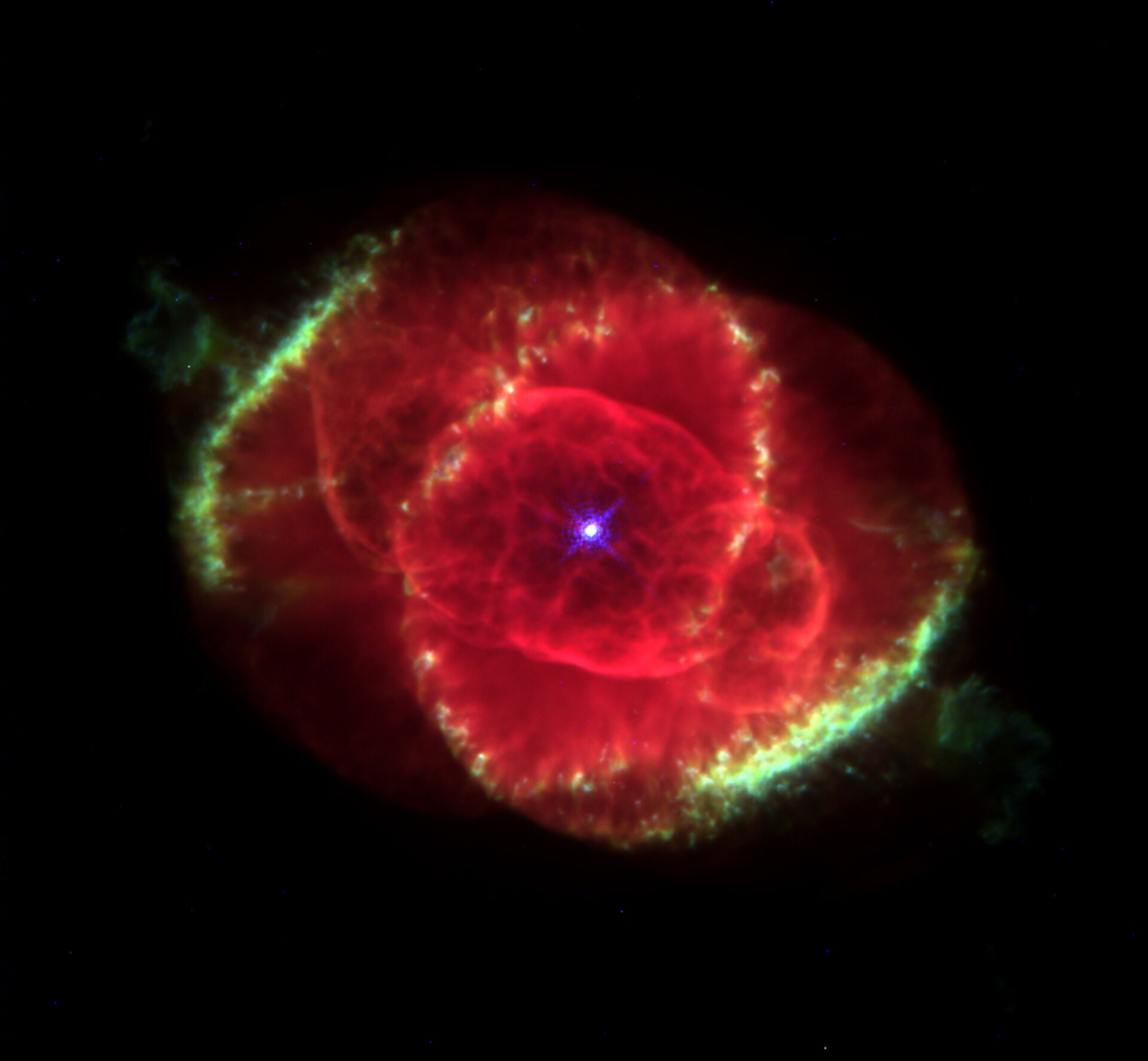
Taken by the Wide Field and Planetary Camera on board NASA/ESA's Hubble Space Telescope, this image shows one of the most complex planetary nebulae ever seen, NGC 6543, nicknamed the 'Cat's Eye Nebula'.
The term 'planetary nebula' is a misnomer; dying stars create these cocoons when they lose outer layers of gas. The process has nothing to do with planet formation, which is predicted to happen early in a star's life.
Here Hubble reveals surprisingly intricate structures including concentric gas shells, jets of high-speed gas and unusual shock-induced knots of gas. Estimated to be about one thousand years old, the nebula is a visual 'fossil record' of the dynamics and late evolution of a dying star.
A preliminary interpretation suggests that the star might be a double-star system. The suspected companion star also might be responsible for a pair of high-speed jets of gas that lie at right angles to this equatorial ring.