ESA selects prime contractor for Gaia astrometry mission
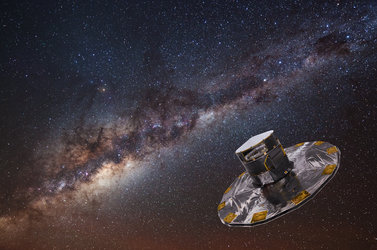
During a ceremony held in Toulouse on 11 May 2006, ESA officially awarded EADS Astrium the contract to develop and build the Gaia satellite. The goal of this space mission, currently planned for launch in 2011, is to make the largest, most precise map of our own Galaxy to date.
The contract, worth 317 million Euros, has been jointly signed by ESA’s Director of Science, Professor David Southwood, and Antoine Bouvier, Chief Executive Officer for EADS Astrium. The Toulouse branch will lead the Gaia development

“GAIA is our next grand challenge – to understand our galactic home, the Milky Way,” says David Southwood. “It is a great privilege to meet the team in EADS Astrium and to wish them well in working with us in this great project.”
Gaia will be the most accurate optical astronomy satellite ever built so far. It will continuously scan the sky for at least five years from a point in space known as the second Lagrangian point (or L2), located at about 1.6 million kilometres away from the Earth, in the direction opposite to the Sun. This position in space offers a very stable thermal environment, very high observing efficiency (since the Sun, Earth and Moon are behind the instrument field of view) and a low radiation environment.
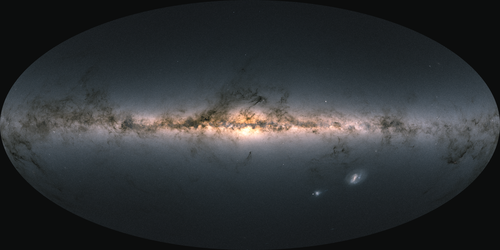
Gaia’s goal is to perform the largest census of our Galaxy and build a highly accurate 3D map. The satellite will determine the position, colour and true motion of one thousand million stars. Gaia will also identify as many as 10 000 planets around other stars, and discover several tens of thousands of new bodies - comets and asteroids - in our own Solar System.
The accuracy of Gaia measurements will be extremely high - if Gaia were on the Moon, it could measure the thumbnail of a person on Earth! The spacecraft will use the global astronomy concept successfully demonstrated on its predecessor – ESA’s mission Hipparcos, also built by EADS Astrium - which successfully mapped over 100,000 stars in the late 1980s.

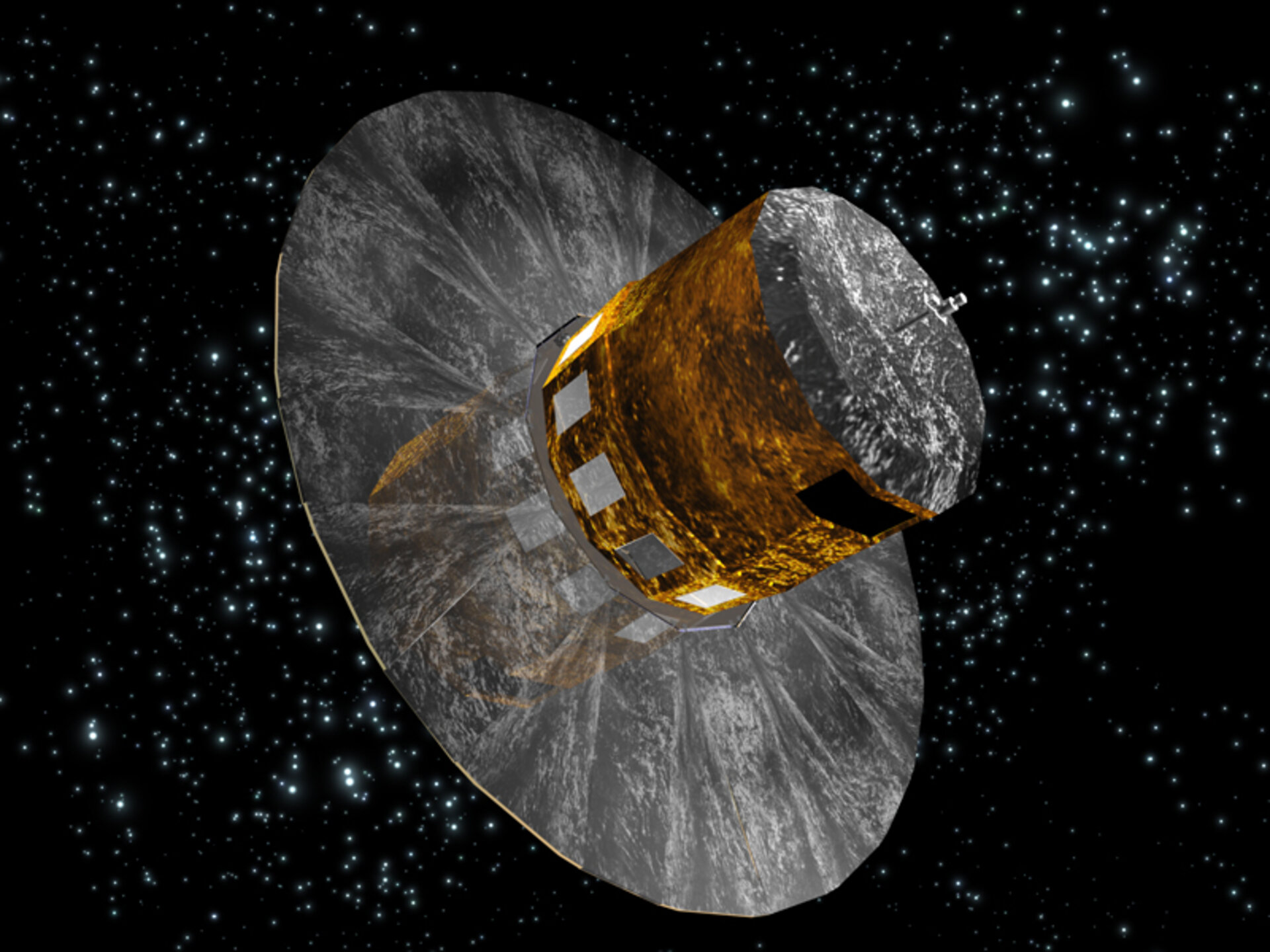
Gaia will be equipped with a latest-generation scientific payload, integrating the most sensitive telescope ever made. Its design is based on silicon carbide (SiC) technology, also used on Herschel, ESA’s next infrared mission. The focal plane is of impressive dimensions - about half a square metre - and features one thousand million pixels.
Gaia will also be equipped with two key components. The first one is a deployable sun-shield, covering an area of one hundred square metres, to minimise the temperature fluctuations on the highly sensitive optics. The second is a new micro-propulsion system, to be used to smoothly control the spacecraft in order not to disturb the optics during the sky scanning.
For more information
Rudolf Schmidt, ESA Gaia Project Manager
E-mail: 
Fred Jansen, ESA Gaia Project Scientist
E-mail: