


Chandrayaan-1 in a nutshell
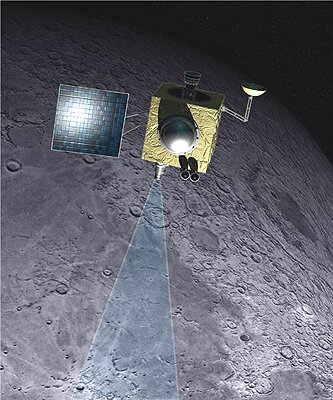
Chandrayaan-1 was the first Indian space agency (ISRO) probe to make it to the surface of the Moon. The mission analysed the composition and geology of the lunar surface.
Name: In Hindi ‘Chandra’ means Moon and ‘Yaan’ means ship; together creating the beautiful meaning ‘Journey to the Moon’.
Short description: Chandrayaan-1 carried a variety of instruments to study the lunar surface composition, carry out high-resolution remote sensing and produce a 3D map of the Moon. The mission also included the Moon Impact Probe that landed and investigated the lunar surface.
Launch: Chandrayaan-1 was launched on 22 October 2008 on a Polar Satellite Launch Vehicle (PSLV) from Sriharikota, India.

Journey: After launch, Chandrayaan-1 orbited Earth for 13 days, while five engine burns increased the ellipticity of its orbit. On 8 November, one final burn inserted the spacecraft into a lunar orbit. During the following four days, Chandrayaan-1 was brought closer to the lunar surface and into its final polar orbit around the Moon.
On 14 November, the Moon Impact Probe separated from the Chandrayaan orbiter and descended to the Moon’s south pole. This officially marked India as the fourth nation to reach the lunar surface.
Europe’s contribution: Europe supplied three instruments for the mission: the Chandrayaan Imaging X-ray Spectrometer (CIXS), the Sub-keV Atom Reflecting Analyser (SARA), and the Near-infrared spectrometer (SIR-2). ESA also contributed to the spacecraft operations, data handling and archiving.
Key mission results: Chandrayaan-1 most important findings were related to water and the Moon. Before this mission, the only hints of water on the Moon came from Apollo samples, where scientists discovered hydrogen particles preserved inside volcanic glass. This meant that the Moon did have water when it had active volcanoes long ago, but it does not inform us about the Moon today.
Chandrayaan-1 discovered traces of water molecules in sunlit areas of the Moon. An analysis of the full set of data from NASA’s Moon Mineralogy Mapper carried onboard Chandrayaan-1 revealed multiple locations of water ice in permanently shadowed regions.
End of mission: Ground stations made their final contact with Chandrayaan-1 on 28 August 2009, 310 days after it was launched. This brought an early end to the initially planned two-year mission. However, at that point Chandrayaan-1 had already completed 95% of its mission objectives and was considered a great success. The end of the mission was attributed to a problem with the power supply due to overheating.