ESAHome
   
Space Science
About Space ScienceESA's 'Cosmic Vision'Science & Technology in-depth
Multimedia
Science imagesScience videosAnimationsDownloadsSounds from space
Media centre
Press ReleasesPress kitsESA Television
Resources
Reference sectionGlossaryFAQs
Science missions
Services
HelpLegal disclaimerCommentsSubscribe
Follow us
RSS feedsESA Sci on Twitter


Bookmark and Share


Article Images
Press images - page 2
 
19 September 2007


Herschel’scooling system
Download:
 HI-RES JPEG (Size: 2330 kb)
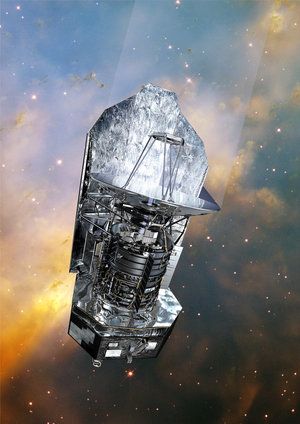
This is an artist's impression of Herschel’s superfluid helium tank.

To protect the sensitive instruments from heat generated during operations and to achieve its challenging objectives, the satellite must operate at very low temperatures. This is why the spacecraft’s brain – or its payload module – hosts a ‘cryostat’, a cryogenic module inside which the cold components of the scientific instruments are mounted.

Inside the cryostat, the sensitive instrument detectors are cooled down to about -273 ºC (0.3 degrees above absolute zero). This low temperature is achieved using superfluid helium (at about -271 ºC) and an additional cooling stage inside the focal plane units.

Inside the tank, helium is kept in its superfluid state at its boiling point (1.65 K or –271.5 °C). The helium liquid and gas cools the focal plane units of the instruments and the shields. The liquid boils and a porous plug allows the separation of the liquid from the gas such that only gas leaves the tank. It slowly flows from the tank into pipes around the payload to cool it to between 1.7 K (–271.4 °C), 4 K (–269 °C) and about 10 K (-263 °C).

The gas then continues into the rings of three thermal shields to cool them to 30K (–241°C), 50 K (–221°C) and 60 K (–211 °C), respectively.

Credits: ESA (Image by AOES Medialab)


Herschel’s cooling system
Download:
 HI-RES JPEG (Size: 2097 kb)
This is an artist's impression of Herschel’s superfluid helium tank.

To protect the sensitive instruments from heat generated during operations and to achieve its challenging objectives, the satellite must operate at very low temperatures. This is why the spacecraft’s brain – or its payload module – hosts a ‘cryostat’, a cryogenic module inside which the cold components of the scientific instruments are mounted.

Inside the cryostat, the sensitive instrument detectors are cooled down to about -273 ºC (0.3 degrees above absolute zero). This low temperature is achieved using superfluid helium (at about -271 ºC) and an additional cooling stage inside the focal plane units.

Inside the tank, helium is kept in its superfluid state at its boiling point (1.65 K or –271.5 °C). The helium liquid and gas cools the focal plane units of the instruments and the shields. The liquid boils and a porous plug allows the separation of the liquid from the gas such that only gas leaves the tank. It slowly flows from the tank into pipes around the payload to cool it to between 1.7 K (–271.4 °C), 4 K (–269 °C) and about 10 K (-263 °C).

Credits: ESA (Image by AOES Medialab)


Herschel’s cooling system
Download:
 HI-RES JPEG (Size: 1981 kb)
This is an artist's impression of Herschel’s superfluid helium tank.

To protect the sensitive instruments from heat generated during operations and to achieve its challenging objectives, the satellite must operate at very low temperatures. This is why the spacecraft’s brain – or its payload module – hosts a cryostat, a cryogenic module inside which the cold components of the scientific instruments are mounted.

Inside the cryostat, the sensitive instrument detectors are cooled down to about -273ºC (0.3 degrees above absolute zero). This low temperature is achieved using superfluid helium (at about -271ºC) and an additional cooling stage inside the focal plane units.

Inside the tank, helium is kept in its superfluid state at its boiling point (1.65 K or –271.5°C). The helium liquid and gas cools the focal plane units of the instruments and the shields. The liquid boils and a porous plug allows the separation of the liquid from the gas such that only gas leaves the tank. It slowly flows from the tank into pipes around the payload to cool it to between 1.7 K (–271.4°C), 4 K (–269°C) and about 10 K (-263°C).

The gas then continues into the rings of three thermal shields to cool them to 30K (–241°C), 50 K (–221°C) and 60 K (–211°C), respectively.

The gas is then finally released in space. The cryostat vacuum vessel is facing cold space and radiatively cools to about 70 K (–203°C).

Credits: ESA (Image by AOES Medialab)


Herschel's instruments
Download:
 HI-RES JPEG (Size: 1902 kb)
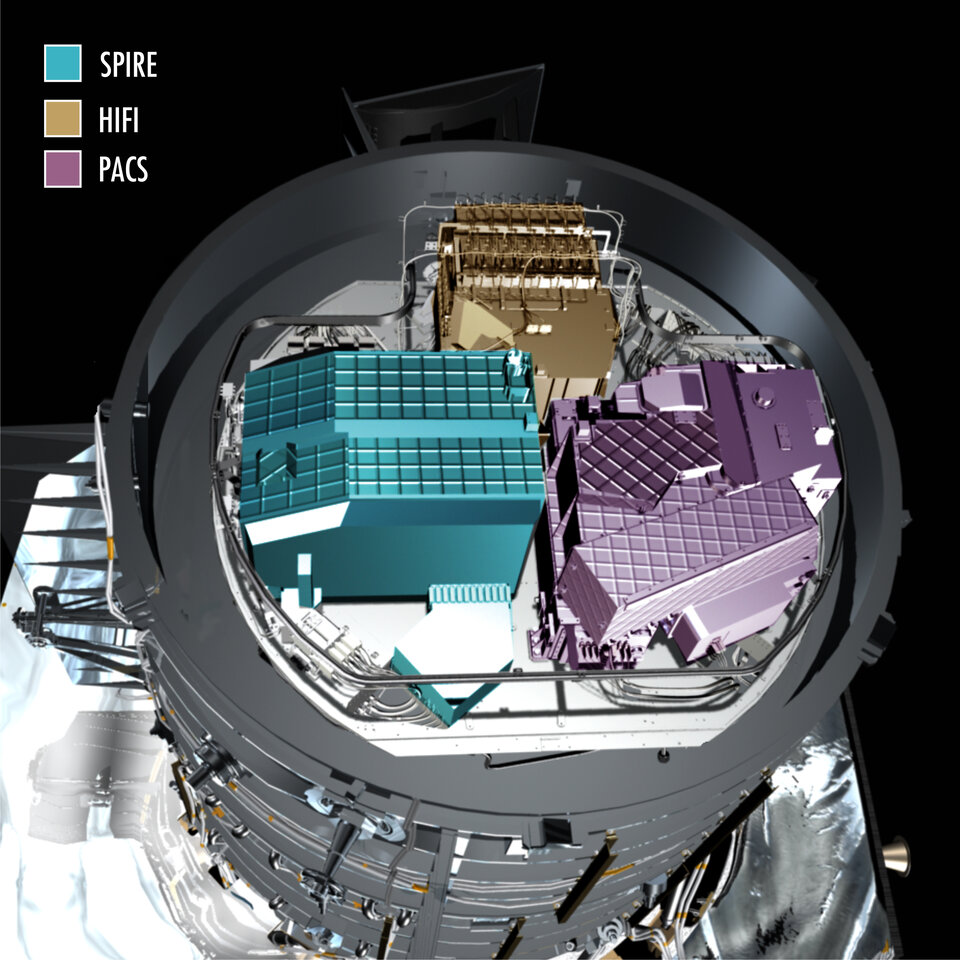
Three on-board instruments turn Herschel’s telescope from a mere light collector into a pair of hi-tech eyes. The instrument detectors form the retina, where the light from astronomical objects is really seen. The instruments then detect and analyse the light in many different ways.

This artist’s impression shows the top view of the Herschel focal plane, with the focal plane units (FPUs) of the three scientific instruments: HIFI (Heterodyne Instrument for the Far Infrared), a high-resolution spectrometer, developed under the coordination of the SRON Netherlands Institute for Space Research; PACS (Photoconductor Array Camera and Spectrometer), developed under the coordination of the MPE, Germany; SPIRE (Spectral and Photometric Imaging REceiver), a camera, developed under the coordination of the Cardiff University (UK).

The three focal plane units are mounted on top of the optical bench inside the cryostat vacuum vessel, the top of which has been removed in this view to reveal the focal plane.

Credits: ESA


Integrating the instruments
Download:
 HI-RES JPEG (Size: 4823 kb)
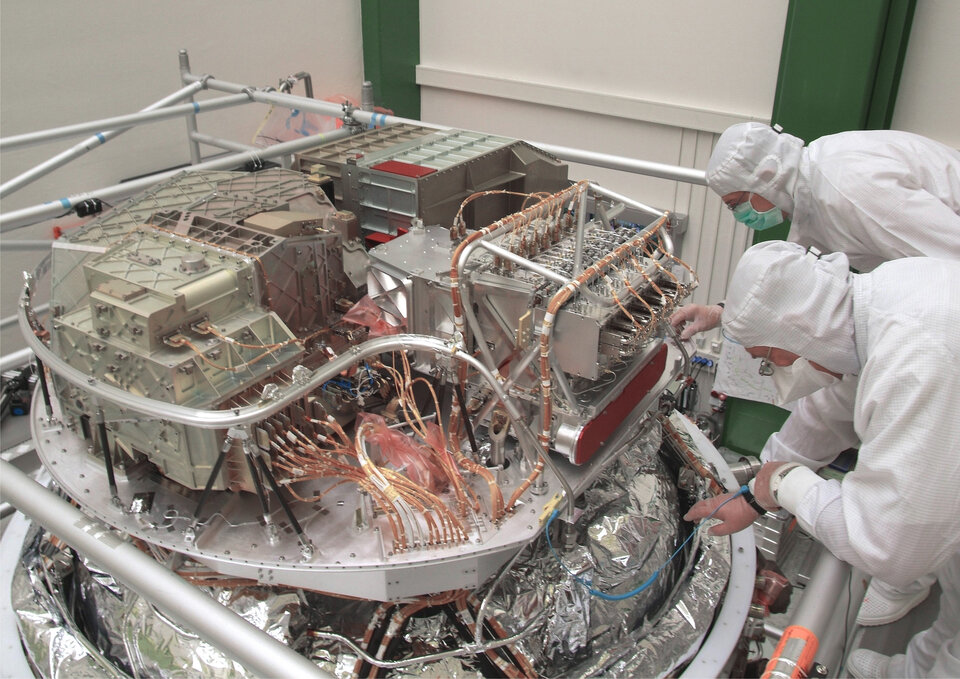
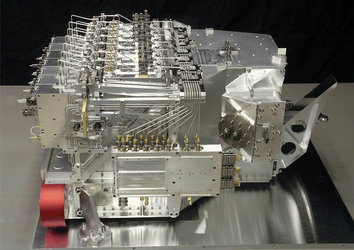
This picture was taken during the integration of the three focal plane units - HIFI (front-right), PACS (front-left) and SPIRE (back) - in July 2007 in the Astrium facility at Friedrichshafen.

Credits: Astrium
 
 
Herschel’s telescope
Download:
 HI-RES JPEG (Size: 2623 kb)
The Herschel telescope is a classic Cassegrain design with a 3.5-metre primary mirror and the secondary mirror. The manufacture, alignment and optical characterisation down to operational temperatures (70 K or -203 ºC) was completed in September 2006.

The telescope is now stored in the Astrium facilities in Toulouse waiting for integration to the Herschel satellite.

Credits: Astrium (P. Dumas)


Latest Herschel multimedia
ESA multimedia gallery
Related links
HerschelHerschel fact sheetISO overviewPlanck overview
For the media
‘Heart’ of Herschel to be presented to mediaHerschel media pagePress images - page 1Press images - page 3
Related articles
Herschel's heart and brain mated


   Copyright 2000 - 2012 © European Space Agency. All rights reserved.