

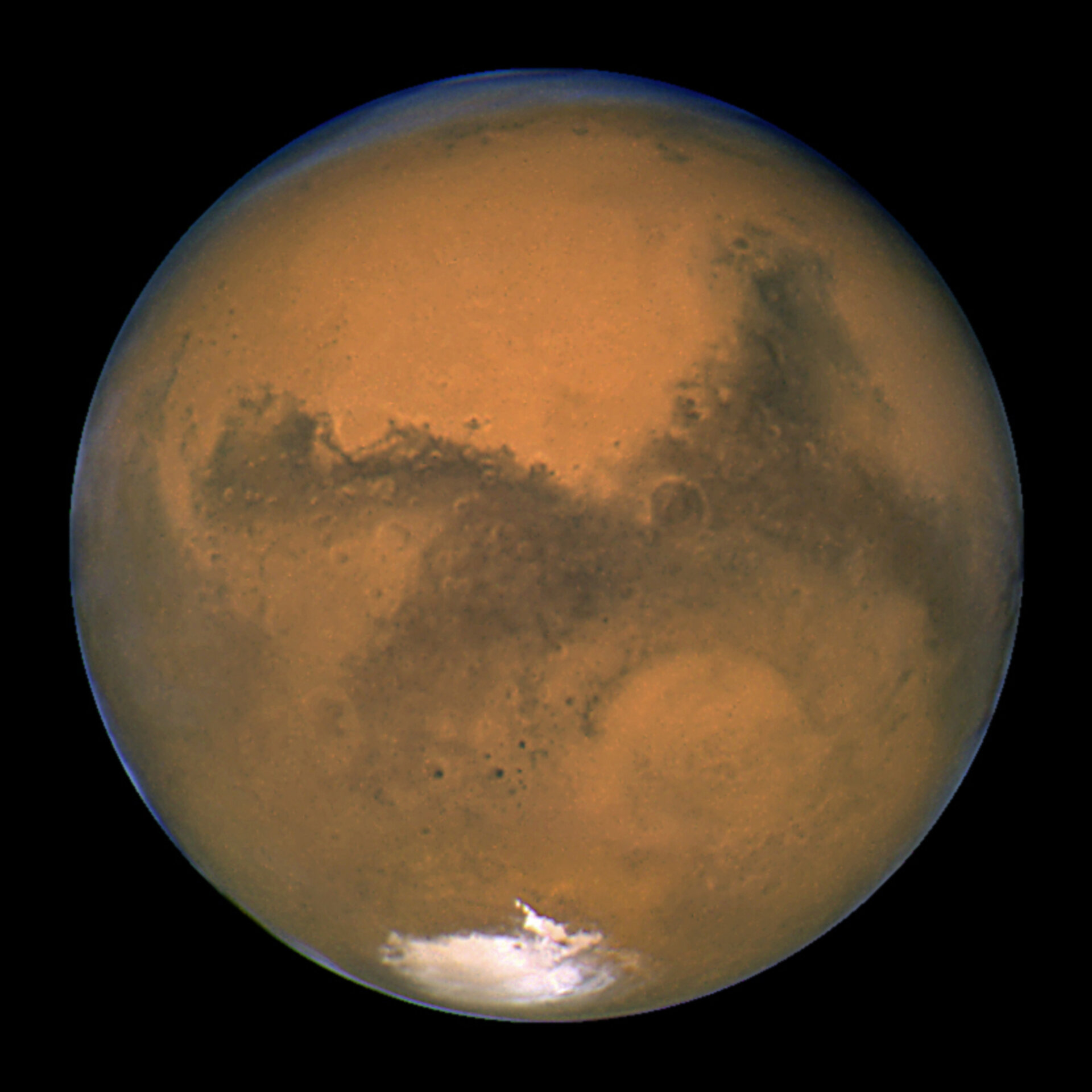
Latest view of Mars at closest approach
The NASA/ESA Hubble Space Telescope took this close-up view of the Red Planet Mars when it was just 55 760 220 kilometres away on 26 August 2003.
This colour picture was assembled from a series of images taken between 22:20 and 23:12 UT on 26 August 2003 with Hubble's Wide Field and Planetary Camera 2. The picture was taken just 11 hours before the planet made its closest approach to Earth in 60 000 years on 27 August 2003.
Many small dark circular impact craters can be seen, demonstrating Hubble's ability to reveal fine detail on the planet's surface. One of the most striking is the 450-kilometre diameter Huygens crater seen near the image centre.
The picture shows that it a relatively warm summer on Mars as evident in the lack of ice clouds at mid latitude, and the receding southern polar cap. Ice on the rugged topography gives a somewhat ragged, scalloped look. Up north, at the top of the globe where it is Martian winter, freezing clouds cover the northern polar cap.
Even in the relatively warm southern hemisphere, daytime high temperatures are only just above 0°C in the Hellas impact basin, the circular feature near the image center. Hellas is nearly 8 kilometres deep with a diameter of 1760 kilometres, Hellas was formed when an asteroid crashed into Mars millions of years ago.

