Watching solar activity muddle Earth’s magnetic field
Scientists have found that extreme solar activity drastically compresses the magnetosphere and modifies the composition of ions in near-Earth space. They are now looking to model how these changes affect orbiting satellites, including the GPS system.
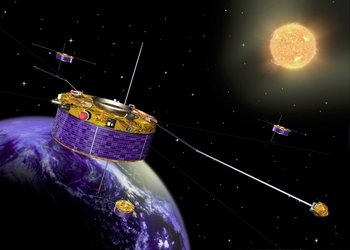
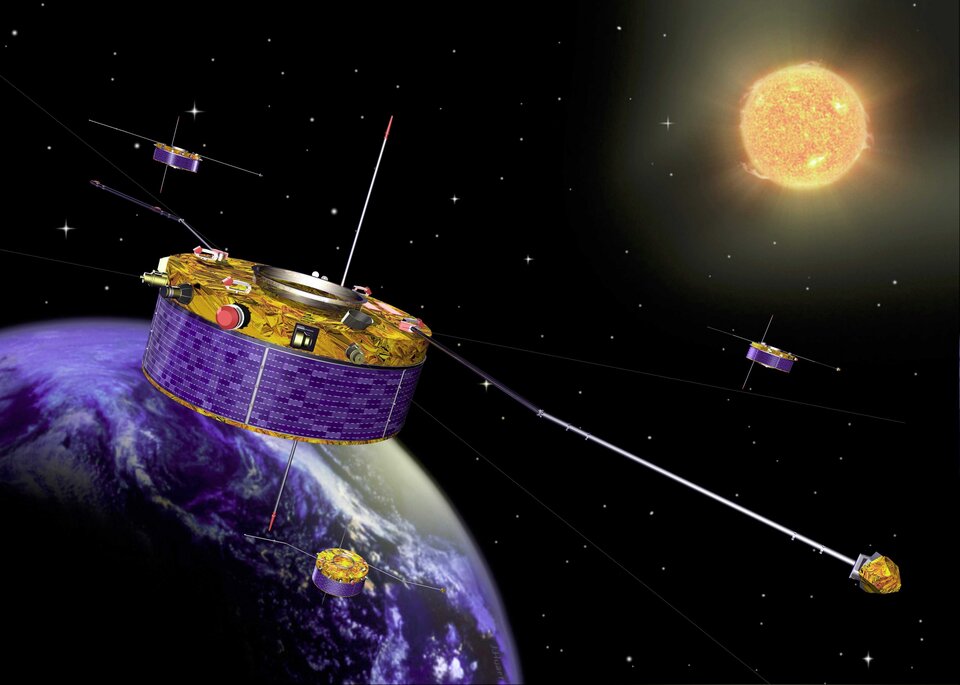
The results were obtained from coordinated in-situ measurements performed by ESA’s four Cluster satellites along with the two Chinese/ESA Double Star satellites.
Under normal solar conditions, GPS satellites orbit within the magnetosphere—the protective magnetic bubble carved out by Earth’s magnetic field. But when solar activity increases, the picture changes significantly: compressed and particles become energized, exposing satellites to higher doses of radiation that can perturb signal reception.
Looking at such a large-scale physical phenomena with a single satellite is akin to predicting the impact of a tsunami with a single buoy.
Such increased solar activity affects all satellites, not only the GPS system. This is why monitoring and forecasting its impact on near-Earth space is becoming increasingly critical to safeguarding daily life on Earth. One way to do this is by studying the physics of near-Earth space and observing the impact of such activity in time.
During two extreme solar explosions, or solar flares, on 21 January 2005 and 13 December 2006, the Cluster constellation and the two Double Star satellites were favourably positioned to observe the events at a large scale. The satellites carried out coordinated measurements of the response of the magnetosphere to these events.
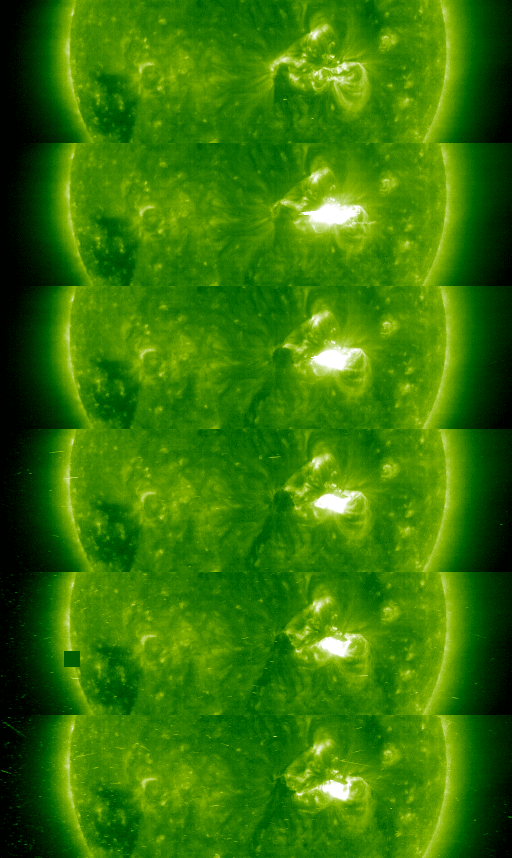
During both events, the velocity of positively charged particles in the solar wind was found to be higher than 900 km/s, more than twice their normal speed. In addition, the density of charged particles around Earth was recorded as five times higher than normal. The measurements taken in January 2005 also showed a drastic change in ion composition.
These factors together caused the magnetosphere to be compressed. Data show that the ‘nose’ of the dayside magnetopause (the outer boundary of the magnetosphere), usually located about
The second explosion in December 2006 released extremely powerful high-energy X-rays followed by a huge amount of mass from the solar atmosphere (called a coronal mass ejection). During the event, GPS signal reception on ground was lost.
Typical nose-like ion structures in near-Earth space were washed out as energetic particles were injected into the magnetosphere. These nose-like structures, that had formed earlier in the ‘ring current’ in the equatorial region near Earth, were detected simultaneously on opposite sides of Earth. Measurements of the ring current showed that its strength had increased.
About five hours after the coronal mass ejection hit Earth’s magnetosphere, a Double Star satellite observed penetrating solar energetic particles on the night side. These particles are hazardous to astronauts as well as satellites.

“With these detailed observations, we’ll be able to plug in data and better estimate what happens to the inner magnetosphere and near-Earth space during such explosions on the Sun”, said Iannis Dandouras, lead author of the results published recently, and Principal Investigator of the Cluster Ion Spectrometer.
“Looking at such a large-scale physical phenomena with a single satellite is akin to predicting the impact of a tsunami with a single buoy,” added Matt Taylor, ESA’s Project Scientist for Cluster and Double Star. “With Cluster and Double Star we have monitored both sides of Earth simultaneously, and obtained valuable in-situ data.”
Notes for editors:
These results appear in Dandouras, I.S., Rème, H., Cao, J. & Escoubet, P. (2009). Magnetosphere response to the 2005 and 2006 extreme solar events as observed by the Cluster and Double Star spacecraft. Advances in Space Research. Vol.43,618–623.
For more information:
Iannis Dandouras
CESR, Université de Toulouse/CNRS, Toulouse, France
Email: iannis.dandouras@cesr.fr
Arnaud Masson, ESA Deputy Cluster Project Scientist
Email: Arnaud.Masson@esa.int
Matt Taylor, ESA Cluster Project Scientist
Email: Matthew.Taylor@esa.int
Philippe Escoubet, ESA Cluster Mission Manager
Email: Philippe.Escoubet@esa.int