


What are solar flares?
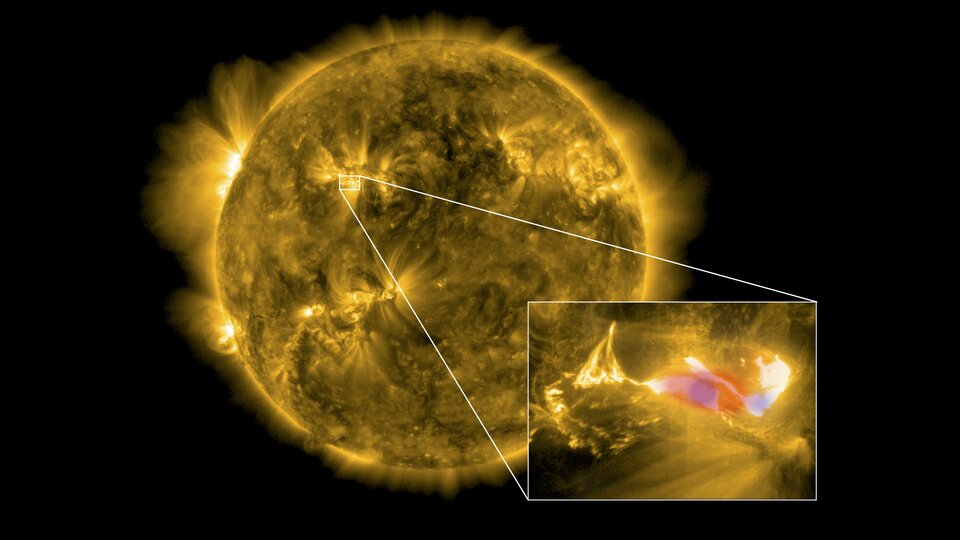
A solar flare is a tremendous explosion on the Sun that happens when energy stored in 'twisted' magnetic fields (usually above sunspots) is suddenly released.
In a matter of just a few minutes they heat material to many millions of degrees and produce a burst of radiation across the electromagnetic spectrum, from radio waves to X-rays and gamma rays.
Scientists classify solar flares according to their peak brightness in X-ray wavelengths. There are five categories, listed here in order from most intense to least intense:
X-class flares are the biggest; they are major events that can trigger radio blackouts around the whole world and long-lasting radiation storms in the upper atmosphere.
M-class flares are medium-sized; they generally cause brief radio blackouts that affect Earth's polar regions. Minor radiation storms sometimes follow an M-class flare.
C-class flares are small with few noticeable consequences here on Earth. At its peak, a C-class flare is ten times less powerful than an M-class flare.
B-class flares are ten times smaller or weaker than C-class flares.
A-class flares are at least ten times less intense than B-class flares, with no noticeable consequences on Earth.
To indicate the strength of a flare, the class letter is often followed by a number. The higher the number, the stronger the flare!
Flare, coronal mass ejection, or both?
While a flare is a burst of radiation, a 'coronal mass ejection' (CME) flings out large amounts of solar material in the form of huge bubbles of charged particles (plasma) threaded with magnetic field lines.
Although flares are sometimes accompanied by CMEs and other eruptive solar phenomena, they have also been seen to occur separately.


Access the video
This has important implications for understanding and predicting the effects of solar activity on the Earth and in space.
The electromagnetic radiation from solar flares directly affects the ionosphere (the upper, charged layer of Earth's atmosphere) and radio communications. High-energy radiation can also energise and ionise particles along the way.
Meanwhile, the energetic particles moved along by CMEs can damage electronic equipment and astronauts or passengers in high-flying aircraft.
Additionally, a CME can deform Earth's magnetic field, affecting the magnetic field direction (so you can't trust your compass anymore) and even inducing electrical currents in Earth itself. This is called a geomagnetic storm, which can cause electrical power outages and damage communications satellites.
To understand and predict space weather and the effect of solar activity on the Earth, we need to understand both CMEs and flares.