Saturn's auroral light show
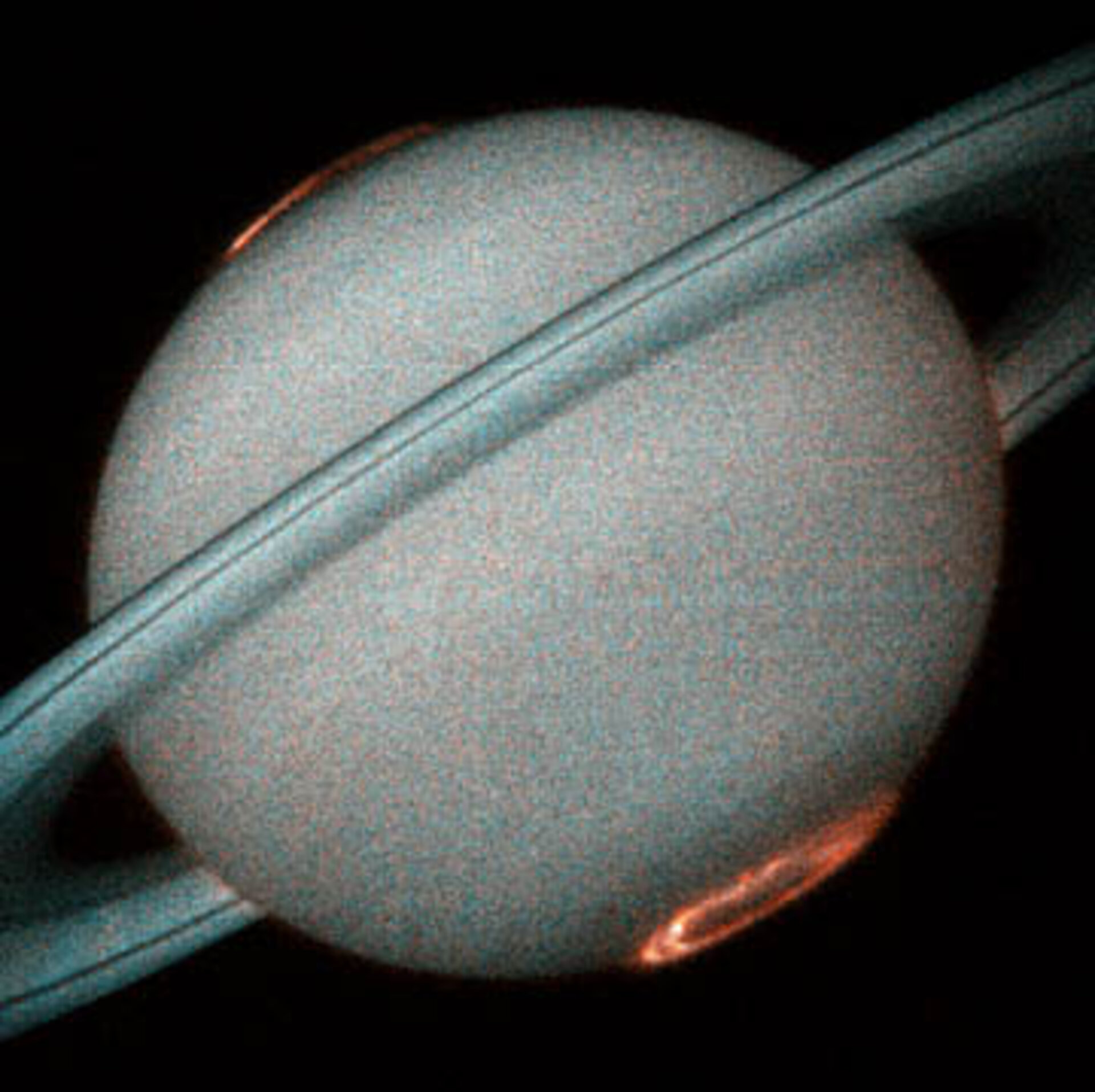
This is the first image of Saturn's ultraviolet aurorae taken by the NASA/ESA Hubble Space Telescope in October 1997, when Saturn was at a distance of 1300 million kilometres from Earth.
The southern aurora is seen at lower right, the northern at upper left. The picture was taken with the Space Telescope Imaging Spectrograph (STIS), which was being used as a camera and providing more than ten times the sensitivity of previous Hubble instruments in this ultraviolet range.
STIS images reveal detail never before seen in the spectacular auroral curtains of light that encircle Saturn's north and south poles and rise more than a thousand kilometres above the cloud tops.
Saturn's auroral displays are caused by the interactions of Saturn’s atmosphere and magnetic field with the ‘solar wind’, much like the Earth's aurorae that are occasionally seen in the night sky. But unlike the Earth, Saturn's aurorae only occur in ultraviolet light, invisible to us from Earth's surface, so they can only be observed from space.
The study of Saturn’s aurorae began just seventeen years ago. The Pioneer 11 spacecraft observed a far-ultraviolet brightening on Saturn's poles in 1979. The Saturn fly-bys of the Voyager 1 and 2 spacecraft in the early 1980s provided a basic description of the aurorae and mapped for the first time planet's enormous magnetic field that guides energetic electrons into the atmosphere near the north and south poles.
The first images of Saturn's aurorae were provided in 1994-5 by the Hubble Space Telescope using both ESA’s Faint Object Camera and Wide Field and Planetary Camera.
These Hubble aurora investigations provided a framework that will complement the in situ measurements of Saturn's magnetic field and charged particles by NASA/ESA's Cassini-Huygens spacecraft, now en route to its rendezvous with Saturn in July this year.
The Hubble Space Telescope will also be viewing Saturn's aurorae around the time of the Cassini-Huygens Saturn orbit insertion. This effort will be in conjunction with the Cassini-Huygens spacecraft's measurement of how the solar wind interacts with the Saturnian system. Credits: NASA/JPL