ESAHome
   
Space Science
About Space ScienceESA's 'Cosmic Vision'Science & Technology in-depth
Multimedia
Science imagesScience videosAnimationsDownloadsSounds from space
Media centre
Press ReleasesPress kitsESA Television
Resources
Reference sectionGlossaryFAQs
Science missions
Services
HelpLegal disclaimerCommentsSubscribe
Follow us
RSS feedsESA Sci on Twitter


Bookmark and Share


Article Images
Press images - page 3
 
19 September 2007


HIFI
Download:
 HI-RES JPEG (Size: 4111 kb)
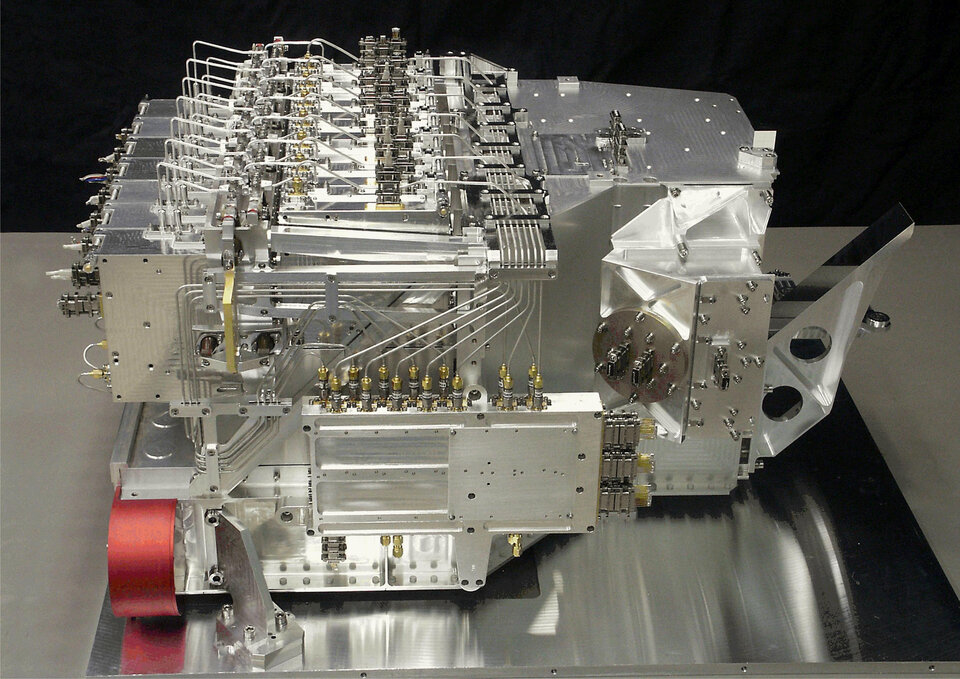
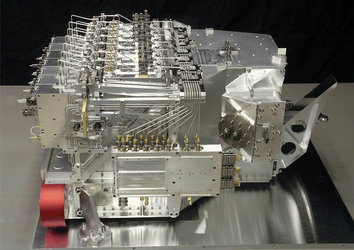
This is a picture of the Heterodyne Instrument for the Far Infrared's (HIFI) focal plane unit.

HIFI is a very high-resolution heterodyne spectrometer. The heterodyne detection principle involves translating the frequency range of the signal observed by the telescope to a lower frequency where it is easier to perform the required measurements.

This is done by mixing the incoming signal with a very stable monochromatic signal, generated by a local oscillator, and extracting the difference frequency for further processing. HIFI observes in seven bands covering 480 to 1910 gigaHertz.

The scientific observations from HIFI will among other objectives help astronomers understand the interrelation between stars and the interstellar medium.

It was developed by a consortium led by SRON Netherlands Institute for Space Science.

Credits: SRON Netherlands Institute for Space Research


HIFI instrument
Download:
 HI-RES JPG (Size: 2353 kb)
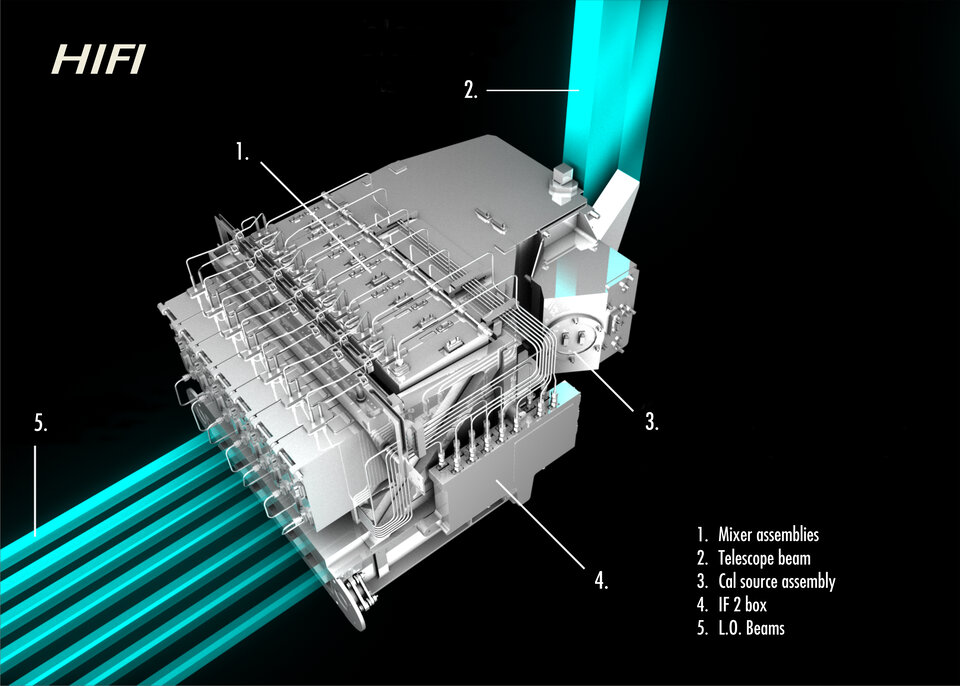
This is an artist's impression of the Heterodyne Instrument for the Far Infrared's (HIFI) focal plane unit.

HIFI is a very high-resolution heterodyne spectrometer. The heterodyne detection principle involves translating the frequency range of the signal observed by the telescope to a lower frequency where it is easier to perform the required measurements.

This is done by mixing the incoming signal with a very stable monochromatic signal, generated by a local oscillator, and extracting the difference frequency for further processing.

HIFI observes in seven bands covering 480 to 1910 gigaHertz.

It was developed by a consortium led by SRON Netherlands Institute for Space Science.

Credits: ESA


PACS instrument
Download:
 HI-RES JPEG (Size: 2510 kb)
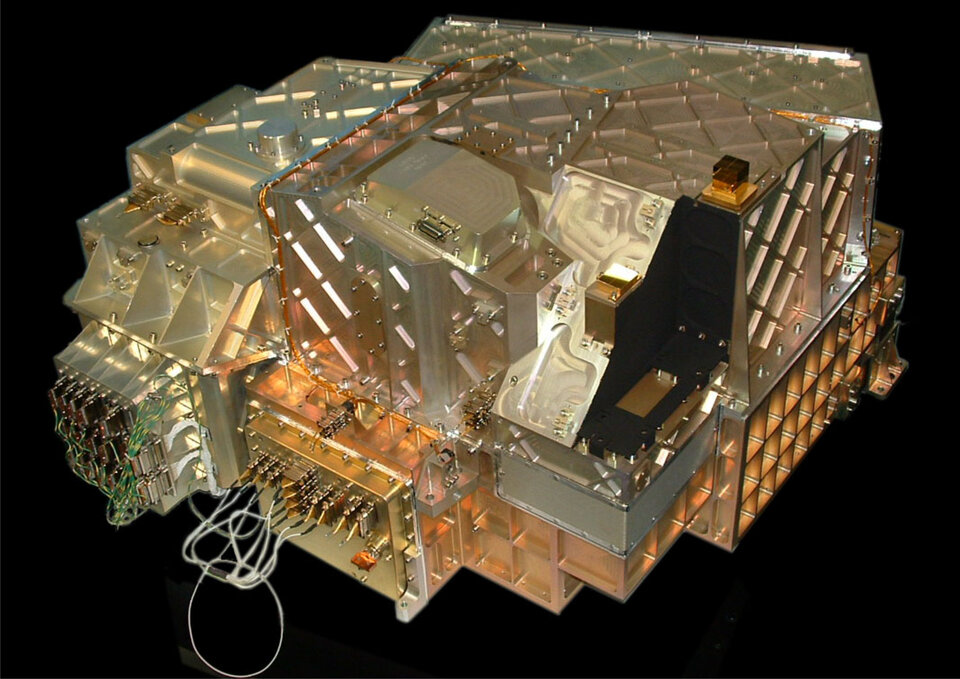
The Photoconductor Array Camera and Spectrometer (PACS) contains a camera and low to medium resolution spectrometer. It operates at wavelengths between 55 and 210 micrometres.

The opening of this infrared window by PACS to sensitive photometry and spectroscopy at high spatial resolution will address a wide range of key questions of current astrophysics concerning the origins of stars, planetary systems, galaxies, and the evolution of the Universe.

Credits: Max-Planck-Institut für extraterrestrische Physik


Artist’s impression of PACS
Download:
 HI-RES JPG (Size: 2136 kb)
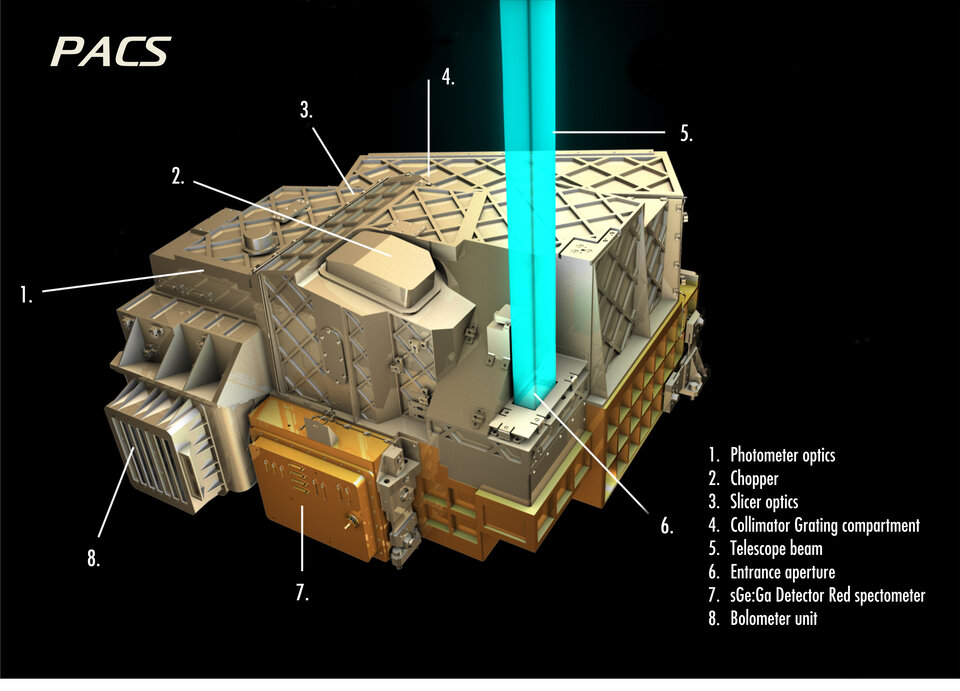
The Photoconductor Array Camera and Spectrometer (PACS) contains a camera and low to medium resolution spectrometer. It operates at wavelengths between 55 and 210 micrometres.

The opening of this infrared window by PACS to sensitive photometry and spectroscopy at high spatial resolution will address a wide range of key questions of current astrophysics concerning the origins of stars, planetary systems, galaxies, and the evolution of the Universe.

PACS contains four detector arrays, two bolometer arrays and two Germanium:Gallium photoconductor arrays. The bolometer arrays are dedicated for wideband photometry, while the photoconductor arrays are to be employed exclusively for medium-resolution spectroscopy. PACS can be operated either as an imaging photometer, or as an integral field line spectrometer.

It was developed by a consortium led by Max-Planck-Institut für extraterrestrische Physik, Germany.

Credits: ESA


SPIRE focal plane unit
Download:
 HI-RES JPG (Size: 7212 kb)
The SPIRE focal plane unit before final delivery to ESA in the cleanroom at the Rutherford Appleton Laboratory, Chilton, Didcot, UK. The instrument is approximately 700 x 400 x 400 mm in size.

Credits: SPIRE Consortium
 
 
Artist’s impression of SPIRE
Download:
 HI-RES JPG (Size: 1711 kb)
The Spectral and Photometric Imaging Receiver (SPIRE) comprises a three-band imaging photometer and an imaging Fourier transform spectrometer. The instrument will be used to undertake large area deep sky photometric imaging surveys and allow follow-up spectroscopic observations of selected sources.

These observations will help tackle two of the most fundamental questions in astronomy: how and when did galaxies form and how do stars form?

The three-band imaging photometer is centred at 250, 350 and 500 micrometres, and an imaging Fourier Transform Spectrometer (FTS) covering 200-670 micrometres. The detectors are arrays of feedhorn-coupled NTD spider-web bolometers cooled to 0.3 K. SPIRE was developed by a consortium led by Cardiff University (UK).

Credits: ESA


solar array and sunshade
Download:
 HI-RES JPEG (Size: 4461 kb)
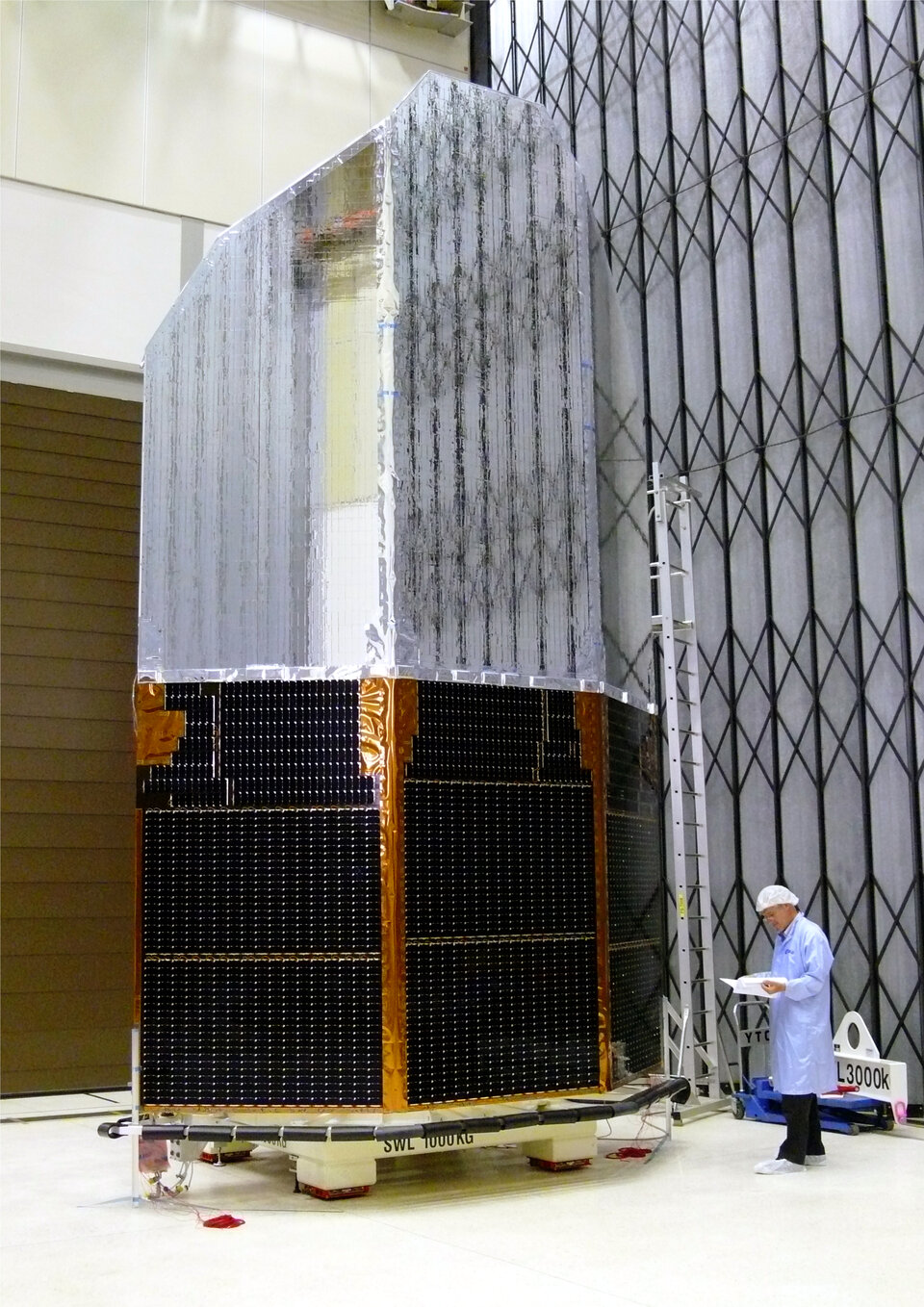
Herschel's solar array and sunshade are currently undergoing final assembly and testing at the ESTEC Test Centre in Noordwijk, the Netherlands.

They will be fitted to the spacecraft later this year. The solar array operates at 140 °C and is powered by high-efficiency gallium arsenide (GaAs) triple-junction solar cells. The cells will provide 1900 Watts of electrical power to the spacecraft. The solar array also shields the scientific instruments from the Sun, since their operating temperature is extremely low, close to Absolute Zero, or -273 °C.

The solar cells are provided by RWE in Germany and electrical integration was performed by Galileo Avionica of Italy. The CFRP (carbon fibre reinforced plastic) panels are manufactured by ATK/COI of the USA. The main contractor for the solar array and sunshade is Dutch Space, based in the Netherlands.

Credits: ESA


Herschel and Planck launch configuration
Download:
 HI-RES JPEG (Size: 1283 kb)
Herschel will launch on an Ariane rocket from the Europe's Spaceport in Kourou, French Guiana in Spring 2009. It will shared the launch with ESA's Planck microwave observatory. The two vehicles will separate shortly after launch and proceed independently to different orbits around the second Lagrange point of the Sun-Earth system (L2). The launcher will burn its solid boosters for just under 2.5 minutes and its main and upper stage engines for about 25 minutes setting Herschel and then Planck on the path to L2.

Credits: ESA - Guarniero
 
 
Latest Herschel multimedia
ESA multimedia gallery
Related links
HerschelHerschel fact sheetISO overviewPlanck overview
For the media
‘Heart’ of Herschel to be presented to mediaHerschel media pagePress images - page 1Press images - page 2
Related articles
Herschel's heart and brain mated


   Copyright 2000 - 2012 © European Space Agency. All rights reserved.