Making light work of the dark
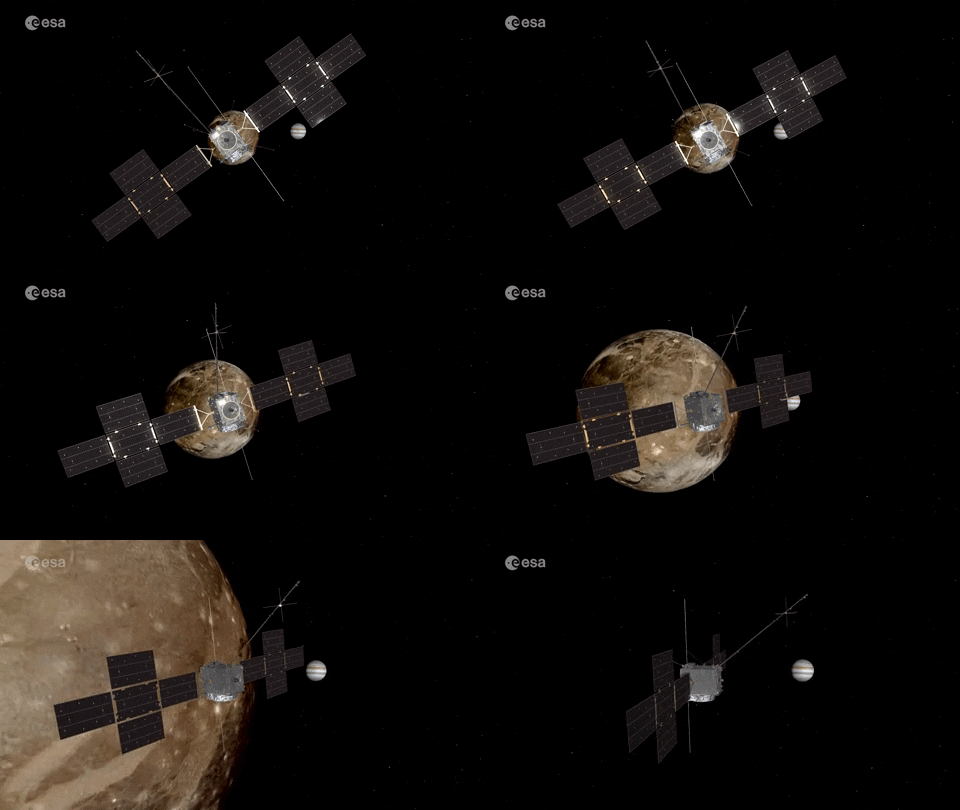
The start of eclipse season for Mars Express. This animation shows the unavoidable passages of the spacecraft through the shadow of Mars, which cut off the sunlight from the orbiter’s solar arrays, used to provide electrical power.
This creates a nervous time for engineers at the European Space Operations Centre (ESOC) in Darmstadt, Germany. Mars Express, however, is making light of this challenging part of the mission.
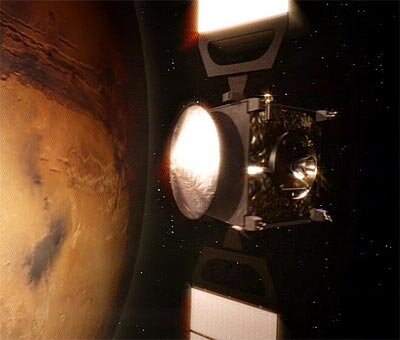
Mars Express orbits the Red Planet in a fixed direction that never changes. As Mars follows its own orbit around the Sun, there are times when Mars Express will be forced into the planet’s shadow. When this happens, the spacecraft must rely on battery power alone to keep it alive.
“So far things are going very well,” says John Reddy of ESA’s Mars Express project team. It is viewpoint shared by Rudolf Schmidt, Mars Express Project Manager. He says, “We have a graph predicting what will happen and, so far, the spacecraft has returned data that match our calculations.”
Mars Express completes one orbit of Mars every 7.5 hours. On 12 February 2004, the spacecraft experienced its first expected eclipse. That one lasted for only a few minutes but, as the days go by, the periods of darkness will rise to a full hour and a half early in March. After this, although the duration of the eclipses will slowly decrease, they will continue for about 150 days.
Away from sunlight, the spacecraft gets very cold and so it must be heated, draining the power reserves. When the spacecraft re-emerges, controllers on Earth must align it to recharge the batteries, otherwise all power could be lost during the next eclipse and critical damage could occur.
Everything must be meticulously planned in advance and the spacecraft carefully programmed with the necessary manoeuvres.
ESOC is in contact with Mars Express for just eight hours every day and so everything must be meticulously planned in advance and the spacecraft carefully programmed with the necessary manoeuvres.
And what of science during this testing time? At first, it was placed on hold so that the health of the spacecraft could be paramount. Now, with added confidence, science operations are beginning to be performed again. “It is our intention to perform as much safe science as we can during this period,” says Reddy.
Although Mars Express will experience other eclipse seasons during its mission, they are not likely to be as trying as this one.