Close encounters with Mars
On 27 August 2003, Mars is less than 56 million kilometres away - approaching closer to our planet than it has done in over 60 000 years.
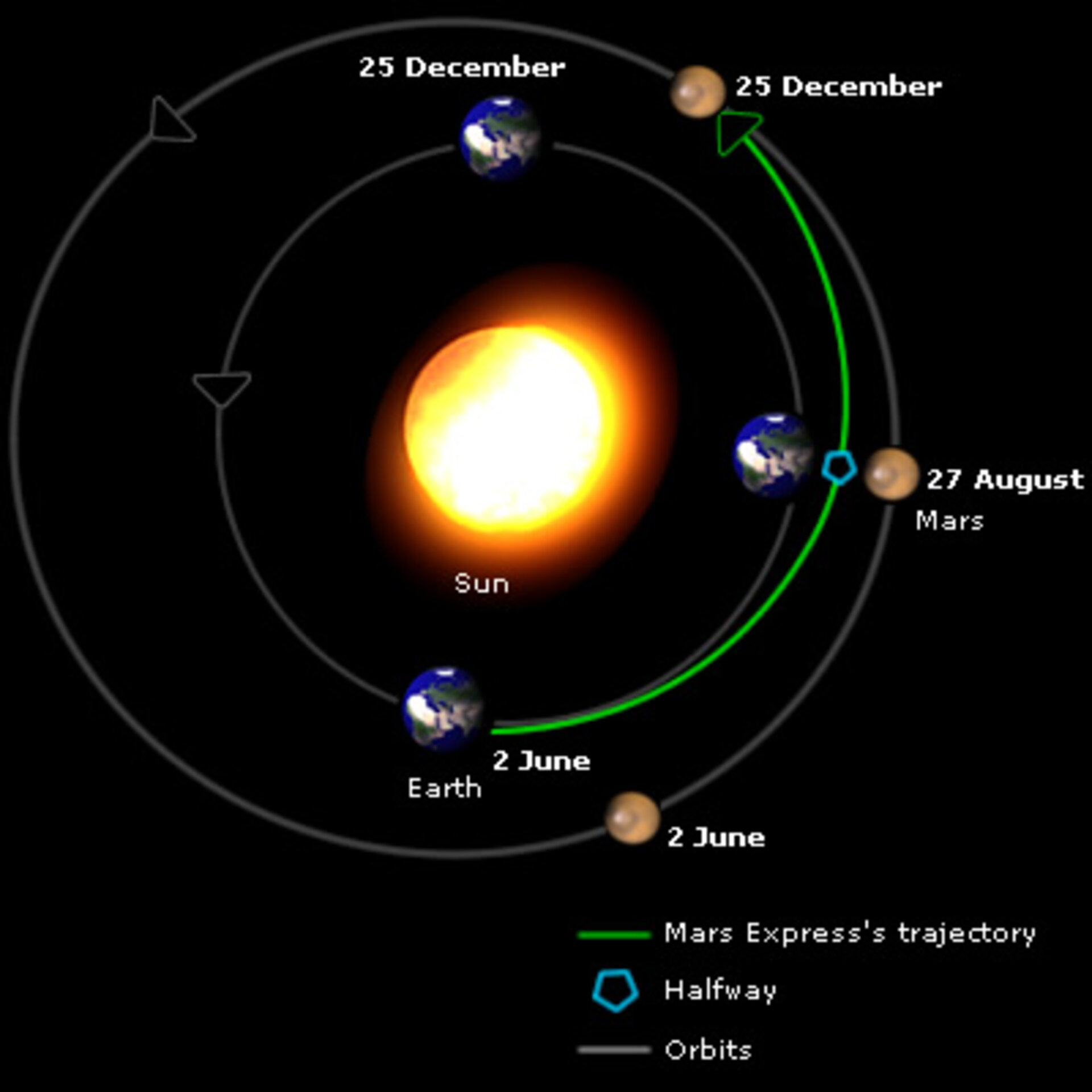
About the same time as this closest approach, Mars Express passes the halfway mark of its journey, in terms of distance along its trajectory. On 1 September 2003, as it hurtles through space at 10 800 kilometres per hour, the spacecraft will have covered over 242 million kilometres, half of the total of 485 million kilometres needed to arrive at Mars. Note that the distance travelled is not the same as the distance between the Earth and Mars.
At first glance, you might think that this time would be better than three months ago to launch a spacecraft to Mars, given the advantage of a shorter route. However, planning interplanetary journeys is more complicated than just taking account of the distances.
Playing catch up

This is because the planets are also moving in their respective orbits. If you want your spacecraft to rendezvous with another object in space, you must carefully time its launch so that the orbits overlap at some point in the future.
Imagine the Solar System as an athletics racetrack. If you were watching a 400-metres race from the centre of the track and wanted to intercept one of the runners taking part, you could simply chase the runner you want to catch. If you are fast enough, you might eventually catch up but only after using a lot of energy and travelling a long way.
A much better way to catch your athlete is simply to walk across the centre to the other side of the circular track. It is a much shorter distance and you use a lot less energy and time getting there. You calculate your walk so that you arrive at the other side of the track at the same time as they do. Too early and you are waiting for them. Too late and you have missed them completely - you would have to wait one lap until they came around again.
In spaceflight, straight-line paths do not exist for the same reason. All planets move in long, curved paths around the Sun in either circular or elliptical orbits. To reach Mars, the Mars Express probe is now on a trajectory, an arc-shaped path, which gradually makes its way outwards to intersect the orbit of Mars about six months after launch.
It is no coincidence then that the fleet of spaceprobes now travelling to Mars was launched within weeks of each other in 2003. Even with the relatively close positions of the planets, which would cut journey times, scientists still needed to calculate the shortest trajectory between the orbits of Earth and Mars. It makes sense that this occurs around the time of closest approach. Once the shortest path has been established, you can then work back to get the actual launch dates.
All in a row
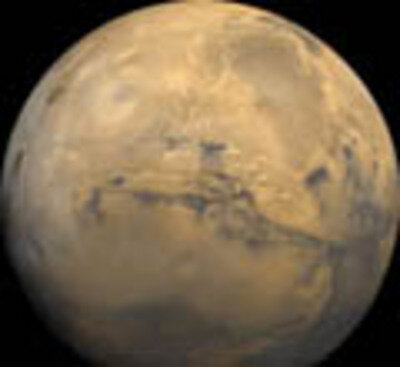
Though Mars will be closest to Earth on 27 August 2003, 'opposition' comes on 28 August 2003. Astronomers call the moment when the Sun, Earth, and Mars form a straight line opposition. Since we are closer to the Sun than Mars, this is also when we are overtaking Mars in our respective orbits.
At a distance of exactly 55 758 006 kilometres from Earth, the Red Planet will be brighter than Jupiter and all the stars in the night sky, outshone only by Venus and the Moon. You will not see anything gigantic in the sky, but you will be able to see Mars's distinctive red-orange colour. Amateur astronomers with good-sized telescopes will be able to see some of the planet's features, such as the polar ice cap, dark surface features, and perhaps even storm clouds.
Interesting as this closest approach is, professional astronomers will be looking forward to even better things. Probes that orbit the planet have studied Mars and some spacecraft have even landed on it. Later this year, our knowledge will increase dramatically when the flotilla of spacecraft, including Europe's Mars Express, approaches the Red Planet.
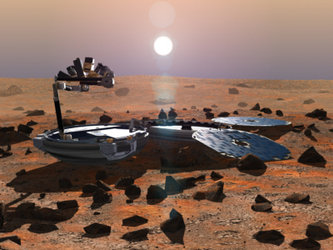
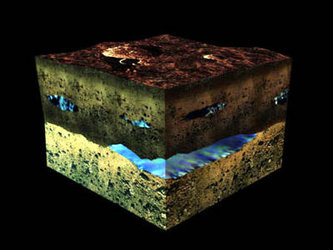
Mars Express will help to answer the questions of whether there has been water, and possibly life, on Mars. It will be mapping the Martian subsurface, surface, atmosphere, and ionosphere from orbit and by conducting observations and experiments on the surface.