Planck fact sheet
ESA's microwave observatory
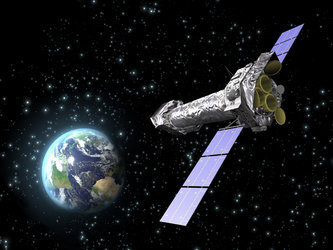
Named after the German Nobel laureate Max Planck (1858-1947), ESA's Planck mission will be the first European space observatory whose main goal is the study of the Cosmic Microwave Background – the relic radiation from the Big Bang.
Observing at microwave wavelengths, ESA's Planck observatory is the third space mission of its kind. It will measure tiny fluctuations in the CMB with unprecedented accuracy, providing the sharpest picture ever of the young Universe — when it was only 380 000 years old — and zeroing-in on theories that describe its birth and evolution.
Planck will measure the fluctuations of the CMB with an accuracy set by fundamental astrophysical limits.
The spacecraft is equipped with a powerful telescope and two instruments operating at radio to sub-millimetre wavelengths. A sophisticated cryogenic system keeps their detectors at temperatures close to absolute zero.
Launch: 14 May 2009 on board an Ariane 5 from ESA's Spaceport in Kourou, French Guiana. The launch window opens at 15:34:32 CEST. Planck will be launched along with Herschel, ESA's microwave observatory which will study the Cosmic Microwave Background.
Status: In operation.
Journey: Planck will be launched with ESA's Herschel infrared observatory. Herschel will separate from the upper stage of the launcher 26 minutes after launch and Planck will follow 2.5 minutes later. The two spacecraft will operate independently. The upper stage will set the spacecraft onto a trajectory that will eventually lead to orbits around the second Lagrangian point (L2), situated about 1.5 million km from Earth in the direction opposite to the Sun.
Orbit: Planck will operate from a Lissajous orbit around L2, the second Lagrangian point of the Sun-Earth system, with an amplitude of
Telescope and instruments: Planck will carry a 1.9x1.5-m telescope, with an effective aperture of 1.5 m. It will focus radiation from the sky onto two arrays of sensitive radio detectors, those of the Low Frequency Instrument and those of the High Frequency Instrument. Together they will measure the temperature of the CMB over the sky, searching for regions very slightly warmer or colder than the average.
Wavelength coverage: Nine bands, from one centimetre to one third of a millimetre, corresponding to a range of wavelengths from microwaves to the very-far-infrared.
Launch mass: About 1.9 tonnes.
Dimensions: Approximately 4.2 m high and 4.2 m wide.
Ground station:ESA's deep space antenna in New Norcia.
Planned lifetime: Routine observations are planned to last 15 months (enough to survey the whole sky twice over); a mission extension of about one year is possible.