Observing the Universe in X-ray light
The atmosphere prevents us from seeing X-rays from space with telescopes on Earth. Yet, some cosmic objects can only be studied in X-ray light. During the past century new ways were found to lift detectors outside our atmosphere and discover the high-energy Universe.
Overcoming the atmosphere
Earth’s atmosphere fortunately protects us from dangerous X-rays coming from space. The flipside of this is that we must go to space if we want to study cosmic objects in X-ray light.
The first X-rays detected in space came from the Sun and were discovered in 1949 by a detector on a V-2 rocket. 13 years later, in 1962, the first non-solar source of X-rays, Scorpius X-1, was discovered on an Aerobee rocket.
Both rockets were research rockets and offered a limited duration of observations. The years following, X-ray astronomy relied on balloons for observations, taking X-ray detectors up to almost 50 km from Earth’s surface and offering longer exposures.
In the early 1970s, the first dedicated X-ray satellites were launched. Since then, dozens of satellites have been launched by various countries and the domain of X-ray astronomy is flourishing.
What are X-rays?
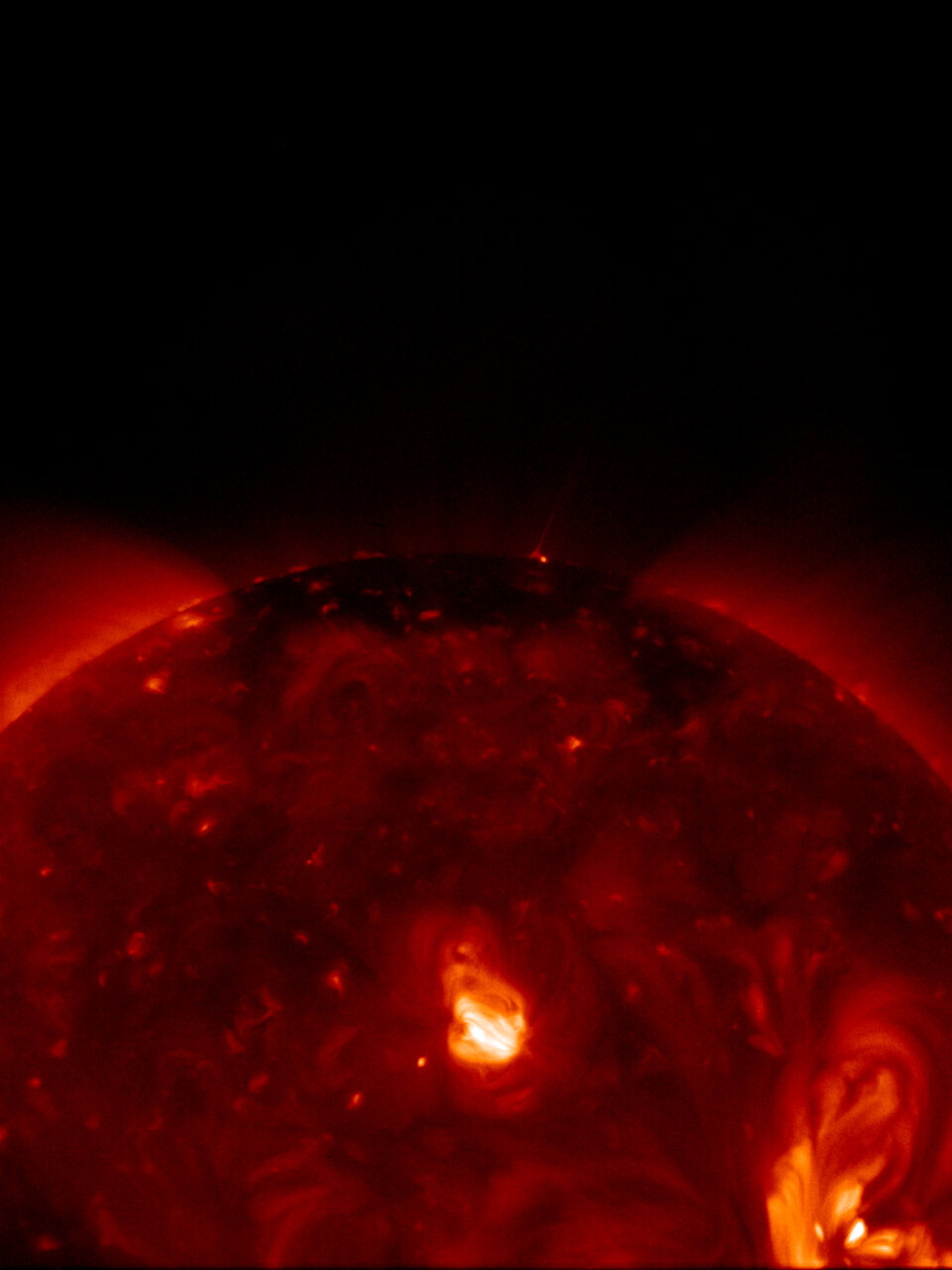
X-rays are a type of light, but unlike visible light – the electromagnetic spectrum that our eyes can see – X-rays are invisible. They have a lot of energy and can easily pass through all kinds of material. When we get medical X-ray images taken of our body, we can distinguish our internal structure because different parts of the body absorb X-rays in varying degrees.
Very hot objects radiate X-rays. An example is the Sun’s outer atmosphere, known as the corona, which is a million degrees Celsius and gives off significant quantities of X-rays. It is therefore no surprise that X-ray astronomy began with studies of the Sun before detections of other X-ray objects elsewhere in the Universe were made.
It’s raining X-rays
The Aerobee rocket that discovered the first extra-solar X-ray source also discovered a signal coming from all over the Universe in X-ray light. This signal was dubbed the ‘cosmic X-ray background’ and it introduced one of the first big mysteries in X-ray astronomy: is there a continuous X-ray signal in the Universe or can all the measured energy be assigned to different individual X-ray sources?
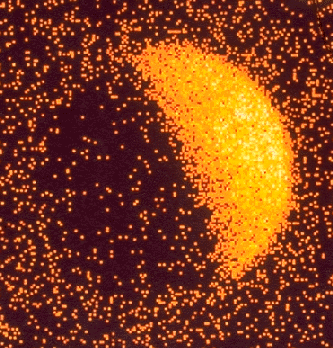
One of the first X-ray survey missions, the DLR ROSAT satellite, took an X-ray image of the Moon. The sunny side of the Moon lights up brightly in X-rays for the same reason it is bright at optical wavelengths – because it reflects light coming from the Sun. The other side of the Moon looks dark, even darker than the background of space, because X-rays from the Sun and the background are completely blocked by the Moon. This was the first official confirmation that the cosmic X-ray background is coming from beyond our Solar System.
The next generation of X-ray satellites, NASA’s Chandra X-ray Observatory and ESA’s XMM-Newton, helped unravel the mystery even more. Chandra surveyed the Universe in high resolution, showing that more than 80% of the X-ray background can be assigned to individual cosmic objects shining in X-ray light. XMM-Newton has used its instruments to look deeper, describing these objects and discovering the physics behind them.

Where do X-rays come from?
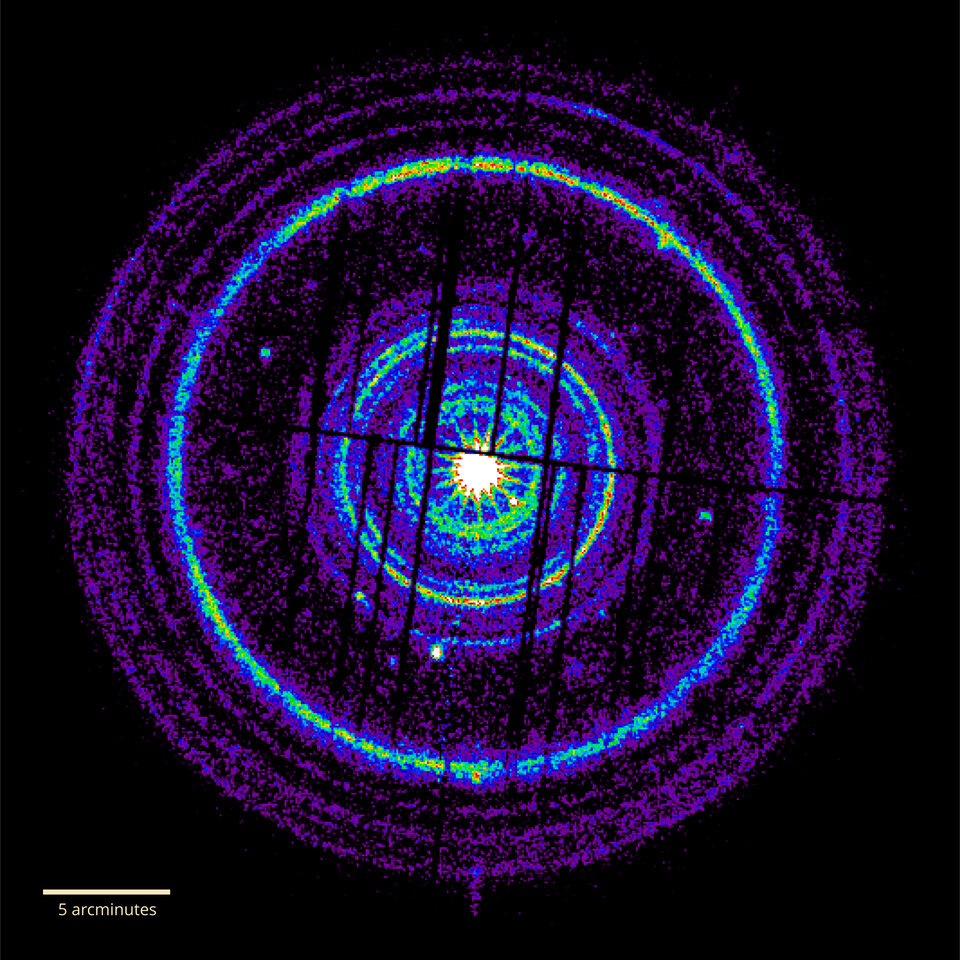
Numerous cosmic objects shine brightly in X-rays. Examples include galaxy clusters, supernovae, binary stars and even black holes.
Galaxy clusters are the largest systems in the Universe bound together by gravity. They contain hundreds to thousands of galaxies and large quantities of hot gas known as plasma, which reaches temperatures of around 50 million degrees and shines brightly in X-rays.
Supernovae are the dramatic deaths of massive stars, initially eight times the mass of our Sun or more. During this huge and energetic explosion, different types of light across the electromagnetic spectrum are sent out, including X-rays.
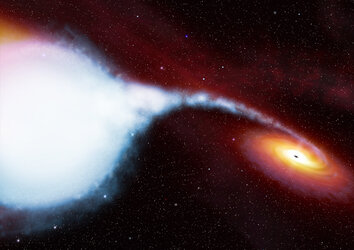
Some binary star systems also shine in X-rays. But these are not ordinary binary star systems. Instead, one member is a dead stellar core, either a neutron star or a black hole which rips gas from the other ordinary star. As the gas spirals through the strong gravitational field of the neutron star or black hole, it forms a surrounding disc, heating up enormously and sending X-rays into space. These systems are known as X-ray binaries.
Black holes do not emit light. But when material falls onto a black hole – whether in an X-ray binary, or onto a supermassive black hole at the centre of a galaxy – the material emits light while being pulled apart and heated. These highly energetic phenomena are accompanied by X-rays.
Finally, just like our Sun, the atmospheres of other stars are extremely hot and emit X-rays. Modern X-ray satellites such as ESA’s XMM-Newton are sensitive enough to measure them.
From spirals to lobster eyes
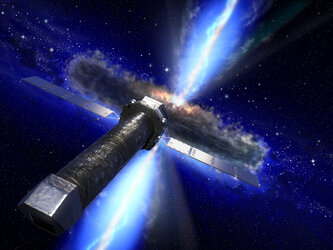
Observing X-rays is not easy because they are so energetic that they pass straight through conventional telescopes. Space telescopes designed for X-rays often use a ring structure of mirrors in several layers so that incoming rays have a small incident angle and can be redirected to the detector. This type of mirror is used by many space missions, including Chandra and XMM-Newton but also ESA’s upcoming mission Athena.
A new type of detector is now being introduced to space missions, surprisingly, a design based on the eyes of lobsters. These new telescopes consist of square tubes leading X-rays down to a central detector. Lobster eyes have the same mechanism where the square pores in their eyes are placed on a sphere extending their viewing angle to 180 degrees. This new technology is used by Einstein Probe, a mission by the Chinese Academy of Sciences in collaboration with ESA.