Solar Orbiter in a nutshell
Closer to the Sun than ever before
Name Solar Orbiter describes exactly what the spacecraft will do - it will orbit the Sun, passing closer than any space probe to date.
Description Being so close to the Sun, Solar Orbiter will gather unique data and imagery of the Sun. It will be the first satellite to provide close-up views of the Sun's polar regions, and it will also be the first spacecraft to almost match the Sun’s rotation to study solar regions from the same viewpoints for several days.
Launch January 2017 (NASA-provided EELV, with Ariane V as back up)
Status In Definition phase
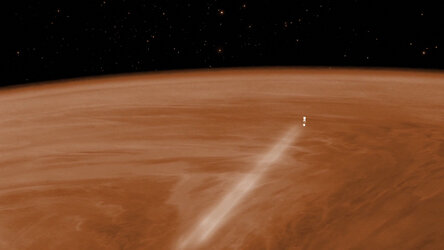
Journey Solar Orbiter will take about 3 years to reach its Sun-centred orbit, approaching as close as (60 solar radii, or 0.28 AU). Regular gravity-assist manoeuvres at Venus will tilt the orbit, bringing the spacecraft to increasingly higher latitudes.
One of Solar Orbiter's prime objectives is to link the Sun and the inner heliosphere. Solar Orbiter will measure the solar wind, magnetic and electric fields, waves and energetic particles close enough to the Sun to reveal their pristine nature.
Solar Orbiter will also perform remote-sensing observations of the source regions of these phenomena in great detail.
This will help to understand the source of space weather, which affects technological systems in space and on the ground, and can present hazards to astronauts.
Solar Orbiter will exploit new technologies being developed by ESA for the BepiColombo mission to Mercury. These include heat-proofing for all the equipment and instruments, the solar power generator and the communications system.