7 May
2003: On 7 May 2003, the planet Mercury slipped across the face of the Sun in a rare event, known as a 'transit'. There are only about 12 celestial alignments like this every century.
About 160 times smaller than the apparent diameter of the Sun, Mercury appeared as a tiny dot, silhouetted on the bright face of the Sun, as it made its five and a half hour transit. The planets Mercury and Venus have orbits closer to the Sun than Earth. They are therefore the only planets that can pass in front of the Sun, as seen from Earth. During the 19th century, transits were used to precisely measure the distance to Mercury and Venus.
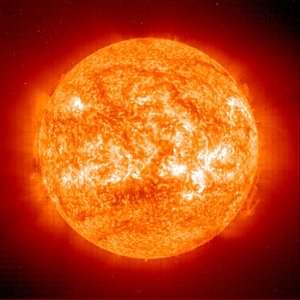
Scientists used the transit on 7 May 2003 as a unique opportunity to better understand the instruments on the ESA/NASA SOHO spacecraft.
The transit allowed scientists to calibrate SOHO's instruments. It included precise measurements of the spacecraft's roll angle in space, subtle image distortions, and an investigation into the effects of stray light, which contaminate the science images.

1713: On 7 May 1713, Alexis Claude Clairaut was born. He determined the first reasonable value for the mass of Venus, an improved value for the mass of the Moon, and predicted the timing of the return of Comet Halley.
A child prodigy, tutored by his father, he was studying calculus at age ten. In 1743, he accompanied Maupertuis on an expedition to Lapland to measure the length of the Earth's meridian. From this experience, he began a book on the shape of the rotating Earth under the influences of gravity and centrifugal forces.
Using Newton’s laws, he showed that the north pole of Earth 'precesses' every 25 800 years. So, 13 000 years from now, the north pole of Earth will not be pointing towards the 'North Star,' but will be pointing away by an angle of about 47 degrees. This happens because the Sun and Moon exert a force on the equatorial bulge of Earth. This causes the axis of rotation of Earth to wobble.
1617: On 7 May 1617, David Fabricus died. A German astronomer, he was a friend of Tycho Brahe and Kepler, and one of the first to follow Galileo in telescope observation of the skies.
He is best known for a naked-eye observation of a star in August 1596, subsequently named 'Omicron Ceti', the first variable star to be discovered, and now known as 'Mira'. Its existence with variable brightness contradicted the Aristotelian dogma that the heavens were both perfect and constant. With his son, Johannes Fabricius, he observed the Sun and noted sunspots. For further observations, they invented the use of a camera obscura and recorded sunspot motion indicating the rotation of the Sun.