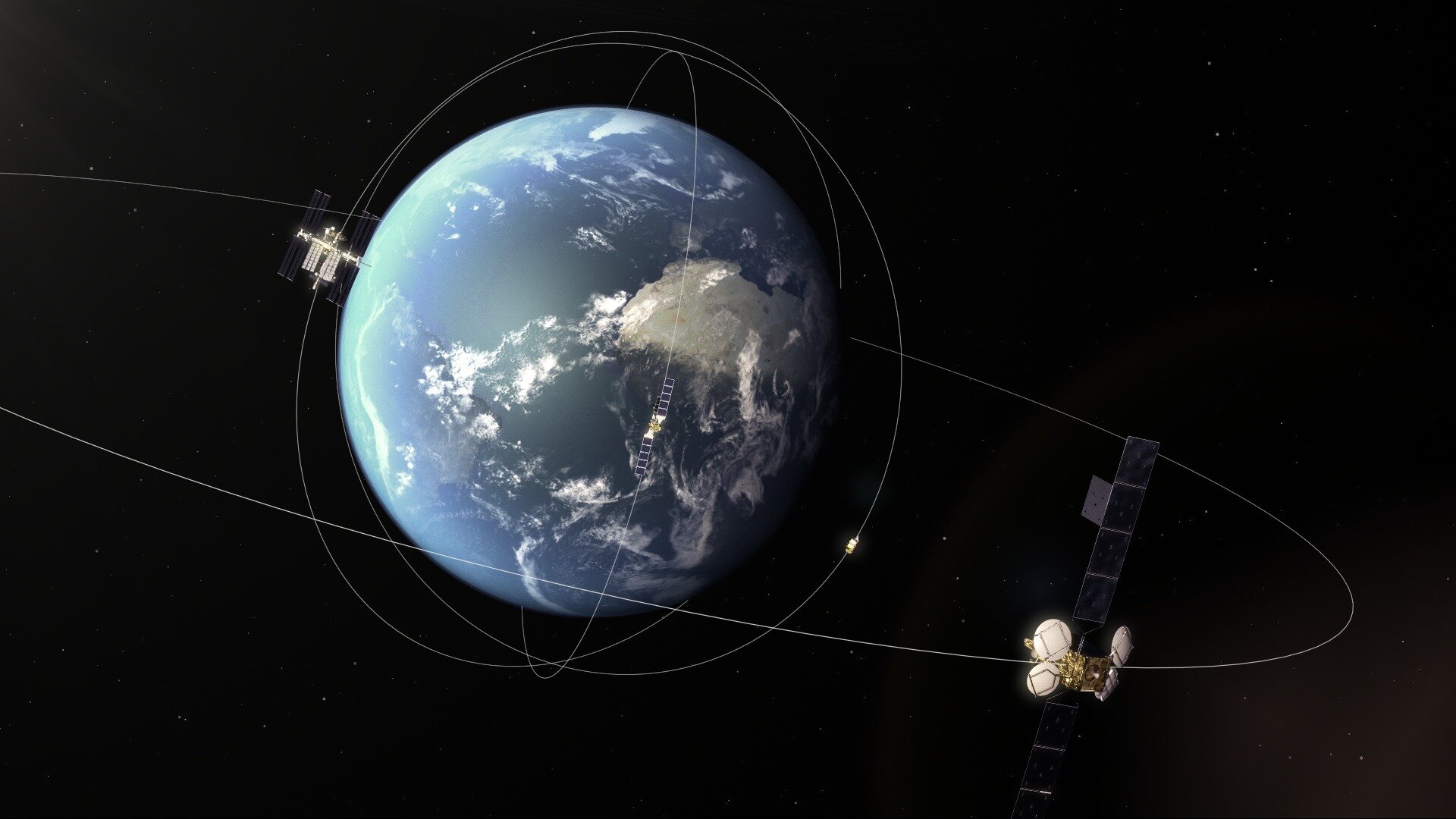
Orbits
Telecommunications satellites are usually placed in geostationary Earth orbit (GEO). GEO is a circular orbit 35 786 kilometres above Earth's equator and follows the direction of Earth's rotation. An object in GEO has an orbital period equal to Earth's rotational period, so to ground observers it appears motionless at a fixed position in the sky.
Satellites in GEO allow permanent communication links to be established by transmitting radio-frequency signals from fixed antennas. These signals are not very different from the signals that are used to broadcast terrestrial television, but usually have a frequency 3–50 times higher. The signal is received by the satellite, amplified and transmitted back to Earth, allowing communications between points thousands of kilometres apart.
A particular property that makes geostationary satellites extremely attractive is their capacity to broadcast. The re-transmitted signal can be picked up by antennas anywhere in the satellite's coverage area. This can be the size of a country, a region, a continent, or even an entire hemisphere. Anyone with an antenna, sometimes as small as 40–50 cm in diameter, can become a direct user of the satellite.
If an object circles Earth faster than about 8 km/s, it becomes a satellite. It still falls under Earth’s gravitational attraction but the drop is matched by the planet’s curvature as the satellite moves along. It is falling but never reaches the ground.
The satellite does not need any propulsion and it will continue to orbit Earth for years. Friction from the thin upper layers of the atmosphere will eventually slow it down and cause it to burn up as it descends into the lower atmosphere.
If a satellite is launched with more energy, it travels faster and the radius of its orbit is larger. The larger orbit means that the angular motion of the satellite around Earth is slower. As a reference, the Moon is 380 000 km from Earth and its orbital period is 28 days.
Low Earth orbits
Low-Earth orbit (LEO) satellites such as the International Space Station and many scientific and observation satellites operate at much lower altitudes: they circle Earth in about 90 minutes at heights of just a few hundred kilometres.
Telecom satellites can also be placed into LEO, being visible from any one place for 10–20 minutes at a time. To guarantee continuity of service, a constellation of tens of satellites would have to be deployed.
LEO telecom systems may require 48, 66, 77, 80 or even 288 satellites to provide the required services. Several of these systems have been deployed to provide communications to mobile terminals. They use a relatively low frequency, the L- & S-bands (1.5–2.5 GHz), which is in the same range as the frequencies used by GSM mobile networks. The fact that the antennas are not very selective is a plus for them: no careful tracking of the satellite is then needed. Also, the low altitude minimises the delay due to signal travel time and reduces the power needed to establish communications.