

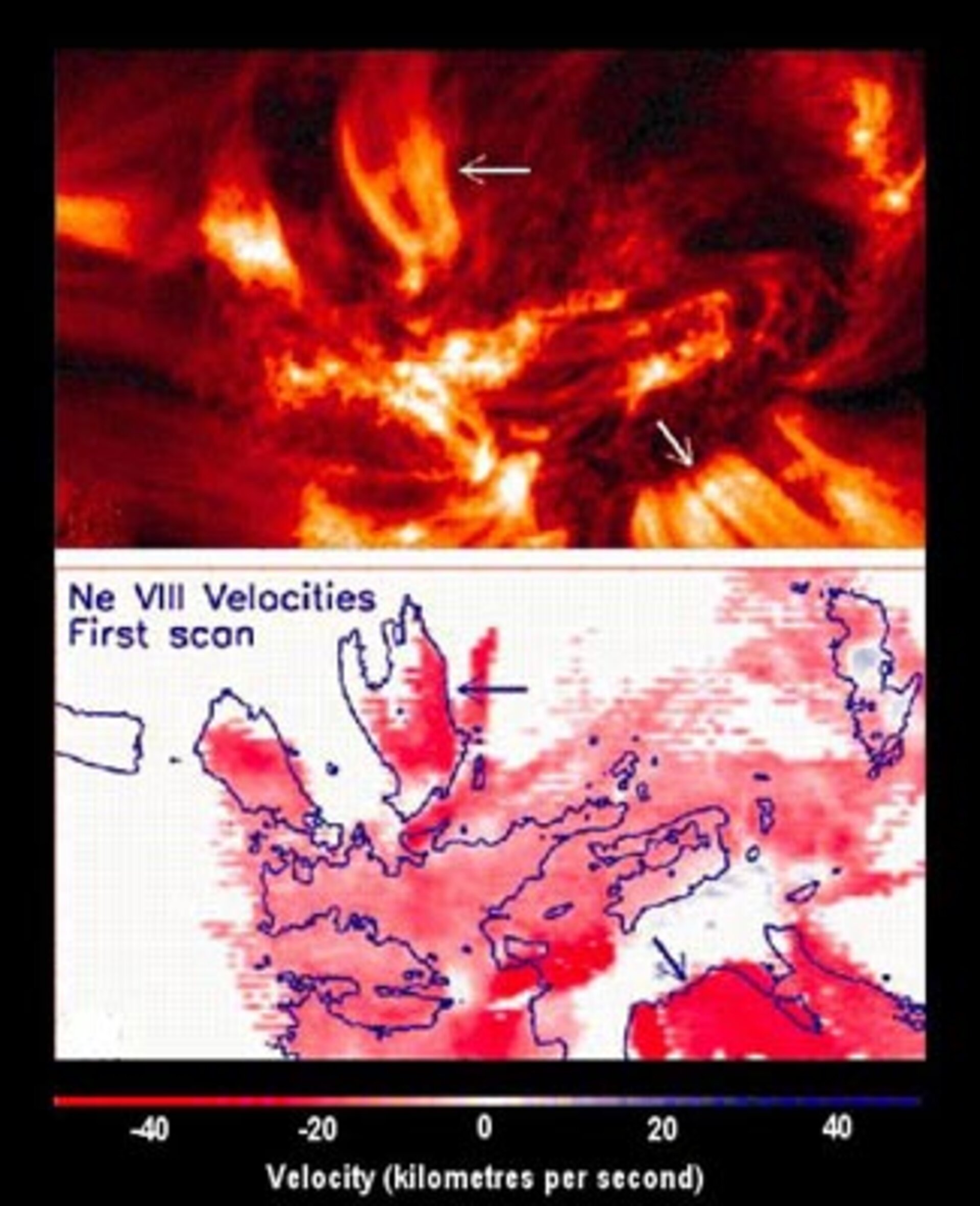
Winds of 320 000 kilometres per hour on the Sun
The SUMER instrument on the ESA-NASA SOHO spacecraft has measured amazing wind speeds during its observations of the Sun. It sets a new record in its examination of two loops of gas arching in the solar atmosphere, where NASA's TRACE satellite spotted bright blobs of gas. Shifts in the wavelength of ultraviolet light from highly ionized neon atoms, seen by SUMER, revealed steady wind speeds of up to 320 000 kilometres per hour. That's fast enough to cross the Atlantic Ocean in less than a minute.
SUMER stands for Solar Ultraviolet Measurements of Emitted Radiation. It is designed to sense flows in the solar atmosphere. Werner Curdt of Germany's Max-Planck-Institut für Aeronomie leads the multinational team responsible for this instrument.
"Some scientists previously thought that the arches, which are commonplace in the Sun's atmosphere, were rather static objects," Curdt comments. "Working together, SOHO and TRACE have changed all that. The arches are often shaken and the gas in the arches can travel at enormous speeds."
Amy Winebarger and her colleagues, at the Harvard-Smithsonian Center for Astrophysics in Massachusetts, coordinated the joint observations by SUMER and TRACE. They have published the results in Astrophysical Journal Letters.


