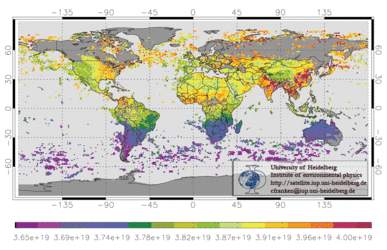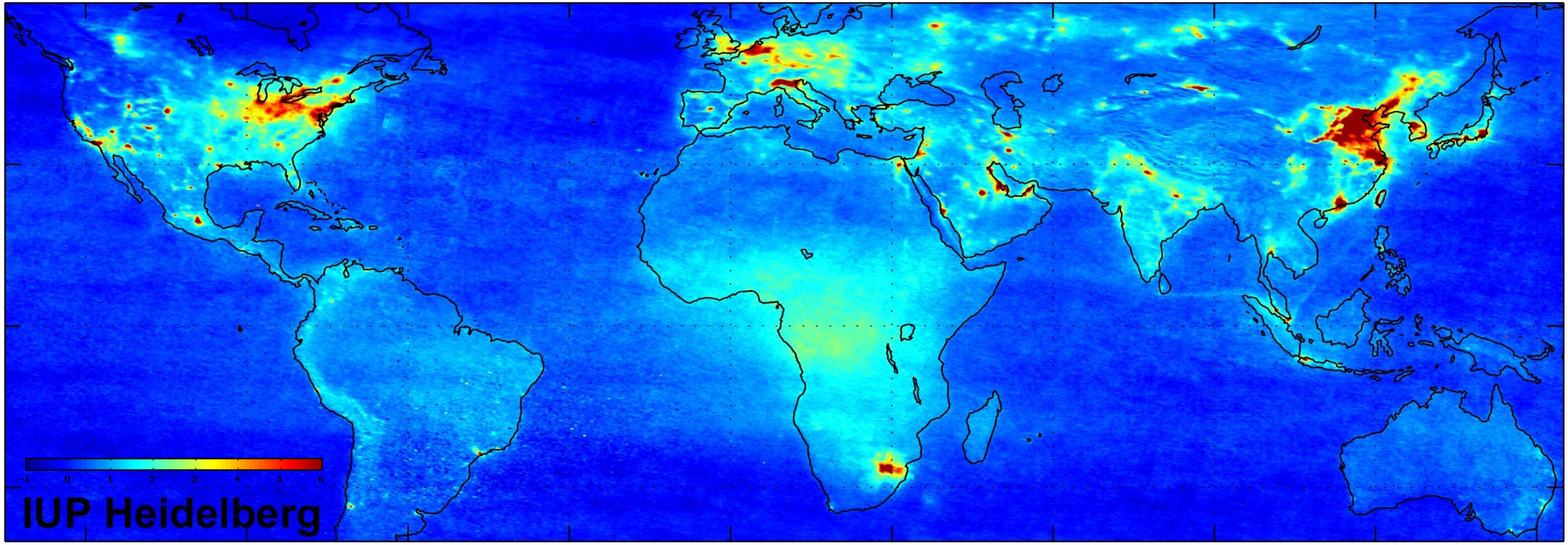
Global air pollution map produced by Envisat's SCIAMACHY
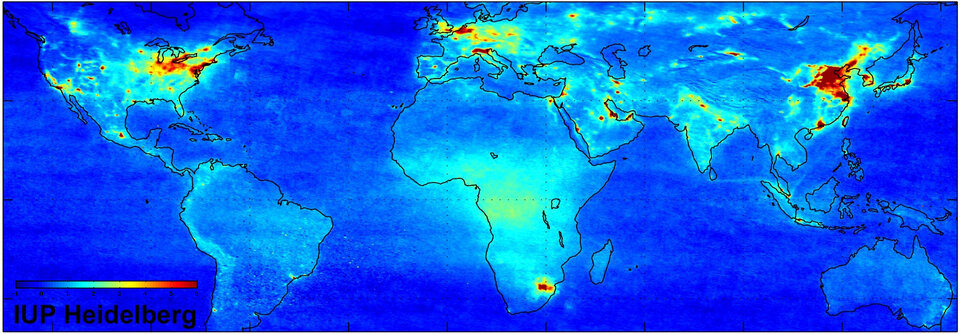
Based on 18 months of Envisat observations, this high-resolution global atmospheric map of nitrogen dioxide pollution makes clear just how human activities impact air quality.
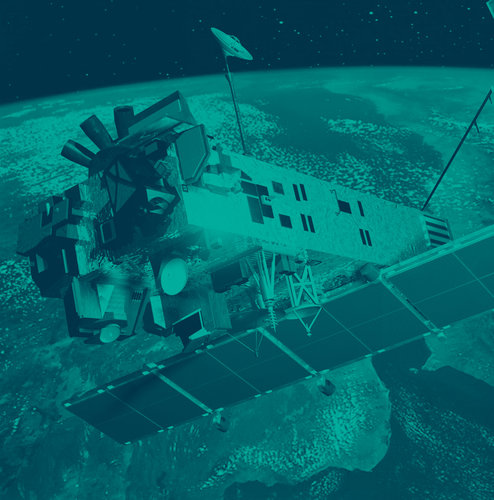
ESA's ten-instrument Envisat, the world's largest satellite for environmental monitoring, was launched in February 2002. Its onboard Scanning Imaging Absorption Spectrometer for Atmospheric Chartography (SCIAMACHY) instrument records the spectrum of sunlight shining through the atmosphere. These results are then finely sifted to find spectral absorption 'fingerprints' of trace gases in the air.
Nitrogen dioxide (NO2) is a mainly man-made gas, excess exposure to which causes lung damage and respiratory problems. It also plays an important role in atmospheric chemistry, because it leads to the production of ozone in the troposphere – which is the lowest part of the atmosphere, extending up to between eight and 16 kilometres high.
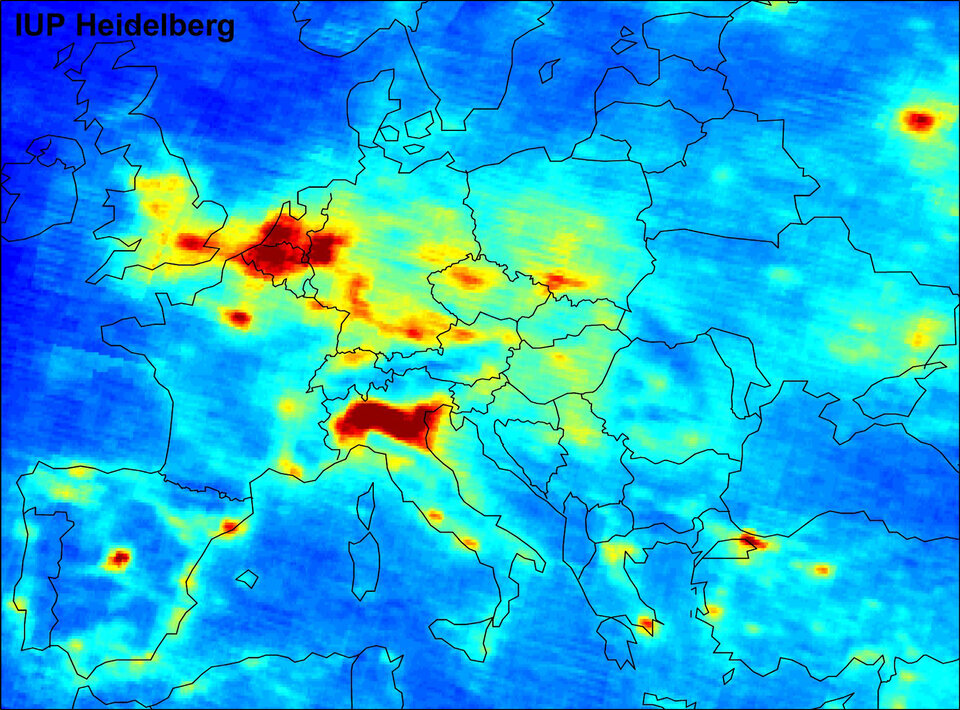
Nitrogen oxides are produced by emissions from power plants, heavy industry and road transport, along with biomass burning. Lightning in the air also creates nitrogen oxides naturally, as does microbial activity in the soil.
Localised in-situ measurements of atmospheric nitrogen dioxide are carried out in many western industrial countries, but ground-based data sources are generally thin on the ground.
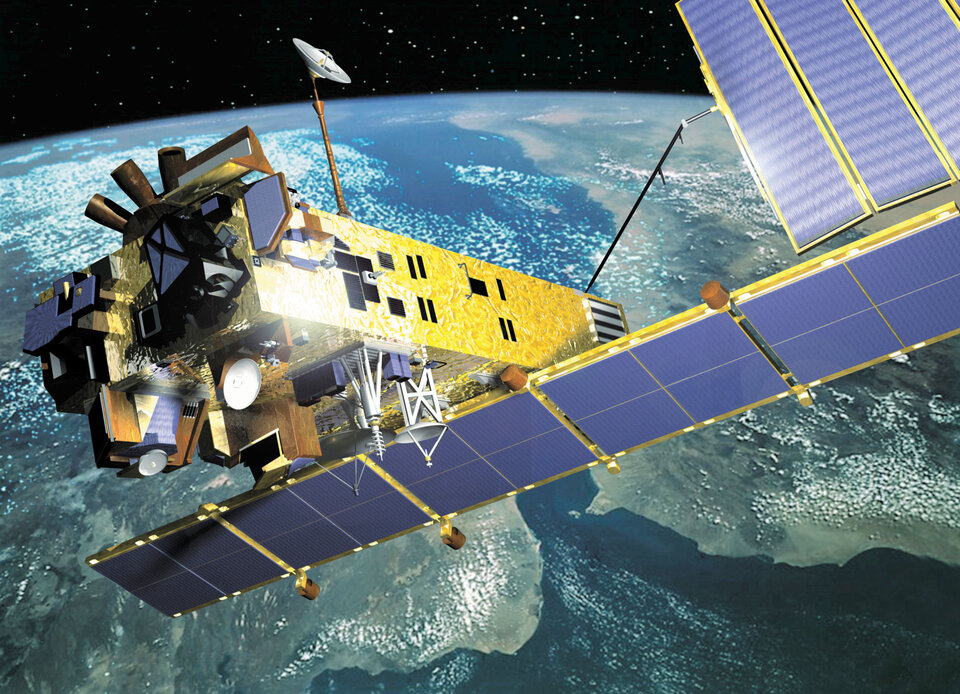
Space-based sensors are the only way to carry out effective global monitoring: the first satellite sensitivity to tropospheric nitrogen dioxide was demonstrated with the Global Ozone Monitoring Experiment (GOME) on ESA's ERS-2. However GOME was only a sub-scale precursor of the German, Dutch and Belgian financed SCIAMACHY flying on Envisat.
While both instruments function in the same way, GOME has a limited spatial resolution of only 320 x 40 km, compared to a typical 60 x 30 km with SCIAMACHY, which also observes the atmosphere in two different views –downwards or 'nadir' looking as well as making 'limb' observations in the direction of flight – and has a significantly larger spectral range than its predecessor.
Teams from the Universities of Bremen and Heidelberg in Germany, the Belgian Institute for Space Aeronomy (BIRA-IASB) and the Royal Netherlands Meteorological Institute (KNMI) have successfully processed SCIAMACHY data to generate the sharpest maps yet made of the vertical columns of tropospheric nitrogen dioxide.
"The higher spatial resolution delivered by SCIAMACHY means we see a lot of detail in these global images, even resolving individual city sources" said Steffen Beirle of the University of Heidelberg's Institute for Environmental Physics, responsible for the map shown above.

"High vertical column distributions of nitrogen dioxide are associated with major cities across North America, Europe and north-east China, along with other sites such as Mexico City in Central America and South African coal-fired power plants located close together in the eastern Highveld plateau of that country.
"Also across South East Asia and much of Africa can be seen nitrogen dioxide produced by biomass burning. Ship tracks are visible in some locations: look at the Red Sea and the Indian Ocean between the southern tip of India and Indonesia. The smoke stacks of ships crossing these routes send a large amount of NO2 into the troposphere.
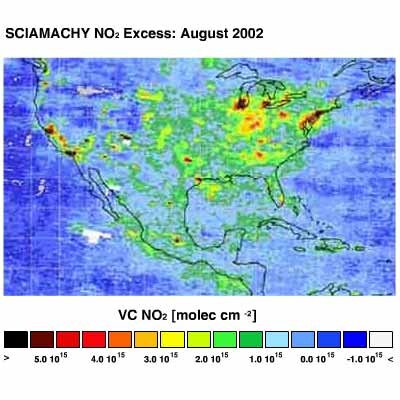
This map is average out across all available data, spanning 18 months. This has the effects of reducing seasonal variations in biomass burning and also those due to human activity changes due to the time of year."
Like GOME, SCIAMACHY works by observing atmosphere-scattered ultraviolet, visible and near-infrared radiation. The hard work comes on the ground, where researchers attempt to retrieve very weak trace gas absorption patterns within the overall spectrum of backscattered light, a feat comparable to finding a needle in a haystack.
The method they use is called Differential Optical Absorption Spectroscopy (DOAS), which is basically a complex filtering process also used with ground-based air-sampling instruments. DOAS removes the predominant spectral 'noise' from air particles' Rayleigh scattering of light (the same phenomenon that causes the sky appear blue) along with the absorption patterns from the oxygen, nitrogen and water molecules that make up most of the atmosphere.
Left behind after these subtractions is the desired 'signal' of narrower trace gas spectral absorption patterns, to be identified against sample cross sections. Applied to SCIAMACHY results, this technique is sufficiently sensitive to retrieve columns lower than a few parts of nitrogen dioxide per billion parts of air. To give an idea of scale, above highly polluted conurbations such as London, NO2 mixing ratios can reach values as high as a hundred parts per billion.
Nitrogen dioxide maps like that shown here have been produced using nadir-sounding data: while NO2 vary widely across the troposphere they are evenly spread across the upper atmosphere, the stratosphere. So nitrogen dioxide levels measured above the remotest parts of the Pacific were used to determine a general column for stratospheric nitrogen dioxide, which could be subtracted from the global data to determine tropospheric vertical column values.
"Results from this and other similar sensors could be used for chemical weather and air quality prediction in future," Beirle added. "For now we are focused on using the SCIAMACHY results to quantify the contributions of the different sources of nitrogen oxides – such as fossil fuel combustion, biomass burning, lightning – especially as the value of the latter is still highly uncertain."
About SCIAMACHY
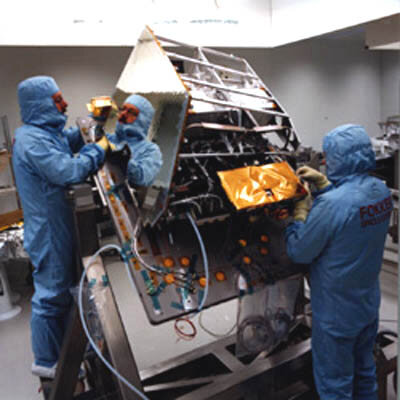
SCIAMACHY is a spectrometer that maps the air over a very wide wavelength range, which allows detection of trace gases, ozone and related gases, clouds and dust particles throughout the atmosphere. It works by measuring sunlight, transmitted, reflected and scattered by the earth's atmosphere or surface in the ultraviolet, visible and near infrared wavelength region. With a 960-km swath it covers the entire world every six days.
This versatile instrument represents a national contribution to ESA's Envisat mission. It was funded by the German government through the German Aerospace Centre (DLR), the Dutch government through the Netherlands Agency for Aerospace Programmes (NIVR) and also the Belgian government through BIRA-IASB.
John Burrows of the University of Bremen's Institute of Environmental Physics first devised the idea for SCIAMACHY, and he now serves as its Principal Investigator. SCIAMACHY is part of a family of atmospheric spectrometers that also includes GOME on ERS-2 and the forthcoming GOME-2 instrument launching next year with the first MetOp mission.