Day 3: Tuesday 23 October 2001
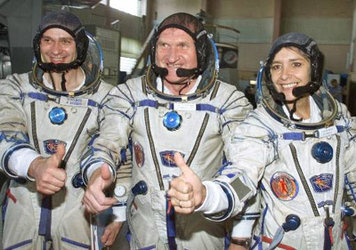
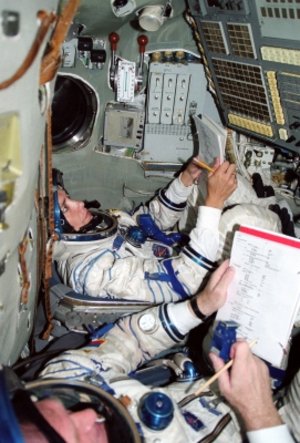
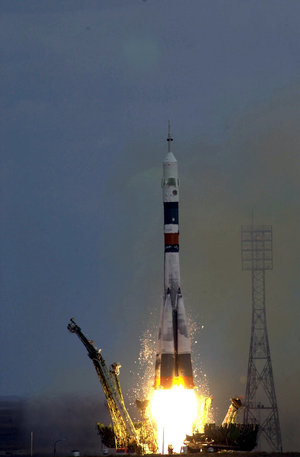
At 12:44 CEST (10:44 GMT) on Tuesday 23 October 2001 the Andromède mission Soyuz vehicle successfully docked with the ISS as scheduled. The whole process was controlled automatically, although the crew on board the Soyuz spacecraft monitored proceedings closely. ESA astronaut Claudie Haigneré worked in close cooperation with the Soyuz commander, Victor Afanassiev and the ground control flight director, Vladimir Soloviev, to be ready to switch to manual mode if need be.
During the approach images of the Space Station could be seen with the old Soyuz spacecraft, which will carry the Andromède crew back to Earth at the end of their mission, being docked to the neighbouring Pirs port.

Claudie Haigneré's colleague in the ESA Astronaut Corps, Reinhold Ewald, who was following events from the control centre at TsUP near Moscow, described what happened next, "A choreographed procedure followed, involving both the Expedition Three crew on board the Space Station and the newly arrived Soyuz crew, to ensure an airtight connection between the two spacecraft."
Reinhold continued, "After a break of 90 minutes whilst the Space Station made one orbit around the Earth, the television link with TsUP was re-established. Observers in the control centre, including French Prime Minister Lionel Jospin, were able to follow how the crews performed procedural steps to equalise atmospheric pressure between the two spacecraft".
At 14:16 CEST (12:16 GMT) after the opening of the hatches between the spacecraft, Claudie Haigneré was the first to enter the Station from the Soyuz, officially making her the first European woman to board the International Space Station.

Representatives of ESA, CNES, Rosaviakosmos and the Chief Engineer of the Russian company RSC Energia responsible for the operation of the Russian manned space vehicles watched the first pictures of the hearty welcome between the cosmonauts and the ISS crew. During their first in-flight call on board the ISS, Mr Jospin was able to relay congratulations to the Andromède crew on behalf of all the participating organisations and the wider general public.
"Before the ISS moved out of the zone of contact the TV images showed a delighted crew waving from 'living room' of the ISS, the Russian Zvezda module", said Reinhold.
The new arrivals first task was to transfer provisions and payloads from the just docked Soyuz to the Station. Also the personal equipment of the visiting crew was moved to the Soyuz that has been attached to the Station since May 2001 and which will serve as their return vehicle on 31 October.
Now that the Andromède crew are on board the Space Station, the second part of their mission can begin. "Before taking a well earned night's rest, Claudie will set up the Spica experiment", said Reinhold. "This experiment is meant to test electronic equipment under space conditions. Aquarius, the biological experiment will also be serviced. Her colleague Konstantin Kozeev, flight engineer N°2 of the Soyuz spacecraft will prepare tomorrow's run of the Plasma Kristall experiment".