

Experiments in space
The experiments that are being prepared for Frank De Winne's Odissea mission to the International Space Station can be summarized as follows:
Biology
Vitamin D:
Characterization of the effect of weightlessness on the mechanism of action of Vitamin D on osteoblasts.
[ Presentation Vitamin D ]Rho signalling:
Signalling through Rho GTPases.
[ Presentation Rho signalling ]-
Ramiros:
Cosmic radiation and microgravity related oxidative stress.
[ Presentation Ramiros ]
Microbiology
-
Message:
Effects of microgravity on bacterial gene expression with special attention to genes involved in the response to stress, in motility (flagella) and in genetic rearrangements.
[ Presentation Message ]
Cardioscience / Cogniscience
Cardiocog:
Effects of microgravity on cardiovascular and respiratory systems, and the stress, cognition and physiological response during spaceflight.
[ Presentation Cardiocog ]-
Neurocog:
Directed Attention Brain Potential in virtual 3-D space in weightlessness.
Human physiology
Sympatho:
Sympathoadrenal activity during spaceflight.Virus:
Monitoring latent virus reactivation and shedding in astronauts.-
Sleep:
Sleep-wake actigraphy and light exposure during spaceflight.
Physical science
GCF:
Protein crystallization in the Granada Crystallisation Facility.
[ Presentation GCF ]-
Zeogrid:
Study of the structure and morphology of Zeogrids obtained under microgravity conditions.
[ Presentation Zeogrid ]
Physical science in the MSG
DCCO (*)
Diffusion Coefficients in Crude Oils.
[ Presentation DCCO ]Nanoslab (*)
Study of aggregation mechanism and kinetics of ZSM-5 and Silicate-1 nanaslabs into ZSM-5/Silicate-1 hybrid phases under microgravity conditions.
[ Presentation Nanoslab ]Promiss (*)
Protein crystal growth monitoring by digital holographic microscope.
[ Presentation Promiss ]-
Cosmic (*)
Combustion synthesis under microgravity conditions.
[ Presentation Cosmic ]
Earth monitoring
-
LSO
Study of optical radiation in the ionosphere of Earth related to thunder activity and seismic processes.
Educational
Video
Video shooting of simple physical phenomena demonstration and broadcast to students.-
ARISS
Radio-amateur contact between astronaut and students.
Ground investigations
Chromosomes
Chromosomal aberrations in blood lymphocytes of astronauts.
[ Presentation Chromosomes ]Xenon-1
Effect of microgravity on the peripheral veno-articular reflex in humans.
[ Presentation Xenon-1 ]-
Aorta
Physiological parameters that predict orthostatic intolerance after spaceflight.
[ Presentation Aorta ]
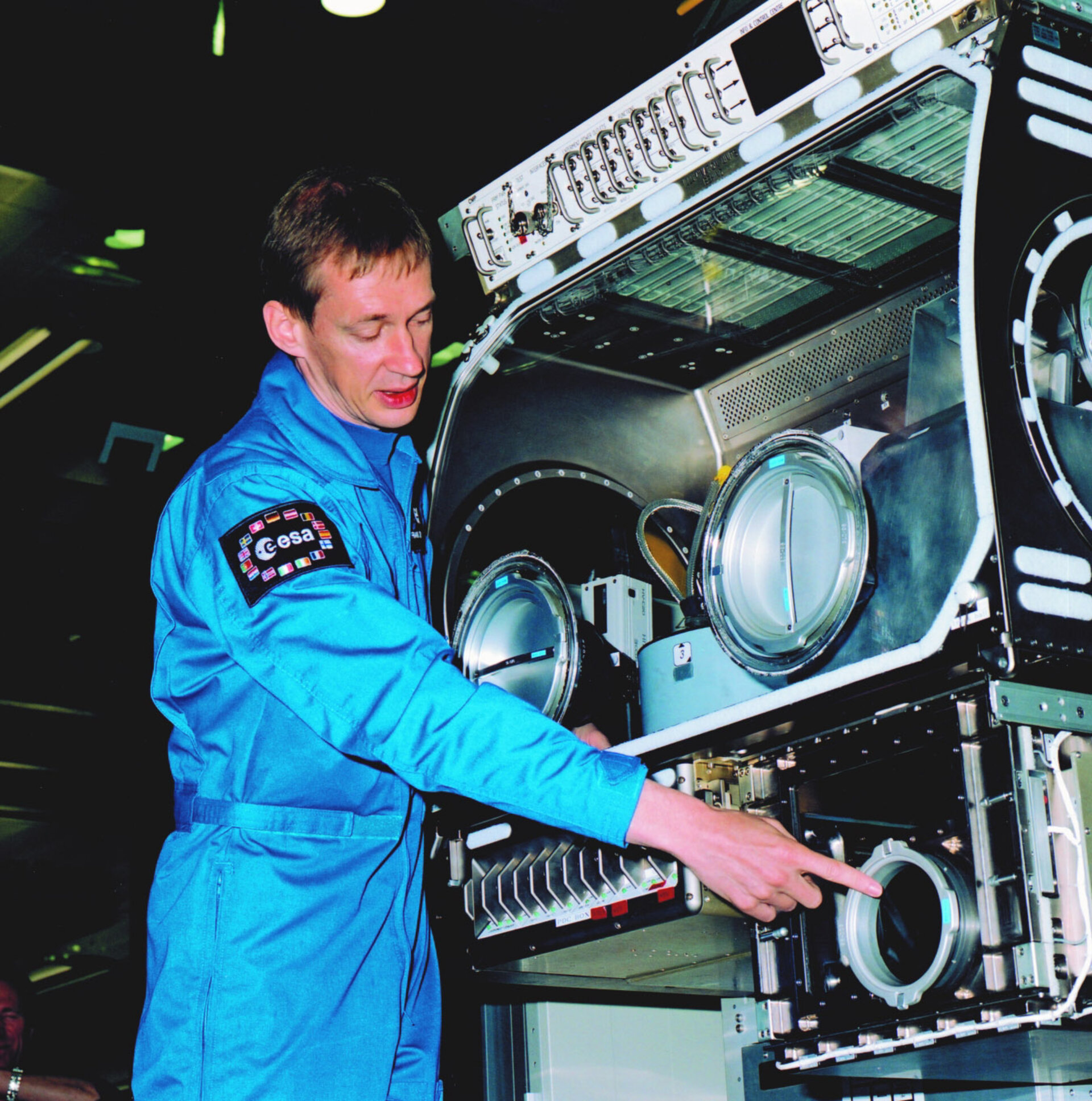
(*) These experiments will be conducted within ESA's Microgravity Science Glovebox (MSG) facility which was installed on the International Space Station in June 2002.