Life and survival in deep space
Rosetta's deep space odyssey comprised lengthy periods of inactivity, punctuated by relatively short spells of intense activity – the encounters with Mars, Earth and asteroids.
Ensuring that the spacecraft survived the hazards of travelling through deep space for more than ten years was therefore one of the great challenges of the Rosetta mission.
Spacecraft hibernation

For some of the outward journey, the spacecraft was placed in 'hibernation' in order to limit consumption of power and fuel, and to minimise operating costs. At such times, the spacecraft was set to spin once per minute while facing the Sun, so that its solar panels could receive as much sunlight as possible.
Almost all of the electrical systems were switched off, with the exception of the radio receivers, command decoders and power supply.
On-board autonomy
Instructions from the ground took up to 50 minutes to reach the spacecraft and so Rosetta had some 'intelligence' to look after itself. This was done by its on-board computers, whose tasks included data management and attitude and orbit control.
In case any problems arose during the lengthy cruise, back-up systems wereadded to ensure that the spacecraft could remain operational during critical mission phases.
Hot and cold

Temperature control was a major headache for the designers of the Rosetta spacecraft. Near the Sun, overheating had to be prevented by using radiators to dissipate surplus heat into space. In the outer Solar System, the hardware and scientific instruments had to be kept warm (especially when in hibernation) to ensure their survival.
This was achieved by using heaters located at strategic points (e.g. fuel tanks, pipework and thrusters), placing louvres over the radiators, and wrapping the spacecraft in multi-layered insulation blankets to cut down on heat losses.
Solar power

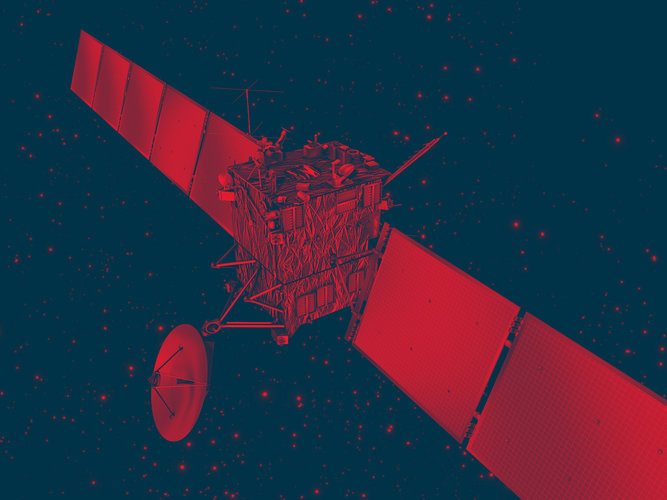
Rosetta was be the first space mission to journey beyond the main asteroid belt and rely solely on solar cells for power generation, rather than the traditional radio-isotope thermal generators.
The new solar-cell technology used on the orbiter's two giant solar panels allowed it to operate over 800 million kilometres from the Sun, where sunlight levels are only 4% those on Earth.
Hundreds of thousands of specially developed, non-reflective, silicon cells generated up to 8700 Watts in the inner Solar System and around 400 Watts for the deep-space comet encounter.