Ground segment
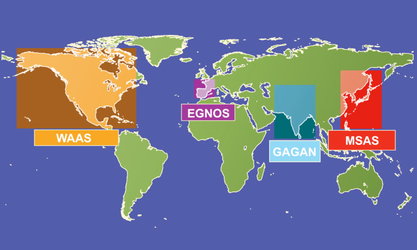
The EGNOS ground segment is composed of: the Master Control Centres; the Ranging and Integrity Monitoring Stations; the Navigation Land Earth Stations; the EGNOS Wide Area Network; and support facilities.
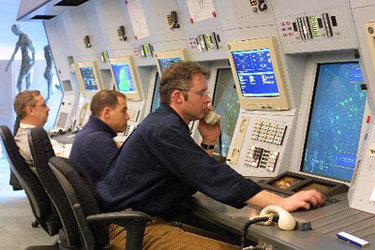
Master Control Centre
Once the EGNOS system is complete there will be four Master Control Centres (MCC), each having:
a central control facility for:
- monitoring and controlling EGNOS G/S
- mission monitoring and archiving ATC I/F
a central processing facility with a real-time software system developed to high software standards in order to:
- provide EGNOS WAD corrections
- ensure the integrity of the EGNOS system for users
- utilise independent RIMS channels to check corrections
Ranging and Integrity Monitoring Stations
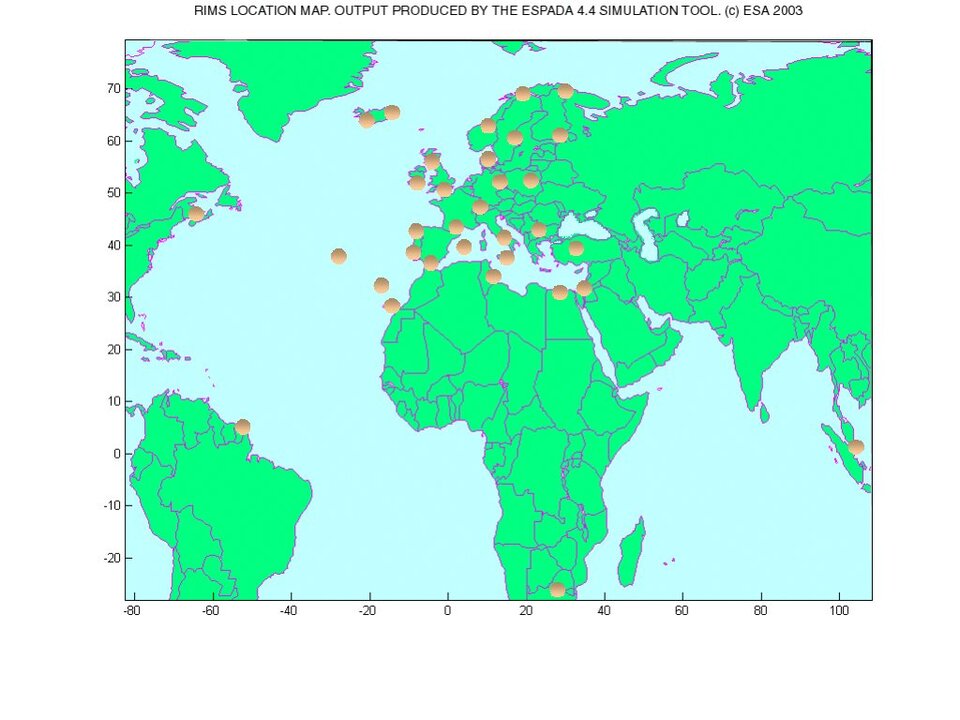
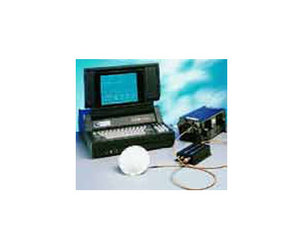
The EGNOS system will have 34 Ranging and Integrity Monitoring Stations (RIMS)
Technical data
- a GPS/GLONASS/GEO receiver
- an atomic clock
- the EGNOS RIMS network is based on TCP/IP, Framerelay and VSAT
Main functions
- perform pseudorange code/phase measurements towards SVis (GPS L1 and L2 + GEO/GLO L1)
- demodulate SIS messages
- mitigate local multipath and interference
- support the detection of anomalies in signals from space (e.g. EWF GPS/GEO)
- packet and transmit data to the MCCs via FEE/EWAN
- provide BITE and M&C capabilities
- provide time offset UTC(k)/ENT (UTC RIMS)
Navigation Land Earth Stations

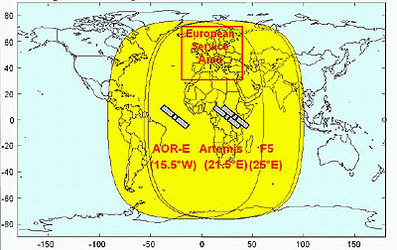
The first stage EGNOS Advanced Operational Capability architecture foresees seven Navigation Land Earth Stations (NLES), five of which will uplink EGNOS messages to the Inmarsat III Atlantic Ocean Region – East (AOR-E) and Indian Ocean Region (IOR) satellites, and two of which will uplink EGNOS messages to the Artemis satellite.
The main functions of the NLES will be to:
- generate a GPS-like signal and transmit this to a GEO transponder
- synchronise this signal to EGNOS time (ENT) at the output of the GEO L1-band antenna
- control the code/carrier coherency
- transmit the GIC and WAD messages to satellites in geostationary orbit.
EGNOS Wide Area Network

The EGNOS Wide Area Network (EWAN) links all the EGNOS components together.
Support facilities
Support facilities are made up of the Performance Access Check out Facility (PACF) and the Application Specific Qualification Facility or ASQF.
The PACF is a single unique centralised facility that provides non-critical operations support, engineering support and some maintenance and logistics support capabilities for the EGNOS operations system. ASQF is a set of tools that provide the technical means through which user-specific applications are qualified in the domain of operations.