• → European Space Agency

      • Space for Europe
      • Space News
      • Space in Images
      • Space in Videos
    • About Us

      • Welcome to ESA
      • DG’s blog
      • For Member State Delegations
      • Business with ESA
      • Law at ESA
      • ESA Exhibitions
      • ESA Publications
      • Careers at ESA
      • ESAshop
    • Our Activities

      • Space News
      • Observing the Earth
      • Human and Robotic Exploration
      • Space Transportation
      • Navigation
      • Space Science
      • Space Engineering & Technology
      • Operations
      • Telecommunications & Integrated Applications
      • Preparing for the Future
    • Careers at ESA

    • For Media

      • Newsroom
      • ESA TV
      • Videos for professionals
      • Photos
    • For Educators

    • For Kids

    • ESA

    • Space in Images

    ESA > Space in Images > 2017 > 01 > Cheops solar cells

    Free Search (24048 images)

    Cheops solar cells

    (563.39 kB)

    Details

    Open/Close
    • Title Cheops solar cells
    • Released 30/01/2017 9:30 am
    • Copyright ESA – C. Carreau
    • Description

      ESA’s CHaracterising ExOPlanet Satellite mission – Cheops – underwent important testing last year to be ready for launch by the end of 2018.

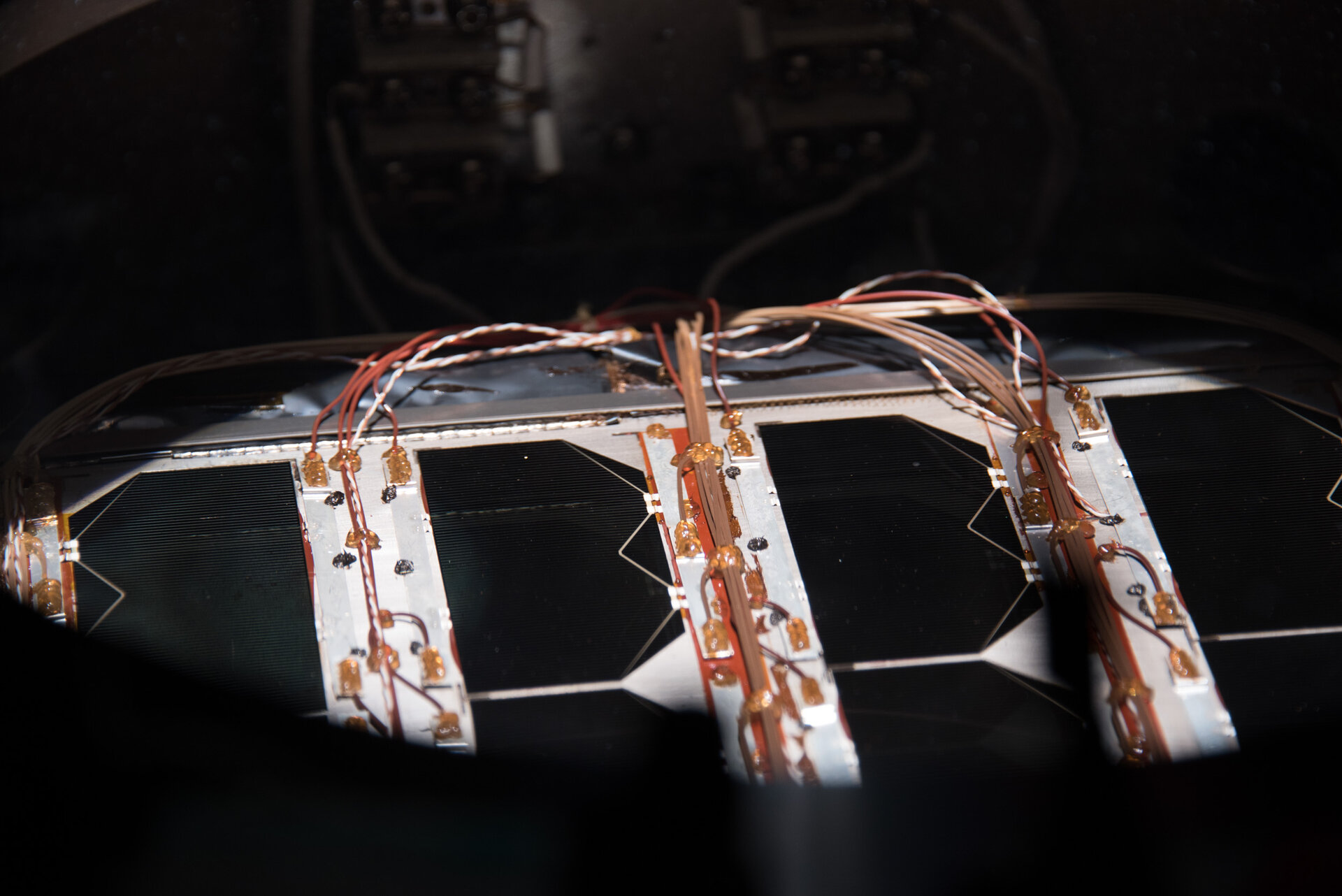
      Cheops will operate from a low orbit circling Earth, taking its power from the Sun. As such, an important focus of the prelaunch testing is qualifying the satellite’s solar arrays and their cells.

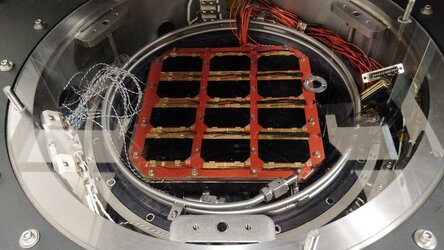
      The image shows part of the 12 solar cell assemblies in the Vacuum Solar Cell Illumination Facility at ESA’s technical centre in the Netherlands.

      The cells were heated to high temperatures to reflect what the satellite will experience once in space. In fact, the actual temperatures were scaled in order to accelerate the ageing effects experienced in flight, to represent a 3.5 year mission in just a few months.

      The cells spent 2000 hours at 140ºC, 2000 hours at 160ºC and 2090 hours at 175ºC. After the tests, the cells’ maximum power and short circuit current had degraded by less than 2%, clearly below the acceptance criterion of 3%.

      As a result of these tests, the Cheops solar arrays and their elements are now ready for the mission.

      Once in space, Cheops will measure the density of exoplanets with sizes or masses in the super-Earth to Neptune range. Its data will set new constraints on the structure of planets in this mass range, and therefore also on their formation and evolution.

      Read more about last year’s tests: Cheops solar arrays tested and built
    • Id 372612

    TAGS

    Open/Close
    • Click on the tags to find the matching images.
    • Activity Space Science
    • Mission CHEOPS
    • Set Space Science image of the week

    TAGS

    Open/Close

    Details

    Open/Close

    Rate this

    Views

    Comments

    Share

    • Currently 5 out of 5 Stars.
    • 1
    • 2
    • 3
    • 4
    • 5

    Rating: 4.8/5 (110 votes cast)

    Thank you for rating!

    You have already rated this page, you can only rate it once!

    Your rating has been changed, thanks for rating!

    3915 0
    Tweet

    COMMENTS

    Open/Close

    COMMENTS

    Open/Close

    RELATED IMAGES

    • 09 July 2018 The integrated Cheops satellite 2205 Votes: 85
    • 11 March 2019 Cheops in the clean room 2790 Votes: 101
    • Space Science image of the week archive

    • Space Live Space science image gallery

    Follow us

    • ESA Space Science Image of the Week on Flickr

    • ESA 3D on Flickr

    • ESA Sci on Twitter

    USING OUR IMAGES

    Terms and conditions

    Contact us

    Commenting guidelines

    • Connect with us
    • Subscribe
    • mobile version
    • FAQ

    • Site Map

    • Contacts

    • Terms and conditions