Flight 160: topping off the launcher
This unusual underside view provides a look under the payload fairing - and into the Sylda 5, on which the first payload to be launched, the INSAT 3E is mounted. Sylda 5 fit over the top of more payloads, to create a payload 'stack', 19 September 2003.
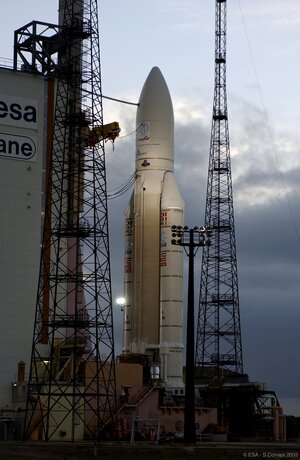
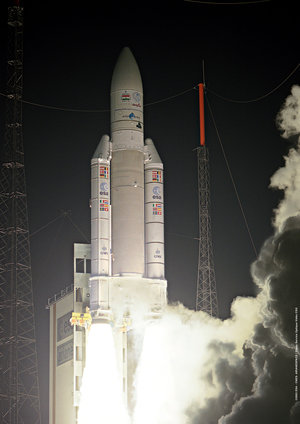
The composite was later be mated ont an Ariane 5G rocket for a launch the same month. On this triple launch, flight V162, the other payloads were the e-Bird communication satellite for Eutelsat, a European operator, and ESA's SMART-1 lunar probe. The generic version of the Ariane 5 family of launchers, the Ariane 5G can lift up to 6.8 metric tons of payload to geostationary transfer orbit (GTO).
The Ariane 5 program was decided by ESA in 1987 to provide a successor to the initial Ariane 1 to 4 series of vehicles in order to ensure continuity of Europe's guaranteed access to space. The development program was delegated to CNES, the French space agency.
Ariane 5 was introduced in 1996. The first successful flight of an Ariane 5G was conducted in October 1997 and this version became operational in 1999 with Arianespace taking over commercial operations on behalf of ESA. Its first commercial flight, in December 1999, lofted ESA's XMM-Newton X-ray observatory to a highly elliptical orbit.
The Ariane 5G could carry a wide range of payloads to all kinds of orbits, including geostationary satellites, space probes, Sun-synchronous Earth observation platforms or Autonomous Transfer Vehicles for resupply and reboost missions to the International Space Station. Upgraded versions were derived from the Ariane 5G through the Ariane 5 Evolution and Ariane 5 Plus programs decided by ESA in 1995.