Artist view of the Ariane 5G launch vehicle showing various payloads it can loft to orbit
Artist view of the Ariane 5G launch vehicle showing various payloads it can loft to orbit. From left to right: a large Sun-synchronous Earth observation platform, a pair of geostationary satellites for communications and meteorology, and an Autonomous Transfer Vehicle. for resupply and reboost missions to the International Space Station.
The generic version of the Ariane 5 family of launchers, the Ariane 5G can lift up to 6.8 metric tons of payload to geostationary transfer orbit (GTO).
The Ariane 5 program was decided by ESA in 1987 to provide a successor to the initial Ariane 1 to 4 series of vehicles in order to ensure continuity of Europe’s guaranteed access to space. The development program was delegated to CNES, the French space agency. Ariane 5 was introduced in 1996. The first successful flight of an Ariane 5G was conducted in October 1997 and this version became operational in 1999 with Arianespace taking over commercial operations on behalf of ESA. Its first commercial flight, in December 1999, lofted ESA’s XMM-Newton X-ray observatory to a highly elliptical orbit.
Upgraded versions have been derived from the Ariane 5G through the Ariane 5 Evolution and Ariane 5 Plus programs decided by ESA in 1995 and 1999 respectively, to increase the GTO payload capacity to 10 tons, with the Ariane 5 ECA, first launched in December 2002. A version with a restartable upper stage, the Ariane 5 ECB, is considered for development beyond 2005.
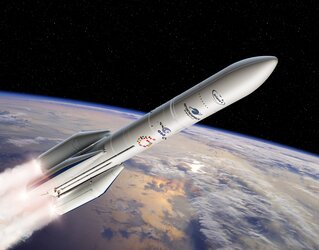
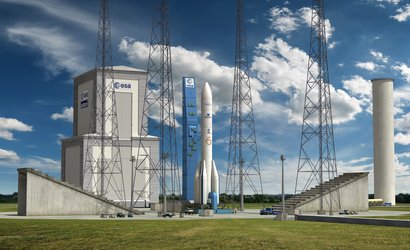
Artist's view of the configuration of Ariane 6 using…
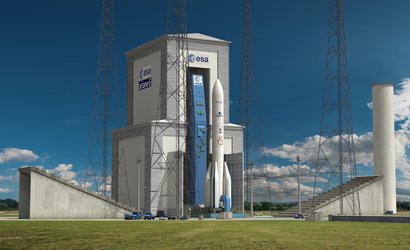
Artist's view of the configuration of Ariane 6 using…
Artist's view of the configuration of Ariane 6 using…
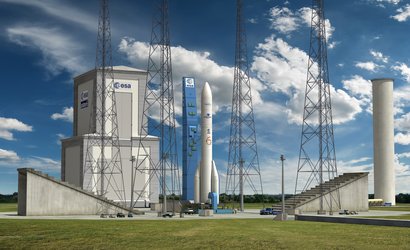
Artist's view of the configuration of Ariane 6 using…